Trader's Blog Contest For October

There is no one technical analysis indicator that will win 100% of the time. There is no holy grail of charting... and if there is, then someone is keeping one hell of a secret. However, technical analysis techniques can help you make educated decisions, putting the odds on your side that you are on the favorable direction of a move.

So the question is...

"Besides MarketClub's 'Trade Triangles', what is your favorite technical analysis indicator?"

Prize

Winner will receive 6 workshops on technical analysis from our authors in INO TV. These MP3s and digital PDF workbooks will be mailed to you courtesy of INO TV.

Construction & Application Of The MACD Indicator

The Theory of Momentum & Lane's Stochastic - George Lane

The Relative Strength Index Explained - Andrew Cardwell

Classic Technical Analysis as a Powerful Trading Methodology - John Tirone

Applying Fibonacci Analysis to Price Action 1 - Joe DiNapoli

Applying Fibonacci Analysis to Price Action 2 - Joe DiNapoli

How To Enter:

Comment on this post telling us what your favorite technical analysis study is and why. There are no wrong answers.

We want to you to share your thoughts and stories with our other visitors. Here are some responses from in the office to get you started:

Bob F. : I'm a fan of the MACD. I like to backtest various exponential moving average and signal settings for different markets.

Melissa P. : Average True Range is one of my favorites. I don't use this indicator for any other reason that to see activity. I can quickly see how much a stock has been moving throughout the day and leave the stagnant stocks alone.

Kenny S. : I have been trying to study up on the concepts regarding standard deviation. I'm still learning about Bollinger bands, but it's something that is very interesting thus far.

Lindsay T. : The MACD is one of my favorites too. I use the MACD crosses to confirm the "Trade Triangle" signals. When the market is moving sideways, I don't always follow each and every "Trade Triangle" unless I have a confirming back up.

---

Rules

1. This contest is open until 11:59 PM on October 31st.

2. No wrong answers, any participation counts as an entry.

3. One entry per email address.

4. Winner will be picked by random integer software.

5. Winner will be contacted on Monday, November 3rd via email.

--

Good luck!
Looking Back, 3 Key Signs To Sell Lehman

I invited Blain from StockTradingToGo.com back to give us his analysis on Lehman. He's missing the 4th key to selling Lehman...TRADE TRIANGLES! If you're a MarketClub member pull up Lehman in MarketClub...then take a look at where the Trade Triangles signaled you.

===============================================================

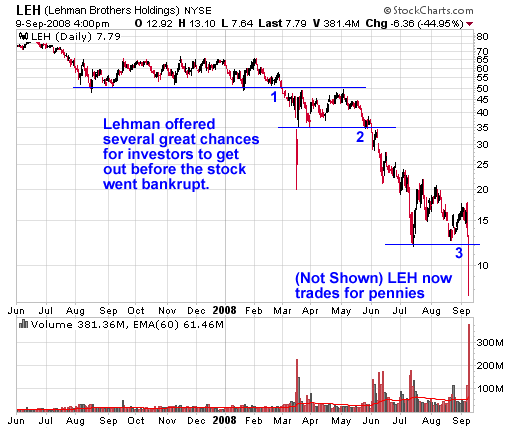
The following stock chart of Lehman Brothers (LEH) offers a great example of simple support and resistance. Support and Resistance is a basic form of technical analysis used commonly every day to mark potential buy and sell points on a stock chart.

Lehman Brothers is a good stock chart to observe for both new and seasoned investors because the recent Lehman bankruptcy offered three key sell signals for investors on the way down.

Note: This chart of Lehman Brothers is a 16 month daily stock chart:

1. The blue 1 show us how at the end of February Lehman stock fell through its first key support trendline at $50. This was a big sign that the bears had control of the stock and longs should get out.

2. The blue 2 shows us where Lehman eventually collapsed below its 2nd major support trendline at $35. This was another key sign for investors to get out of the stock.

3. The blue 3 shows the tipping point for Lehman before it moved to pennies. The break below $12 a share was the last major support Lehman had, and the stock never recovered. Bankruptcy shortly followed.

View More Examples of Technical Analysis.

Fundamental or Technical Analysis

Today I've asked Tony from TheGrainTrader.com to talk a little about Fundamental VS Technical Analysis when it comes to the grains...and trader in general! Enjoy!

==================================================================

I have always been a faithful user of technical analysis as my choice of ways to predict market direction, and I have had much better success with it as compared to what I have had with fundamental analysis.

Technical analysis lets me use a price chart to compare the past and present markets to find profitable trends and patterns, which brings me to one exception that I do use at times.

Although I don’t put much faith in crop reports, hard freezes, or droughts, I have had some use for seasonal patterns in the grain markets, and I like them, because I can identify them on a price chart.

Now, a tendency is just that, a tendency. Not all seasonal patterns are consistent enough to trade on, so you have to be careful to only use them as a guide and not as a fact. You must verify them with technical analysis before you actually make a trade. Don’t make a trade based solely on the seasonal tendency, or you probably won’t have much success!

Seasonal data can be found many places, but the best tendencies to use are the ones you can validate for yourself, on a chart. One of the best tendencies, I have identified, is for Oat futures to bottom around July and August, and then rise into December. (That’s just a little tip!)

Just remember to verify seasonal patterns with technical analysis, and always keep your stops placed! Good luck with your trading.

Tony Lorenzo

TheGrainTrader.com

Traders Toolbox: Support and resistance

Although many of you will find this lesson in one of the most basic concepts of market behavior "old hat", it never hurts to review. One of the first things a new trader is told (I hesitate to say learns as many never do) is to buy a breakout above resistance and sell a fall through support.

Resistance is the level which holds a market down, while support is an area which props up a market much like a ceiling and a floor. The key is to identify the critical levels. There are a number of methods to determine support and resistance: trendlines, moving averages, retracements, Gann angles, etc. However, simple observation can be an effective means of locating the important areas. A quick glance at the October cotton chart reveals the most basic levels of support and resistance (broken lines).

A previous high often provides resistance, while an earlier low tends to offer support. Support or resistance levels are not necessarily flat. For example, trendlines reveal areas of rising support or falling resistance. Also, when broken, uptrend lines offer a new level of rising resistance, while the opposite is true for downtrend lines. In fact, virtually any broken area of support will become resistance and vice versa. After breaking a level of support (or resistance), the market commonly comes back to test that level before resuming the downmove (upmove). This may be the single most effective method of locating low-risk entry points for trading purposes. This lesson may seem like wasted space to the experienced. However, it is amazing how often traders simply forget (or ignore) the power of basic support and resistance levels. This concept can be very profitable, but it may be just too "easy".

Traders Toolbox: Trading tools for today's markets

To some, technical analysis is a mystical method used by individuals to look into the future. Much of the glamour comes from the use of technical analysis as a predictive tool. While predictions can invigorate in a manner such as taking a joy ride, the end result will often feel like a ride gone bad. Although less exciting, the better use of technical tools can be likened to the tools a doctor uses to diagnose the condition of a patient. Similarly, a technical analyst applies his tools to determine the present condition of the market. Once a diagnosis has been made, a trader has a guide on how to approach a market. The understanding and application of tools is an important step in the development of an analyst or a trader. Properly used, various technical tools allow the drawing together of pieces of evidence to determine the market's present condition. While no one can guarantee the correct analysis of a market, the more evidence you gather, the better your odds. Once the evidence is gathered, diagnosing a market often ends up in a process much like jury deliberation. Each piece of evidence is considered; some will be accepted as valid, others may be suspect. Often one or two pieces of evidence prove to be the key in making a final determination. Once an analysis is made, based on the preponderance of evidence, a trader is ready to plan a course of action. TOOLS OF THE TRADE: The purpose of the series is to expose the reader to various analytical tools and to allow an insight into their applications. Hopefully the reader will have a better understanding of why a final diagnosis of a market's conditions has been reached.