"Saturday Seminars" - Determining Trends in the Foreign Exchange Markets

J. Adam Hewison, the founder and president of INO.com, will share with you the technical tools he uses every day to determine trends in the foreign exchange markets. He will also discuss the outlook for the U.S. dollar and major cross-rates and show you a very simple technique to determine the major trend in the currency markets.

Adam will explain negative and positive forces in the marketplace and how the big moves are often set up years in advance. As a former floor trader, Adam will discuss the difference between trading on the floor of an exchange and trading from an office thousands of miles away.

Adam HewisonBefore starting INO in March 1995, Hewison was a foreign exchange trader and advisor. He was one of the first currency traders when the International Monetary Market (IMM) of the Chicago Mercantile Exchange pioneered financial futures in the 1970s, and in the 1980s he introduced a very popular daily fax advisory service, FXPro. He is also the author of two highly-acclaimed guides to the foreign exchange markets: "International Monetary Report" and "Right on the Money, the Definitive Guide to Forecasting Foreign Exchange Rates".

In addition to an IMM membership, Hewison held seats on the CME's Index and Options Market (IOM), and was a charter member of the New York Futures Exchange (NYFE) and the London International Financial Futures and Options Exchange (LIFFE). Also during his trading career, he managed the currency and risk exposure of a large multinational corporation, based in Geneva, Switzerland.

---

Saturday Seminars are just a taste of the power of INO TV. The web's only online video and audio library for trading education. So watch four videos in our free version of INO TV click here.

INO TV

Traders Toolbox: Stochastics (K%D)

MarketClub is known for our "Trade Triangle" technology. However, if you have used other technical analysis indicators previously, you can use a combination of the studies and other techniques in conjunction with the "Trade Triangles" to further confirm trends.

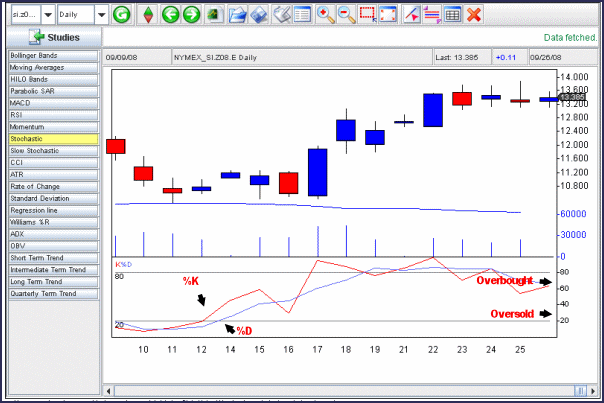
The stochastics indicator created by George Lane measures the relative position of the closing price within a given time interval. This indicator is based upon the premise that prices tend to close near the upper portion of a trading range during uptrends and near the lower portion of a trading range during downtrends. When prices close in the middle of a range, this suggests a sideways market. There are two components to this calculation, the %K value and the %D value. The %K is calculated as follows: %K= (C-Ln / Hn – Ln) x 100 where C = closing price of current period, Ln = lowest low during n time periods. Hn = highest high during n time periods and n = number of periods.

The %D value is the moving average of the %K value. The simple moving average calculation is: %D = 100 (Hn / Ln) also in the %K formula.

These formulas produce two lines that oscillate between a scale of 0 and 100. As with the other oscillators, a stochastic value below 30% suggest an oversold condition, while a value greater than 70% suggests an overbought condition.

Some simple trading rules apply in the use of the stochastics indicator. A sell rule would be to sell when the fast (%K) crosses over the slow (%D) and both are pointing down, but are still above the 70% level. A buy signal would be triggered when the fast crosses the slow, and both point up, but are below the 30% level.

Another type of signal occurs when the stochastics indicator diverges from a price move similar to momentum and RSI.

---

You can learn more about the Stochastics and George Lane by visiting INO TV.

Trader's Blog Contest For October

There is no one technical analysis indicator that will win 100% of the time. There is no holy grail of charting... and if there is, then someone is keeping one hell of a secret. However, technical analysis techniques can help you make educated decisions, putting the odds on your side that you are on the favorable direction of a move.

So the question is...

"Besides MarketClub's 'Trade Triangles', what is your favorite technical analysis indicator?"

Prize

Winner will receive 6 workshops on technical analysis from our authors in INO TV. These MP3s and digital PDF workbooks will be mailed to you courtesy of INO TV.

Construction & Application Of The MACD Indicator

The Theory of Momentum & Lane's Stochastic - George Lane

The Relative Strength Index Explained - Andrew Cardwell

Classic Technical Analysis as a Powerful Trading Methodology - John Tirone

Applying Fibonacci Analysis to Price Action 1 - Joe DiNapoli

Applying Fibonacci Analysis to Price Action 2 - Joe DiNapoli

How To Enter:

Comment on this post telling us what your favorite technical analysis study is and why. There are no wrong answers.

We want to you to share your thoughts and stories with our other visitors. Here are some responses from in the office to get you started:

Bob F. : I'm a fan of the MACD. I like to backtest various exponential moving average and signal settings for different markets.

Melissa P. : Average True Range is one of my favorites. I don't use this indicator for any other reason that to see activity. I can quickly see how much a stock has been moving throughout the day and leave the stagnant stocks alone.

Kenny S. : I have been trying to study up on the concepts regarding standard deviation. I'm still learning about Bollinger bands, but it's something that is very interesting thus far.

Lindsay T. : The MACD is one of my favorites too. I use the MACD crosses to confirm the "Trade Triangle" signals. When the market is moving sideways, I don't always follow each and every "Trade Triangle" unless I have a confirming back up.

---

Rules

1. This contest is open until 11:59 PM on October 31st.

2. No wrong answers, any participation counts as an entry.

3. One entry per email address.

4. Winner will be picked by random integer software.

5. Winner will be contacted on Monday, November 3rd via email.

--

Good luck!

Traders Toolbox: Relative Strength Index (RSI)

MarketClub is known for our "Trade Triangle" technology. However, if you have used other technical analysis indicators previously, you can use a combination of the studies and other techniques in conjunction with the "Trade Triangles" to further confirm trends.

Developed by Welles Wilder, the Relative Strength Index (RSI) addresses the two major flaws of momentum – the need to have a constant band against which to compare price movement and the ability to smooth the ebb and flow of price movement.

Sharp up or down movement 10 days ago (in the case of a 10-day momentum line) can cause pronounced shifts in the momentum line even if the current prices are relatively stable, giving false signals. Also, different commodities may have different “overbought” and “oversold” levels. RSI corrects these concerns by smoothing the movement and by creating a constant range from 0 to 100.

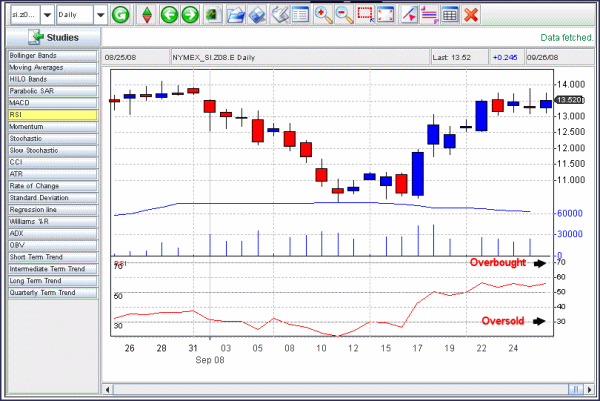
The formula for calculating RSI is as follows: RSI= 100-[100/(1+RS)] where RS= average of the days closing higher during the interval divided by the average of the days closing lower during the interval.

The RSI indicator is plotted on a vertical scale of 0 to 100. The general rule of thumb is overbought levels are at 70% and oversold levels are at 30%. When the reading of the indicator surpasses 70, an overbought conditions exists. An oversold condition exists with readings below 30.

Similar to momentum, a trader should look for bullish and bearish divergences to occur when trading with RSI. A 14-day interval is commonly used, but personal fine-tuning and experimentation always is needed.

---

You can learn more about the Relative Strength Index by visiting INO TV.

"Saturday Seminars" - Cycles & Oscillators

You will leave Walter's workshop with a working knowledge of how to combine cycles and oscillators to identify cycle tops and bottoms as they occur plus five specific oscillator/cycle combinations that you can immediately apply to the markets - weekly, daily and intra-day. The workshop is presented in two sections.

CYCLES - In the first part of his workshop, Walt will explain the four dominant cycles and discuss techniques to find these cycles in the market. The development and use of timing bands and Fibonacci ratios will be examined to determine the timing of the cycles and specific techniques will be illustrated for determining the future price levels of cycle tops and bottoms.

OSCILLATORS - Several techniques will be presented to improve the performance of oscillators, often turning a mediocre one into a powerhouse. Walter will explain how to combine oscillators with cycles to identify tops and bottoms as they are occurring, and will show specific oscillator cycle combinations to identify cycle tops and bottoms mechanically.

Walter BressertWalter Bressert has been using market cycles to trade stocks and commodities since the 1970s when his HAL Commodity Cycles was one of the most widely known advisory services focusing on cycles.

---

Saturday Seminars are just a taste of the power of INO TV. The web's only online video and audio library for trading education. So watch four videos in our free version of INO TV click here.

INO TV