Your Option Contract Was Assigned - Now What?

Options trading can serve as a powerful means to generate consistent income and mitigate portfolio risk while producing high probability win rates. Options trading allows one to profit without predicting which way the stock will move. Options aren’t about whether or not the stock will move up or down; it’s about the probability of the stock not moving up or down more than a specified amount. Options allow your portfolio to generate smooth and consistent income month after month without predicting which way the stock market will move. Options are a bet on where stocks won’t go, not where they will go. Running an option-based portfolio offers a superior risk profile relative to a stock-based portfolio while providing a statistical edge to optimize favorable trade outcomes. Options are a long-term game that requires discipline, patience, time, maximizing the number of trade occurrences and continuing to trade through all market conditions.

Put simply; an options-based approach provides a margin of safety with a decreased risk profile while providing high-probability win rates. Despite this favorable trading backdrop, occasionally options can be assigned and move against you despite managing the risk profile. How do you manage these unrealized losses and navigate these assignments to mitigate downside risk and ultimately sell your assignment at a net gain? This is the scary side of options that is rarely talked about, here I’ll demonstrate the actions I take to manage these assignments.

Assignment

Even though options trading provides a statistical advantage and generates high probability win rates, being assigned shares inevitably occurs. Briefly, when selling a put option, you agree to buy shares at an agreed-upon price (strike price) by an agreed-upon date (expiration) in exchange for premium income.

You collect premium income to compensate you for agreeing to buy shares at the agreed price by the agreed-upon date. As the contract lifecycle unfolds and the stock does not break below the strike price, profits can be realized early by buying-to-close or letting the contract expire to capture the entire premium. When the stock breaks down and trades below the agreed-upon price at expiration of the contract, the stock will be assigned. Continue reading "Your Option Contract Was Assigned - Now What?"
As Expected The Fed Cuts Rates

Hello traders everywhere. As expected the Fed cuts rates by 25 basis points to a range of 1.75 - 2.00%. This cut is the second cut that Fed has implemented in 10 years, the first rate cut came back in July when the Fed cut the rate by 25 basis points to a range of 2.0% - 2.25%.

The market was clearly disappointed by the 25 point cut as it was expecting or hoping for a 50 point cut. The S&P 500, DOW and NASDAQ have all headed lower on the day with the NASDAQ leading the way losing -1.0%.

Though the U.S. economy continues growing at a "moderate" rate and the labor market "remains strong," the Fed said in its policy statement that it was cutting rates "in light of the implications of global developments for the economic outlook as well as muted inflation pressures."

With continued growth and strong hiring "the most likely outcomes," the Fed nevertheless cited "uncertainties" about the outlook and pledged to "act as appropriate" to sustain the expansion.

New projections showed policymakers at the median expected rates to stay within the new range through 2020. However, in a sign of ongoing divisions within the Fed, seven of 17 policymakers projected one more quarter-point rate cut in 2019. Continue reading "As Expected The Fed Cuts Rates"

New Highs On The Horizon

Hello traders everywhere. Once again we are on the verge of new all-time highs for both the S&P 500 (3,027.98) and DOW (27,359.16) as both indexes along with the NASDAQ will post their third straight week of gains. Even though the markets overall will end the week mixed on a daily level, all three indexes will end the weeks with gains of +1.1%, +1.6%, and +1.2% respectively.

Will we see record highs on Monday when trading opens?

Crude oil is going to post a weekly loss of roughly -2.8% as trading closes Friday. This drop is a reflection of how fears of excess supply continue to keep crude prices down even as hopes for coming trade talks boost the outlook for the global economy. And although oil prices have rebounded this year, they are down about 20% in the past year, compared with a nearly 4% climb in U.S. stocks.

Bitcoin continues to disappoint as it's trapped below the $11k market and after posting a weekly gain of +9% last week it gave back a bit of that move this week losing -1.8% trading just above the $10k level at $10,300 right below its 50-day MA. We will need to see a move above $10,949.00 for a potential breakout and move higher.

Key Levels To Watch Next Week:

Continue reading "New Highs On The Horizon"

There's No Edge In Stock Picking

Those that subscribe to the efficient market hypothesis believe that there’s no edge or advantage when it comes to picking stocks. Thus, stock-picking is a binary event and boils down to a 50/50 probability or simply chance. Everything that can be possibly known about a stock is known, and all the available information, technical analysis, and fundamental analysis is priced into the underlying stock price. The efficient market theory may be the Achilles heel of professional money managers’ performance and their inability to outperform their benchmarks. A staggering 92% of actively managed funds do not outperform their benchmark hence the massive inflows into passive index investing and ETFs.

Furthermore, when looking at The Russell 3000 Index over a 26-year timeframe (1983 to 2006) which comprises the largest 3000 U.S. companies, 39% of stocks were unprofitable investments, 64% of stocks underperformed the Russell 3000 and 25% of stocks were responsible for all the market’s gains. Taken together, only 36% of stocks outperformed the Russell 3000 index. If the efficient market theory is correct, is stock picking a useless endeavor? If stock-picking boils down to chance, is there a strategy that places the statistical odds of success in one’s favor?

Efficient Market Hypothesis

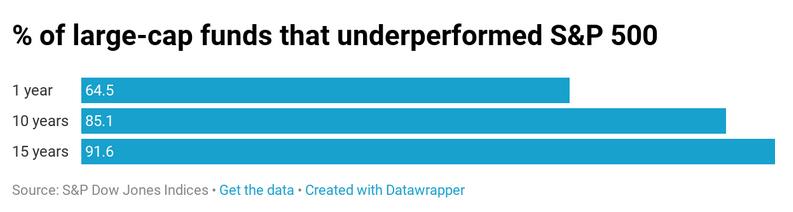
Markets aren’t always functioning efficiently. Markets can be irrational and become overbought or oversold. Outside of these extremes, however, markets are efficient, and over the long-term the vast majority of actively managed funds are unsuccessful at beating their benchmarks. Everything that can possibly be known about a stock is known, and there’s no edge in stock picking. As of Q1 2019, for the ninth consecutive year, the majority (64.5%) of large-cap funds lagged the S&P 500 last year. The longer the timeframe, the weaker the performance, after 10 years, 85% of large-cap funds underperformed the S&P 500, and after 15 years, nearly 92% are underperforming the index (Figures 1 and 2). These dismal results hold true across large-cap, mid-cap, and small-cap funds. Even if these actively managed funds happen to outperform their index, it’s due to chance, and this margin of outperformance is primarily negated by hefty management fees, rendering stock-picking useless. To further emphasize this point, for the Russell 3000, 39% of stocks were unprofitable investments, 64% of stocks underperformed the index, and 25% of stocks were responsible for all the market’s gains. Taken together, only 36% of stocks outperformed the Russell 3000 index.

Stock Picking
Continue reading "There's No Edge In Stock Picking"

Market Breaks Out Of Trading Range

Hello traders everywhere. In Wednesday's video, I discussed how the market had been stuck in a trading range for the last month and that we needed to see a move above the 50-day MA to potentially see a move higher. Well, we got that move on Thursday when the news of an agreement between China and the U.S. to set a meeting for trade talks hit the wire resulting in a big move higher which resulted in three new green weekly Trade Triangles being issued for the S&P 500, NASDAQ and DOW.

The market is ending the week relatively quiet as the U.S. economy added 130,000 jobs in August, the Labor Department said. Economists polled by Dow Jones expected jobs to grow by 150,000 last month. Unemployment remained steady at a rate of 3.7% while wages rose more than expected. Wages expanded by 0.4% on a month-over-month basis and by 3.2% year over year. August marked the third straight month that job creation in the U.S. slowed. In June, 178,000 jobs were added while 159,000 were created in July.

After four straight weeks, of declines, the major indexes are looking to post consecutive weeks of gains with the S&P 500 gaining +1.8%, the DOW +1.5%, and the NASDAQ will post a weekly increase of +2%. Will we continue to move higher from here or is just a short-term bump?

Key Levels To Watch Next Week:

Continue reading "Market Breaks Out Of Trading Range"