
 S&P Trader Larry Levin, President of Trading Advantage LLC, has agreed to share one of his favorite trading secrets as a special treat to our viewers. Determining a trend can often be tricky. Get Larry's expert opinion on how to keep it simple. If you like this article, you won't want to miss his secret one-time framing technique!
-----------------------------------------------------------------------------------------------------------------------------------------------------
How to Determine When the Market is Really Trending
How often have you looked at a chart and tried to determine whether or not the market is really trending? How many times have you been fooled by your Stochastics or RSI indicators? How many times have you sold because your oscillators were screaming overbought then watched the market dip a little and then continue higher, stopping you out for another loss? One of the most important things you are probably trying to figure out with any given market is if it is in a trend, and in which direction that trend is moving.
Find the trend and make friends with it
Swimming upstream is difficult, and that kind of battle is probably why you’ll often hear traders say, “The trend is your friend.” But spotting a real trend can be tricky, especially for first time traders and chart observers. You don’t need really fancy calculations or trading software to spot a trend in a market, and if you find it, don’t fight it.
Guess who bought the dip? That's right, the floor traders and the other professionals
If a market is really trending, there will always be reactions against the prevailing trend. Those are the signals most floor traders love. They know that many investors in the general public will fall for the "fade" nearly every time. So how do you know whether or not what you are seeing is a real trending market or not?
The basics are very simple. A market in an uptrend will likely have higher highs and higher lows. The opposite is true for a downtrend. Lower highs and lower lows tell you when the market is in a downtrend.
You never want to go against these situations.
IMPORTANT TRADING RULES:
1) We never get long or buy in a downtrending market.
2) We never sell or go short in an uptrending market.
It's just like stepping in front of a freight train.
A market on a move higher will attract new buyers and selling forces will help establish higher highs. When the price dips, more buyers will come in on what they perceive as a value entry point, delivering those higher lows. On the downside, selling pressure will cause lower lows and any move above those results in more sales, topping off those lower highs.
Find support and resistance and find trading opportunities
Once you have determined the overall trend, you can look for support and resistance points. Knowing these price levels can help you follow the trend, buying on dips in a market that might be trending higher or selling on pops when the prevailing trend is likely lower. It doesn't get any better than that!
Did you like this trading tip? Click HERE for a technique Larry used to make over 1.9 million dollars in the market:
Best Trades to you,
Larry Levin
Founder & President- Trading Advantage
Disclaimer: Trading in futures and options involves a substantial degree of a risk of loss and is not suitable for all investors. Past performance is not necessarily indicative of future results.
 As part of INO.com’s ongoing effort to bring solid educational information for investors, we are pleased to offer you free access to one of the most sought after grain traders in the industry. Grain floor trader Matt Pierce shares his Monday grain report with us for free. If you would like to receive this report via email for free each week, simply visit
 Bernanke’s speech was a huge news story, and talk of QE2 ending / QE3 possibilities is going to be an even bigger spring story. So, we decided to get in on the fun, and think you should too! Guess what you think the exact number of the Dow (DJI) or Dollar (DX) value will be on the close of June 30, and the winner receives….
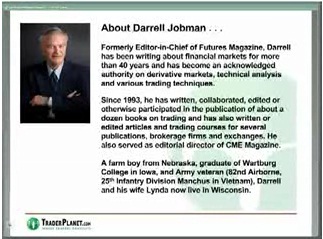 Are you a short term trader or thinking of becoming one? Then chances are, you don't want to miss this free video seminar by former Editor-in-Chief of Futures Magazine, Darrell Jobman! Darrell has become an acknowledged authority on derivative markets, technical analysis and various trading techniques. He has participated in the publication of about a dozen books on trading, and has written articles and trading courses for publications, brokerage firms, and exchanges.