This may make you feel better.

From our media partner: The Associated Press.

CEOs, famous investors hit hard by market plunge

By RACHEL BECK
AP Business Writer

(AP:NEW YORK) Here's something that might provide a bit of solace amid the plunging values in your retirement accounts: Warren Buffett is losing lots of money, too. So are Kirk Kerkorian, Carl Icahn and Sumner Redstone.

They are still plenty rich, but their losses _ some on paper and others actually realized _ illustrate how few have been spared in today's punishing market when even big-name investors, corporate executives and hedge-fund titans are all watching their wealth evaporate.

The portfolio damage for some of these high-flyers has soared to billions of dollars in recent months. And they can't just blame the market's downdraft _ some did themselves in with badly timed stock purchases or margin calls on shares bought with loans.

"It's always hard to beat the market no matter who you are," said Robert Hansen, senior associate dean at Dartmouth's Tuck School of Business. "But when the ocean waters get that rough, it is hard for any boat to avoid getting swamped."

It has been a painful year for anyone exposed to the stock market. The Standard & Poor's 500 stock index, considered a barometer for the broad market, has lost about 36 percent since January, with every single sector _ including once thriving energy and utilities _ seeing declines of about 20 percent or more.

Such losses in the last year have wiped out an estimated $2 trillion in equity value from 401(k) and individual retirement accounts, nearly half the holdings in those plans, according to new findings by the Center for Retirement Research at Boston College. Similar losses are seen in the portfolios of private and public pension plans, which have lost $1.9 trillion, the researchers found.

As stocks have plunged, so have the value of chief executives' equity stakes in their own companies. The average year-to-date decline is 49 percent for the corporate stock holdings of CEOs at 175 large U.S. companies, according to new research by compensation consulting firm Steven Hall & Partners.

Topping that list is Buffett, who has seen the value of equity in his company, Berkshire Hathaway, fall by about $13.6 billion, or 22 percent, so far this year, to leave his holdings valued at $48.1 billion. Oracle founder and CEO Larry Ellison has seen his equity stake fall by $6.2 billion, or about 24 percent, to $20.1 billion, according to the research that ran from the start of the year through the close of trading Oct. 29.

Rounding out the top five in that study were Microsoft's Steve Ballmer, whose company equity fell by $5.1 billion to $9.4 billion; Amazon.com's Jeff Bezos, whose equity fell by $3.6 billion to $5.7 billion; and News Corp.'s Rupert Murdoch, with a $4 billion contraction to $3 billion.

News Corp. and Microsoft declined comment, while representatives from Berkshire Hathaway, Oracle and Amazon.com didn't respond to requests for comment.

Those results included the value of the CEOs' stock, exercisable and non-exercisable stock options and shares that haven't yet vested. They are drawn from each company's most recent proxy statement, which means they might not include subsequent stock purchases or sales.

"Everyone wants to see executives have skin in the game, and this shows they certainly do," said Steven Hall, a founder and managing director of the compensation consulting firm. "But in the end, we have to remember they still have billions to fall back on."

But there have been recent instances where executives' large equity positions have blown up _ not only damaging a particular CEO's portfolio but the company's shareholders, too.

A growing number of executives at companies including Boston Scientific, XTO Energy Corp. and Williams Sonoma Inc. have been forced to sell stakes in their companies to cover stock loans to banks and brokers. The company stock was used as collateral for those loans. The falling prices triggered what is known as a "margin call."

"A decrease in insider ownership is bad for corporate governance," said Ben Silverman, director of research at the research firm InsiderScore.com. "Then executives' interests are less aligned with their shareholders."

Investors in Chesapeake Energy Corp. were recently faced with the surprising news that company CEO Aubrey McClendon was forced to sell almost 95 percent of his holdings _ representing more than a 5 percent stake in the natural gas giant _ to meet a margin call. His firesale of more than 31 million shares, valued at nearly $570 million, put downward pressure on Chesapeake's stock in the days surrounding the mid-October transaction.

McClendon has called this a personal matter and said he would rebuild the ownership position, according to Chesapeake spokesman Tom Price.

Redstone, the famed 85-year-old chairman and controlling shareholder of CBS Corp. and Viacom Inc., was forced to sell $233 million worth of nonvoting shares in those companies. That was done to satisfy National Amusements' loan covenants, which had been violated when the value of its CBS and Viacom shares fell below required levels in the loan agreements.

National Amusements is Redstone's family holding company, and the stock sales represented 20 percent of the holding company's CBS shares and 10 percent of its Viacom shares. A spokesman for National Amusements declined to comment.

Certainly some of the biggest investors aren't happy with recent market events.

Earlier this year, billionaire Kerkorian's investment firm Tracinda Corp. paid about $1 billion, at an average share price of near $7.10, for about 141 million shares in Ford Motor Corp. That represented a 6.49 percent stake in Ford.

Those shares have tumbled as the automaker's financial condition weakened considerably amid slumping sales and tighter credit conditions. That drove Tracinda to disclose twice in recent weeks that it was selling some of its Ford stock _ one batch of 7.3 million shares sold at an average price of $2.43 each, and the other for 26.4 million shares at an average sale price of $2.01 each. That means for about a quarter of his total Ford holdings, he got $71 million.

Tracinda spokeswoman Winnie Lerner declined to comment.

Activist investor Icahn faces an equally ugly situation with his investment in Yahoo Inc. earlier this year, when he bought about 69 million shares for a nearly 5 percent ownership stake. As of June 30, those shares were valued at about $20.60 each, according to a regulatory filing.

Over the summer, he fought hard to get Yahoo's board to agree to a takeover by Microsoft Corp., a deal that never went through. As a concession, Icahn got a seat on the Yahoo board for himself and two allies.

But his Yahoo holdings are off sharply, with the company's shares trading around $13 each. That means he's down more than $500 million since late June. Icahn didn't respond to a request for comment.

As Tuck's Hansen notes, the current market conditions are serving up a reality check _ not just for individual investors but for the biggest names around.

"Fishing isn't called catching, and investing isn't just called making money," Hansen said. "We have to remember that things can go down by a lot."

Copyright 2008 The Associated Press.

Trader's Blog Contest For November

Isn't it hard to sit back and let someone else manage your money? If you are going take a loss wouldn't you rather it be your fault opposed to your broker?

Have you had an experience where you were talked into a overpriced mutual fund, paid an over inflated commission fee or been caught in a "churning cycle" where your broker is cashing in commission on pointless trades? What was your worst experience with a money manager or full service broker? I'm sure we have plenty of horror stories, so why not vent, share and win.

So the question is…

“What is your worst broker experience?”

Prize

Winner will receive 6 workshops on trader psychology from our authors in INO TV. These MP3s and digital PDF workbooks will be mailed to you courtesy of INO TV.

Slump Busting Techniques -Linda Raschke
How You Can Be Right When The Crowd Losses – Jake Bernstien
New Samuri Secrets for Trading: Motivation & Focus – Richard McCall
The Wyckoff Method – Using Principals of Mass Psychology – Hank Pruden
Developing the Psychological Edge to Maximize Your Trading – Robin Dayne
The Dynamics of a Trader's Mindset – Mark Douglas

How To Enter:

Comment on this post telling us about your worst broker experience. There are no wrong answers. We just want to you to share your thoughts and stories with our other visitors.

Rules

1. This contest is open until 11:59 PM on November 30th.

2. No wrong answers, any participation counts as an entry.

3. One entry per email address.

4. Winner will be picked by random integer software.

5. Winner will be contacted on Monday, December 1st via email.

Good luck!

One Last Day For The October Contest...

If you haven't entered Trader's Blog contest for October, you only have until the stroke of midnight on Alls Hallow's Eve to enter. It couldn't be any easier... just click the INO TV and Trader's Blog October Contest link that is sitting on the right hand side of your screen. Click the comment link and just answer the question,

"Besides MarketClub's 'Trade Triangles,' what is your favorite technical analysis indicator?"

It just takes a second and there are no wrong answers, just differences of opinions. I will be using an random integer generator to pick a winner who will receive 6 free DVD/Audios from our INO TV trader's library. These 6 discs will cover an array of technical analysis indicators and will be shipped to you with no strings attached.

HAPPY HALLOWEEN & GOOD LUCK!

---

To see the rules of the drawing, please see the original post please click the link on the right, or click here.

Forex 1-2-3 Method

Let's face it... Forex is a market that has HUGE potential, HUGE liquidity, and little good information out there on how to trade it with success. That's why I've asked Mark McRae from Forex Avenger to come and teach us a bit about a 1-2-3 Method that his partner David Curran from Forex Avenger has had major success with. Please take time, read the blog entry, and visit Forex Avenger to see the success they have experienced trading forex!

====================================================================

This particular technique has been around for a long time and I first saw it used in the futures market. Since then I have seen traders using it on just about every market and when applied well, can give amazingly accurate entry levels.

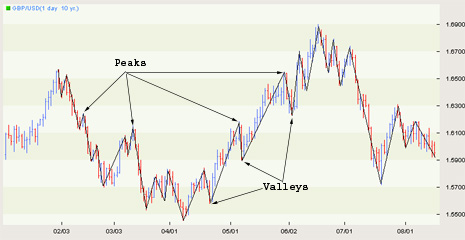
Lets first start with the basic concept. During the course of any trend, either up or down, the market will form little peaks and valleys. see the chart below:

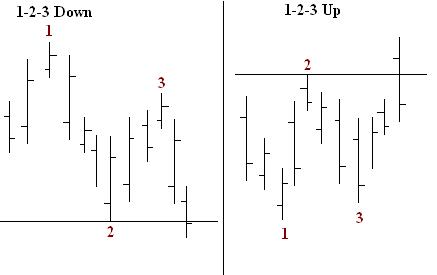
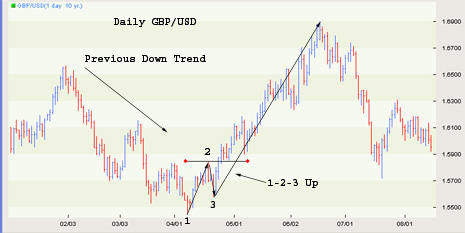
The problem is, how do you know when to enter the market and where do you get out. This is where the 1-2-3 method comes in. First let's look at a typical 1-2-3 set up:


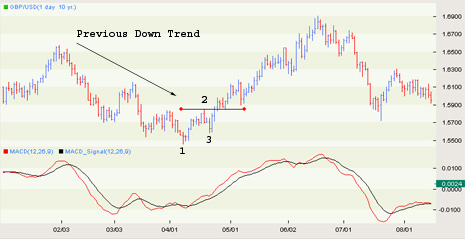
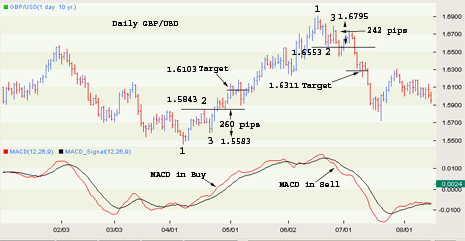
Nice and simple, but it still doesn't tell us if we should take the trade. For this we add an indictor. You could use just about any indicator with this method, but my preferred indicator is MACD with the standard settings of 12,26,9. With the indicator added, it now looks like this:

Now here is where it gets interesting. The rules for the trade are as follows:

Uptrend

  1. This works best as a reversal pattern, so identify a previous downtrend.
  2. Wait for the MACD to signal a buy and for the 1-2-3 set up tobe in place.
  3. As the market pulls back to point 3, the MACD should remain inbuy mode or just slightly dip into sell.
  4. Place a buy entry order 1 pip above point 2
  5. Place a stop loss order 1 pip below point 3
  6. Measure the distance between point 2 and 3 and project thatforward for your exit.
  7. Point 3, should not be lower than point 1

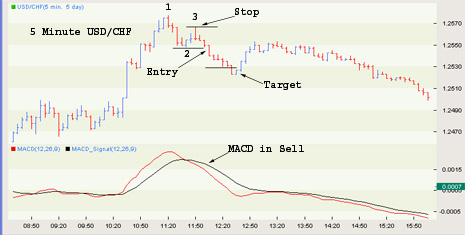
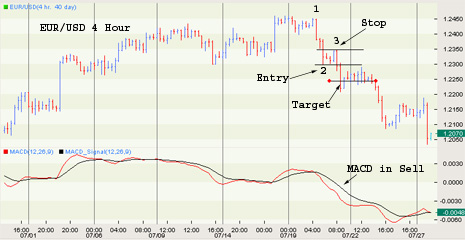
The reverse is true for short trades. As the market progresses you can trail your stop to 1 pip below the most recent low (Valley in an uptrend). You can also use a break in a trend line as an exit.

Some examples:


There are a lot of variations on the 1-2-3 setup but the basic concept is always the same. Try experimenting with it on your favorite time frame.

Good Trading

Best Regards
Mark McRae Forex Avenger

Bio - Mark McRae is a fulltime professional trader, author and coach. He has coached some of the top names in Forex trading. David Curran, Forex's latest rising star attributes his success in the Forex market to the teachings of Mark McRae. To read more about David, go HERE

Greenspan denies blame for crisis, admits 'flaw'

From our Media Partner Associated Press

Greenspan denies blame for crisis, admits 'flaw' this minute
By MARTIN CRUTSINGER and MARCY GORDON
Associated Press Writers

(AP:WASHINGTON) Badgered by lawmakers, former Federal Reserve Chairman Alan Greenspan denied the nation's economic crisis was his fault on Thursday but conceded the meltdown had revealed a flaw in a lifetime of economic thinking and left him in a "state of shocked disbelief."

Greenspan, who stepped down in 2006, called the banking and housing chaos a "once-in-a-century credit tsunami" that led to a breakdown in how the free market system functions. And he warned that things would get worse before they get better, with rising unemployment and no stabilization in housing prices for "many months."

Gloomy economic reports backed him up. New jobless claims soared to just under 500,000 for last week, and Goldman Sachs, Chrysler and Xerox all said they were cutting thousands more workers. On Wall Street, the Dow Jones Industrial bounced erratically all day before finishing up 172 points _ after a two-day drop of nearly 750.

The financial crisis even prompted the Republican Greenspan, a staunch believer in free markets, to propose that government consider tougher regulations, including requiring financial firms that package mortgages into securities to keep a portion as a check on quality.

He said other regulatory changes should be considered, too, in such areas as fraud.

Also looking for solutions, another banking regulator told Congress the government was working on a loan-guarantee plan that could help many homeowners escape foreclosure as part of the $700 billion bailout legislation. That plan is being discussed by the Treasury Department and the Federal Deposit Insurance Corp., said FDIC Chairman Sheila Bair, who is pushing the idea.

Greenspan's interrogation by the House Oversight Committee was a far cry from his 18 1/2 years as Fed chairman, when he presided over the longest economic boom in the country's history. He was viewed as a free-market icon on Wall Street and held in respect bordering on awe by most members of Congress.

Not now. At an often contentious four-hour hearing, Greenspan, former Treasury Secretary John Snow and Securities and Exchange Commission Chairman Christopher Cox were repeatedly accused by Democrats on the committee of pursuing an anti-regulation agenda that set the stage for the biggest financial crisis in 70 years.

"The list of regulatory mistakes and misjudgments is long," panel chairman Henry Waxman declared.

Greenspan, 82, acknowledged under questioning that he had made a "mistake" in believing that banks, operating in their own self-interest, would do what was necessary to protect their shareholders and institutions. Greenspan called that "a flaw in the model ... that defines how the world works."

He acknowledged that he had also been wrong in rejecting fears that the five-year housing boom was turning into an unsustainable speculative bubble that could harm the economy when it burst. Greenspan maintained during that period that home prices were unlikely to post a significant decline nationally because housing was a local market.

He said Thursday that he held to that belief because until the current housing slump there had never been such a significant decline in prices nationwide. He said the current financial crisis had "turned out to be much broader than anything that I could have imagined."

Greenspan's much-anticipated appearance before the House panel came as the Senate Banking Committee held its own hearing on what the government is doing now to get out of the mess.

Assistant Treasury Secretary Neel Kashkari, who is overseeing the $700 billion financial rescue effort that passed Congress on Oct. 3, said the administration was not only working to get federal purchases of bank stock started quickly but also the program to mop up troubled mortgage-related assets. He also said the government was working to make sure that directives in the legislation to help struggling homeowners avoid foreclosure were being addressed.

Kashkari said the plan could include setting standards that banks should follow for reworking mortgages to make them more affordable. He said the administration was considering a recommendation to provide government loan guarantees to cover the reworked mortgages to make the program more attractive to banks.

"We are passionate about doing everything we can to avoid preventable foreclosures," Kashkari told the committee.

The FDIC's Bair told the same Senate panel that the government needs to do more to help tens of thousands of people avoid foreclosure.

She said the FDIC was working "closely and creatively" with the Treasury Department to come up with a plan.

Greenspan was asked to defend a variety of actions he took as Federal Reserve chairman _ resisting recommendations to use the Fed's powers to crack down on subprime mortgages, for one. And opposing efforts to impose regulations on derivatives, the complex financial instruments that include credit default swaps, which have also figured prominently in the current crisis.

He said that outside of credit default swaps, the bulk of financial derivatives had not caused major problems. He said the boom in subprime lending occurred because of the huge demand for investment opportunities in a global economy, and he blamed the crash on a failure by investors to properly assess the risks from such mortgages, which went to borrowers with weak credit.

As for firms that package mortgages into securities, he said, "As much as I would prefer it otherwise, in this financial environment I see no choice but to require that all securitizers retain a meaningful part of the securities they issue."

On the billions of dollars of losses suffered by financial institutions because of their investments in subprime mortgages, Greenspan said he had been shocked by the failure of banking officials to protect their shareholders from their bad loan decisions.

"A critical pillar to market competition and free markets did break down," Greenspan said. "I still do not fully understand why it happened."

SEC Chairman Cox told the House panel that "somewhere in this terrible mess, laws were broken." And Snow said that lawmakers should have responded more quickly to his pleas for stronger regulation for mortgage giants Fannie Mae and Freddie Mac, which were taken over by the government last month.

In the meantime, Kashkari, the Treasury official overseeing the bailout program, said there has been much progress, resulting in "numerous signs of improvement in our markets and in the confidence in our financial institutions." Still, he cautioned, "the markets remain fragile."

Copyright 2008 The Associated Press. All rights reserved. This material may not be published, broadcast, rewritten or redistributed.