Trader's Blog Contest Winner...

Congratulations to Michael P. of Ontario, Canada for winning the first ever Trader's Blog contest. You will receive your iPod touch courtesy of MarketClub.com and INO.com shortly. Thanks for everyone who participated. It was fun to read those could-a, would-a, should-a moments... now it's time to make them happen.

We asked visitors to write about a trade that they wish they would have entered. Here is what Michael wrote:

---

"One of the best Canadian stocks to play the Canadian Oil Sands is Canadian Oil Sands Trust…COS.UN on the TSX. Around October 2006, rumors started swirling around in the Canadian press that the Canadian Federal government was going to tax all the Income trusts like a corporation, thus any owner of Income trusts would pay double taxes. Well on Oct 31st..Halloween..after market close, they confirmed these rumors. When the market opened on Nov. 1st, COS.UN plunged to a low of $24.32, over 20% in one day. It scared everybody including me because I owned 1300 units. I wish I had taken the contrary view that day and bought more. I would have realized a gain of over 100% in a little over a year, not to mention the 50% increase in the dividend payout since that time!!!"

--

We plan to have many more contests, so stayed tuned and keep interacting with us and again congrats to Michael.

Like Beijing, Capital Gains Can Be Confusing

With all the recent market action I decided to contact Ryan Gibson, from Traders Accounting, Inc., to help explain a bit about how the IRS taxes capital gains. Ryan has always been my "go to" guy when it comes to explaining and UNDERSTANDING the world of accounting and taxes for trading. Please be sure and visit his site for more helpful information, Traders Accounting, Inc.

==================================================================

It’s a good thing China made its debut on the world stage by hosting the 2008 Summer Olympics and not, say, a spelling bee. After all, athletes speak a universal language: run faster, jump higher, throw farther or score more points than your opponents and you’ll bring home the gold, and possibly a Wheaties contract.

But try to order dinner in Beijing? Now that’s tricky. Centuries of cultural isolation have limited China’s exposure to the rest of the world until now, which is all part of the excitement of this year’s momentous Summer Games.

Tricky also might best describe how the IRS taxes capital gains. While it may not be as indecipherable as a Beijing Chinese menu, tax treatment of capital gains and losses are far from a one-size-fits-all proposition, but depends instead on how those capital gains or losses were realized.

Not-so-simple Capital Gains/Losses

First, a short primer on capital gains. For tax purposes, all assets fall into two categories: capital and non-capital. Generally speaking, capital assets are things we acquire for personal use or investment: our home, furnishings, vehicles and other valuables such as jewelry and collectables. By contrast, non-capital assets, as the term implies, tend to be impersonal: sales to customers, accounts receivable, business supplies, hedging transactions and property used for business.

The distinction becomes clear at tax time, when capital assets are subject to capital gains and loss rules. Sales of non-capital assets, however, are taxed as ordinary income, and so fall outside this discussion. A Traders Accounting professional can be invaluable in clarifying your capital gains position and minimizing your tax exposure.

When a capital asset is sold, it either makes money (gain) or loses it (loss), based on what is called adjusted basis. Basis is the price you paid for the asset. Adjusted basis is your basis plus such additions as selling expenses or home improvements, and minus deductions for such things as depreciation or casualty loss.

If you held the asset for a year or less, it is considered a short-term capital gain or loss; if you held it for longer, it is considered a long-term capital gain or loss.

Here’s where it gets trickier. Losses you incur on the sale of some capital assets, including personal items such as your home, furnishings and vehicles, cannot be deducted on your tax return. Similarly, gains from the sale of personal capital assets may be taxable.

Capital Gains Scenarios

Let’s look at three typical gain/loss scenarios to see how they would be taxed under the capital gains/loss rules:

1. Short-term gains and losses: In this situation, you would combine your short-term gains and losses to produce a net short-term total. A total gain is taxed as ordinary income, but a loss can be deducted up to $3,000 on your return. If your loss exceeds $3,000, it can be carried over to the following year as a short-term loss.

2. Long-term gains and losses: Combine long-term gains and losses to arrive at a net long-term total. A total gain is taxed at the 15% maximum capital gains rate. A long-term loss is deductible up to the $3,000 cap and can be carried over to the following year as a long-term loss.

3. Short- and long-term gains and losses: First, combine short-term gains and losses to produce a net short-term total. Next, combine long-term gains and losses to produce a net long-term total. Now combine the two net totals. If the result is a gain, each type of gain is taxed at its applicable rate (see above). If it’s a loss, it is deductible up to the $3,000 cap. If your loss exceeds $3,000, deduct your short-term loss first and carry over the long-term portion.

Mixed Doubles: Short- and Long-Term Gains/Losses

So what happens when you end the year with a mix of short- and long-term gains and losses? Here’s how the IRS taxes the four possible scenarios:

·Short-term gain exceeds long-term loss: The short-term gain is taxed as ordinary income.

·Short-term loss exceeds long-term gain: Deduct the short-term loss to the $3,000 cap and carry over the balance.

·Long-term gain exceeds short-term loss: Deduct the long-term loss to $3,000 and carry over the balance. The net gain is taxed at the long-term rate.

·Long-term loss exceeds short-term gain: Deduct the long-term loss to $3,000 and carry over the balance.

If your broker charges you to conduct trades, don’t forget to subtract his or her fees from your gain. And be sure to read carefully the Form 1099 you receive from your broker. Some brokers record gross gains and losses, meaning they haven’t subtracted their expenses, while others record net gains and losses, meaning they’ve already done the adjustment for you. Always use net gains and losses when preparing your tax return.

If you have any questions or need some advice please visit my site Traders Accounting, Inc.

Ryan Gibson, AZCLDP
Traders Accounting, Inc.

Looking Back, 3 Key Signs To Sell Lehman

I invited Blain from StockTradingToGo.com back to give us his analysis on Lehman. He's missing the 4th key to selling Lehman...TRADE TRIANGLES! If you're a MarketClub member pull up Lehman in MarketClub...then take a look at where the Trade Triangles signaled you.

===============================================================

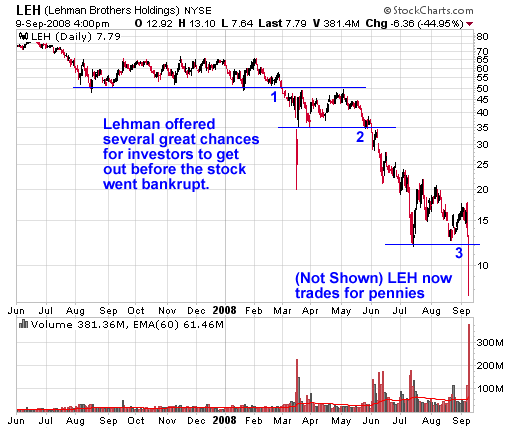
The following stock chart of Lehman Brothers (LEH) offers a great example of simple support and resistance. Support and Resistance is a basic form of technical analysis used commonly every day to mark potential buy and sell points on a stock chart.

Lehman Brothers is a good stock chart to observe for both new and seasoned investors because the recent Lehman bankruptcy offered three key sell signals for investors on the way down.

Note: This chart of Lehman Brothers is a 16 month daily stock chart:

1. The blue 1 show us how at the end of February Lehman stock fell through its first key support trendline at $50. This was a big sign that the bears had control of the stock and longs should get out.

2. The blue 2 shows us where Lehman eventually collapsed below its 2nd major support trendline at $35. This was another key sign for investors to get out of the stock.

3. The blue 3 shows the tipping point for Lehman before it moved to pennies. The break below $12 a share was the last major support Lehman had, and the stock never recovered. Bankruptcy shortly followed.

View More Examples of Technical Analysis.

6 Tips to Having a Productive Financial Morning Routine

Good Morning! I hope everyone actually got some sleep lastnight, as many people I talked to were very worried about 401k's, Money Markets, and the like. If you're trading with the trend, utilizing GOOD information, and following a plan then you should be ok! If you're still having issues, please take a look at the article below by Blain Reinkensmeyer from StockTradingToGo.com. I asked him to talk about how he gets his morning routine put together for the day. Enjoy the post and trade well!

==================================================================

Every trader has a morning routing when it comes to preparing for the market day. Some traders are more intense than others because they have more at stake. Regardless of the size of your portfolio, here are some tips that can help get your morning started right.

1. Wake up before the market opens: The stock market opens every day at 9:30 AM EST and by waking up before you have time to prepare for any potential market surprises or simply set a strategy up for the day. Some traders wake up three hours before the opening bell, some three minutes; it is all based on your routine you develop.

2. Give the financial news a quick check: For me I simply head over to the INO News page or Yahoo finance and read the headlines. More often than not it gives me a quick glimpse of what the market itself is up to and any stocks that have big news. If you don’t like reading, than simply flip on CNBC and watch a few minutes.

3. Check the pre-markets: This is almost a must if you are a day trader because plays can come about pretty quickly. Personally I use the NASDAQ pre market indicator for attaining pre-market quotes. Pre-market trading occurs from 8:00 AM - 9:30 AM EST every day. For the simple trader, the whole purpose of this is to get an idea of what stocks if any are on the move early.

4. Give your portfolio a quick overview: Sign into your online stock broker account and just give your portfolio a look. This is a good opportunity to see if your positions moved the previous night alongside update any stop orders you may have.

5. Active Traders, setup your trading station before the market opens: This is really a “duh” for those that trade out of their homes, but I can honestly say I struggled at this when I used to day trade. I would try to wake up 5 minutes before the opening bell, gather news and get myself setup, and more often than not it doesn’t work. Get your computer running early so you are ready if need be.

6. Read the Paper: Papers such as the Investors Business Daily (IBD) and the Wall Street Journal are an outstanding way to get updated on what the market is up to.

Blain Reinkensmeyer

StockTradingToGo.com

The Biggest Mistake Silver Investors and Traders Make

Last month I invited David Morgan Silver-Investor.com to come and do a guest blog post. Well we received a huge email and comment response to bring him back for more analysis.

==================================================================

The Biggest Mistake Silver Investors and Traders Make!
Do you know what it is?

by David Morgan

To say that investors in the resource sector have been having a bumpy ride for the last six months would be the understatement of the year! Whether you hold mining stocks, buy physical precious metals, or play the futures market, it’s been hard to make dimes and easy to lose dollars. How is a trader supposed to keep his or her balance during these turbulent times, when gold and silver can make bigger up and down moves overnight than they normally do during the daytime session?

I’ve said many times that the market will seek to find and lay bare every weakness a trader has (both in personality and trading style). In order to survive and trade profitably, it is not enough just to become proficient in the mechanics of buying and selling. What is critical is to spend the time necessary to develop a thorough understanding of yourself.

An old Chinese saying that many of my readers have no doubt heard, but which in today’s market environment certainly bears repeating, goes:

If you know your opponent and yourself, you will be victorious in one hundred battles.
If you know only yourself, the odds are even.
If you know neither, there is great danger in one hundred battles.

Tony Burroughs of the Intenders tells us that, to a large extent, our reality is formed by the way we talk to ourselves. Almost always, the outcome of something we are doing will be more productive and positive if we “intend” rather than “try” or “hope.” When the markets are challenging, as they have been lately, “the novice buys into the doubt, but the ‘knower’ pushes the doubt aside and continues forward.”

Start by asking yourself if the reasons you initially invested in mining stocks and metals have changed. Do you believe the fundamentals are different now than they were a few months ago? Are your goals and how you plan to achieve them still aligned? Can you still focus on the larger, long-term picture and turn down the short-term noise?

If you believe, as I do, that this secular bull market for gold and silver has a long way to run, then you can more easily deal with current conditions, limit second-guessing, and make the trading decisions that will keep you in the game.

My friend Pat Gorman has spent much of his life helping others to develop the tools they need to succeed, as well as spending no small amount of time in the search for balance in walking his own path. He likes to speak of two important concepts that can help us stay centered and move forward professionally and personally. These concepts are discipline and gratitude.

Be disciplined in studying about the markets you choose to invest in, and then follow through on what you have learned. Just as important, take time on a regular basis to express your gratitude for what life has given you and the opportunities it presents. Sure the markets and the profit we hope to make from them are important. But doesn’t the real value in our lives rest with our relationships and the health of family, friends, and ourselves? Aren’t you privileged to live in a country that in spite of its many problems is still a beacon for millions of people from around the world?

Developing a thorough understanding about yourself and making sure your self-talk moves you in the direction of your personal and professional goals may not seem as exciting as pulling off a ten-bagger mining stock trade or catching a one-dollar move on a silver futures contract. But it really does offer the potential of helping your trading to become more consistent and enables it to flow with the market, regardless of what it is doing on a given day, week, or month.

Let’s face it. Not only is the market unaware that you exist, but it probably wouldn’t care, even if it knew. There are valid reasons for seeing the trading floors as battlefields, because that’s what they really are . . . titanic battles between bulls and bears.

When the day comes that you have developed a good understanding not only of the markets, but of yourself as well, you may then truly become “victorious in one hundred (trades) battles.” I’d say this is a very worthy endeavor. How about you?

Get Real, Buy Real,
David Morgan

Mr. Morgan is the founder of Silver-Investor.com and has followed the silver market daily for over thirty years. Much of this Web site is devoted to education about money, metals and mining.