Breaking News: US Relaxes Crude Export Restrictions

Adam Feik - INO.com Contributor - Energies


The US Commerce Department on Tuesday announced it started on December 8th approving a backlog of requests to export certain, specific forms of processed light oil. Crude exports have been banned since 1975. Tuesday’s announcement doesn’t end the crude oil export ban entirely, but the department on Tuesday did also issue long-awaited guidelines “outlining exactly what kinds of oil other would-be exporters can ship.” (Reuters)

Reuters reported this new action “effectively clears the way for the shipment of as much as a million barrels per day of ultra-light U.S. crude to the rest of the world.” Ed Morse, global head of commodities research at Citigroup, was quoted as saying US condensate exports could rise from 200,000 bpd to as much as 1 million bpd by the end of 2015, thanks to this new regulatory change.

For now, exports of untreated crude remain banned. Refined fuels such as gasoline and diesel, though, have not been banned from selling abroad. The question has been at what point crude becomes “refined,” and thus eligible to be exported. “Processed condensate,” a semi-refined form of the product, has been a gray area. Continue reading "Breaking News: US Relaxes Crude Export Restrictions"

Is The Ruble Meltdown Over?

Lior Alkalay - INO.com Contributor - Forex


The 16th of December will be remembered by investors across the globe, and Russia specifically, as “Black Tuesday;” a day when investors got a quick and unwelcome reminder of the 1998 crisis during which Russia was bankrupted. On Black Tuesday, the Ruble tumbled by 21.1% in less than a day and hit 78.51; Credit Default Swaps (CDS) for 5 years have priced in a 8.8% chance for a Russian bankruptcy. Black Tuesday was, simply put, an utter meltdown; investors were in a panic, Russians were running to the banks and the risk of a total collapse of the Russian economy hung in the air. Yet two weeks later, as some of the chaos from that Black Tuesday began to dissipate, some stability has emerged and with it the Ruble has regained some lost ground. The two questions which beg to be asked and answered; Is it the calm before the storm or perhaps a step toward stability? As we attempt to answer these questions we will also, hopefully, shed some light on the Ruble’s possible trajectory as a consequence.

What Ignited the Chaos?

Although it is still debatable as to what exactly was the last straw, there are clearly two very big contenders. The first was Rosneft, the Russian oil giant, was effectively bailed out by the Russian State through the tapping of the country’s emergency reserves. Continue reading "Is The Ruble Meltdown Over?"

Natural Gas Takes Its Turn At The Puke Bowl

Adam Feik - INO.com Contributor - Energies


Natural gas futures on Friday dropped below $3 for the first time since September 2012, on an intraday basis. December is now on track for the dubious distinction of producing natty’s largest one-month drop since 2008 – currently about a 26% month-to-date (MTD) decline – as producers continue churning out the commodity even while mild weather has resulted in below-normal consumption.

Crude oil, by comparison, has declined about 17% in December (MTD).

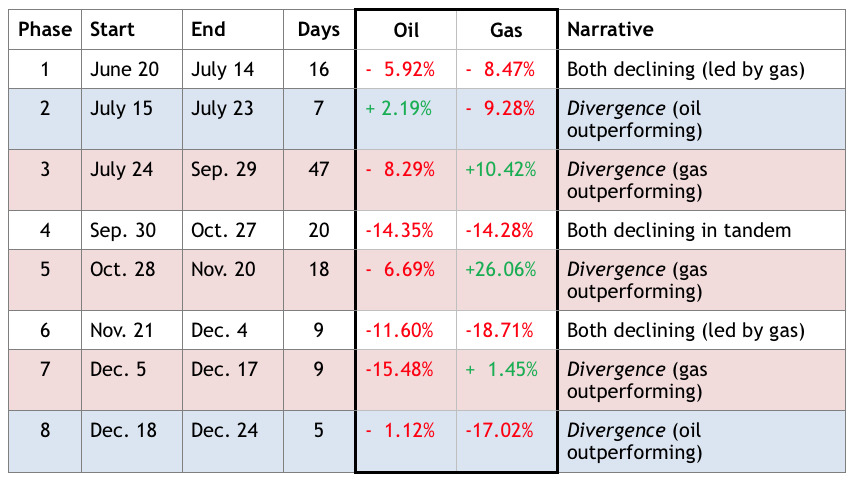
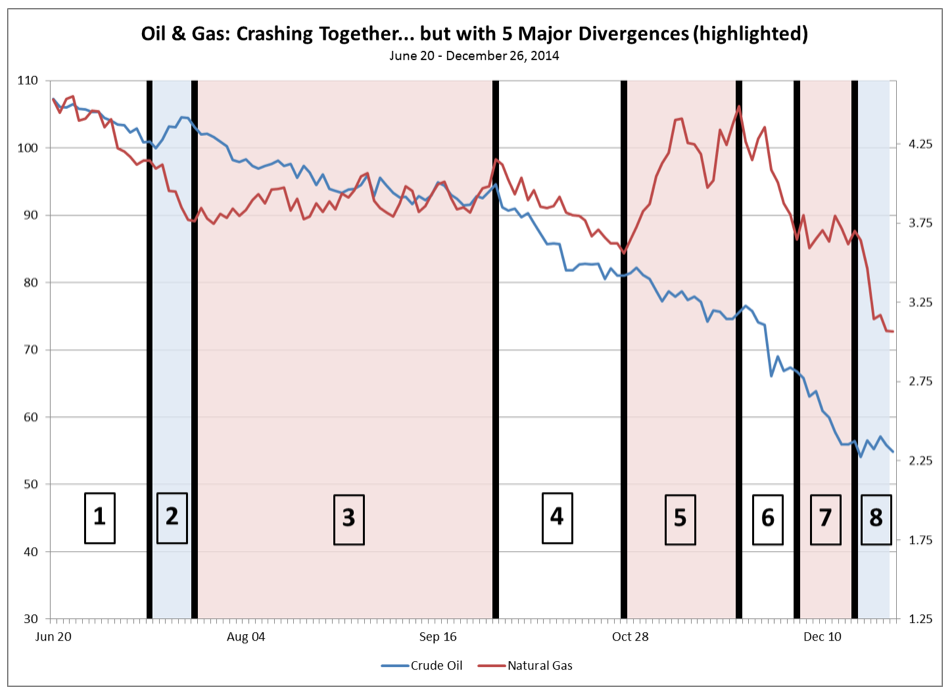
Natural gas and crude oil prices have taken turns out-dropping each other over the past 6 months. This simple graph (and accompanying chart) shows how oil and gas have crashed both together and separately for the last 6 months. What do I mean by that? Both have nosedived, but with 5 distinct periods of divergence (highlighted in blue when oil is outperforming, and highlighted in red when gas is outperforming). See for yourself:

In total:

  • Oil & gas have crashed “together” for 3 of the 8 periods, for a total of 45 trading days in which gas has generally declined more than oil.
  • Oil has “diverged” to the upside in 2 periods (highlighted in blue), for a total of 12 trading days.
  • Gas has “diverged” to the upside in 3 periods (highlighted in red), for a total of 74 trading days.

Actually, at its recent peak on Nov. 20th, natural gas prices were only a few pennies below their June 20th level; so effectively all of natty’s 2014 crash has occurred in just over 23 trading days since just before Thanksgiving.

What happened to natural gas from Oct. 28th through Nov. 20th, when it rose about 26%? Continue reading "Natural Gas Takes Its Turn At The Puke Bowl"

Gold Versus Top Currencies! And The Winner Is….

Aibek Burabayev - INO.com Contributor - Metals


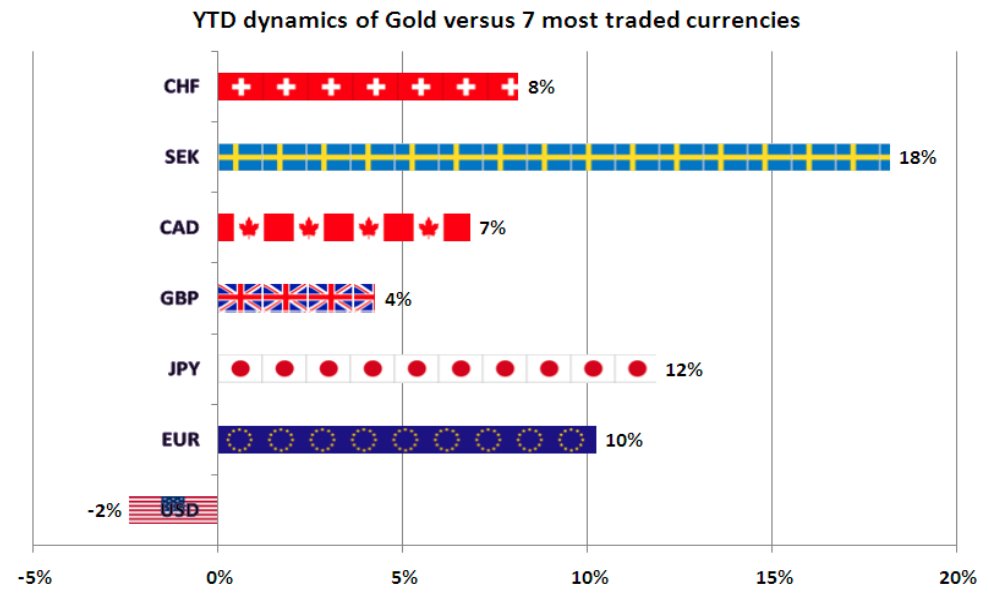
Long ago, Gold was an exchange medium and one of the very first hard currencies. In this post, I will show you YTD results of the competition between this former currency and the top 7 modern currencies. I selected the US dollar first, and the others are 6 components of US dollar index placed by weight: EUR, JPY, GBP, CAD, SEK and CHF. I bet some of you never even thought about such currency crosses for Gold.

On the above diagram, you’ll see DXY components in different extents. They lost their value against Gold and only the 'king currency' managed to survive and even gain a small profit. So the winner is US dollar and the top loser is Swedish krona, the net difference between them is 20%, impressive! Continue reading "Gold Versus Top Currencies! And The Winner Is…."

Does the big GDP revision get us any closer to 'normal' rates?

George Yacik - INO.com Contributor - Fed & Interest Rates


Will Tuesday’s GDP upgrade to its fastest growth in more than 10 years nudge – or push – the Federal Reserve to raise interest rates earlier than Janet Yellen recently signaled, i.e., no earlier than the first quarter of next year?
Alas, probably not.

The final revised estimate for third quarter GDP showed the economy growing at a robust 5% annualized rate, the fastest pace in 11 years. That was far higher than the previous estimate of 3.9% and well above both the 4.3% rate the Street was looking for as well as the most optimistic individual forecast of 4.5%. It was also up from the second quarter’s growth rate of 4.6%.

Ninety minutes later, the Commerce Department came out with another report that showed personal spending rising 0.6% in November, the most in three months, while personal income gained 0.4%, the strongest pace in five months.

A week earlier, the Securities Industry and Financial Markets Association predicted that GDP growth would hit 3% next year, which it says “would be the strongest growth in nearly a decade.”

If this latest batch of strong economic news still doesn’t convince the Fed that it should start raising interest rates sooner than it indicated only a week before, we can only conclude that the Fed has lost sight of its statutory mandate, namely to “foster maximum employment and price stability.”

Instead, it has become how to best finesse its extrication from its near-zero interest rate policy and start raising rates without setting off a giant market selloff. So the easy thing to do, as most other major decisions are made in Washington, is to do nothing and deal with it later, whenever that is. Which of course by then the problem will have grown much worse and much more difficult to deal with.

At its FOMC monetary policy meeting the week before, the Fed said that it “judges that it can be patient” in normalizing monetary policy, adding that “it likely will be appropriate” to maintain its near zero target rate range for a Continue reading "Does the big GDP revision get us any closer to 'normal' rates?"