ETFs For Rising Consumer Debt

According to The New York Federal Reserve, consumer debt is at record highs.

At the end of 2022, U.S. consumer debt across all categories totaled $16.9 trillion. That was an increase of $1.3 trillion from one year ago. What's more alarming is that in 2019, the total U.S. consumer debt was $14.14 trillion.

So, while higher interest rates likely fueled some of the increase from 2021 to 2022, increasing consumer debt had occurred even before the Federal Reserve began its rate hikes.

What is concerning about the increasing consumer debt is what it says about the future of our economy. In 2017, the International Monetary Fund released a report that showed a correlation between rising consumer debt and the economy's health. The IMF concluded that rising consumer debt was good for the economy in the short term.

For example, the more consumers take out auto loans, the more the automotive industry, from the auto parts manufacturers to the big auto manufacturers to even the auto dealers, will experience an increase in labor needs. This increase reduces unemployment, which increases overall economic activity and spurs the economy.

Consumer debt rises related to the housing industry have the same effect but on an even larger scale. It's been reported that for every new home built in the U.S., 1.5 new jobs are created.

The IMF study clearly says that while consumer debt is increasing, there are economic benefits. But, in three to five years, those positive effects are reversed. The report states that growth is slower than it would have been if the debt had not increased, and more importantly, the odds of a financial crisis increased.

The IMF went into detail about how much consumer debt needs to grow in order to raise the likelihood of a financial crisis. Their calculations indicate that a five percent increase in the ratio of household debt to the gross domestic product over a three-year period forecasts a 1.25 percentage point decline in inflation-adjusted growth three years in the future. Continue reading "ETFs For Rising Consumer Debt"
2 Small-Caps For Your Watchlist

It’s been a choppy start to the year for the major market averages and while many large-caps have begun new uptrends, several small-cap names remain stuck in the mud, unable to gain much upside traction.

In some examples, this underperformance is justified with many businesses not being worth owning and or having weak balance sheets.

However, there are a few small-cap names with solid business models and decent balance sheets generating free cash flow, and contrarian investors are being presented with an opportunity to invest in these stocks at a very reasonable price, especially given that they have robust growth plans.

In this update, we’ll look at two stocks worthy of adding to one’s watchlist:

MarineMax (HZO)

MarineMax (HZO) is a small-cap name ($600 million market cap) in the Retail-Leisure Products industry group, and is the world’s largest lifestyle recreational retailer of boats and yachts plus yacht concierge and superyacht services.

The company was founded in 1998 in Clearwater, Florida, and has grown through strategic acquisitions to now control a footprint of 125 locations globally, including 57 owned and operated marinas and 78 dealerships.

Some of the company’s recent acquisitions include BoatYard.com and Boatzon, Fraser Superyacht Services, MidCoast Marine Group LLC, and IGY Marinas.

Understandably, many investors might not be that interested in owning a business that derives its revenue from recreational boat and yacht sales during a period where consumers are pulling on their spending and in what appears to be a recessionary environment with increasing layoffs. Continue reading "2 Small-Caps For Your Watchlist"

The Port We Need In This Market Storm

Editor’s Note: Our experts here at INO.com cover a lot of investing topics and great stocks every week. To help you make sense of it all, every Wednesday we’re going to pick one of those stocks and use Magnifi Personal to compare it with its peers or competitors. Here we go…


When markets turn as volatile and uncertain as they’ve been this week, it’s a good idea to look for sectors you’d want to be invested in no matter where the markets go.

Healthcare is one such sector.

It encompasses two contrasting types of businesses. The first is boring, large-cap stocks in the pharmaceutical and healthcare services sectors. These traditionally provide some defensive qualities if the economy starts to slow. That’s true because a lot of healthcare spending is not dependent on cycles in the economy. People get sick no matter the economy.

The more exciting part of the healthcare sector is very growth-oriented, with high valuation multiples. This is the biotechnology sector, with exciting fields like genomics, CRSPR gene-editing machines, and cures for cancer.

And even beyond biotech, there are also other growth segments in this healthcare sector, including medical data businesses and medical equipment suppliers. All of these are riding long-term trends such as aging and increased healthcare spending, along with big data and AI.

The safer pharma sector looks especially enticing for more conservative investors. Vincent Deluard, strategist at StoneX, has run numbers showing pharmaceuticals have maintained 15% to 20% margins over the past 40 years. He told the Financial Times: “They have almost no exposure to energy and basic material costs: their main expenses are research and development, marketing and lobbying… Inflation in drugs prices and medical services has been twice that of the broad consumer price index in the past 40 years.”

But for the adventurous among you, putting money into the more exciting biotech small caps may be the way to go. Valuations are cheap, with a substantial upside.

So, I asked Magnifi Personal to compare an ETF from each healthcare segment - pharma and biotech. I didn’t even have to find the right ETFs. Continue reading "The Port We Need In This Market Storm"

Was The Collapse of SVB a Black Swan?

According to some doomsayers, the stock market is on the brink of a crash, and the collapse of Silicon Valley Bank (SVB) is being considered as a potential "Black Swan" event.

They believe it could trigger a domino effect similar to the Lehman Brothers collapse in 2008. There are already indications of this, as the failure of SVB has had a ripple effect in Europe, with the second largest Swiss bank, Credit Suisse, also being hit.

YTD SPF IXG SIVB JPM BAC CS

Source: TradingView

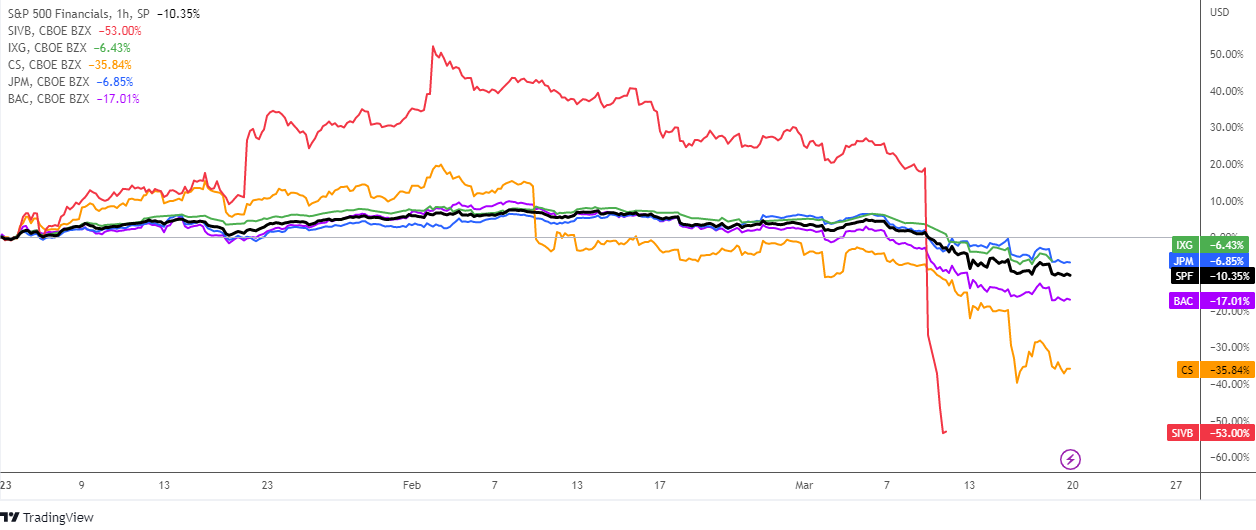
In the comparative chart above there is a year-to-date dynamics of S&P 500 Financials index (SPF, black), the iShares Global Financials ETF (IXG, green), SVB Financial Group (SIVB, red), Credit Suisse (CS, orange), JPMorgan Chase (JPM, blue) and Bank of America (BAC, purple).

On the chart, all of the lines indicate negative performance, with each one below the zero mark. Indeed, SVB and CS are the ultimate losers, while BAC is also suffering a significant loss at -17.01%. Meanwhile, IXG, JPM, and SPF fared slightly better, with losses of -6.43%, -6.85%, and -10.35%, respectively.

This indicates that banking stocks around the world are losing ground following the trigger from SVB, as seen with the decline in IXG and the top two banks in the US. Continue reading "Was The Collapse of SVB a Black Swan?"

ETFs To Play The Banking Situation

With the collapse of Silicon Valley Bank, everyone is looking at the banking industry. Some think it has more room to fall, while others believe now is the best buying opportunity we have seen in a decade.

At this time, I believe it is too hard to pick which direction banks or the market overall is heading.

My reason for saying that is that very few people fully understand the real risk to the banking system at this time.

A few weeks ago, Wall Street banking analysts gave banks good stock ratings. Janet Yellen, the head of the Treasury Department, recently said the banking industry was healthy. Even Jerome Powell, Chairman of the Federal Reserve, recently sat in front of congress and testified that the banking system was solid and well-capitalized.

Well, that certainly wasn't the case for SVB.

While I understand that when Janet Yellen or Fed Chairman Powell make these statements, they are speaking about the whole industry, not one-off banks, as we saw during the financial crisis in 07-08, it only takes a few small cracks in the system to open the flood gates.

And when the 15th largest bank in the U.S. fails, it's hard to ignore that crack, despite the argument that SVB is different from most other banks because they lend to riskier clients in the form of 'start-up' businesses.

The argument that SVB is and was different may make sense, but if that is true, how do you explain Credit Suisse needing a $50 billion loan from the Swiss National Bank?

Finally, for years we have been told that the banks, both here in the U.S. and worldwide, have parts on their balance sheets that are referred to as 'black boxes.' These are certain businesses or investments that we, outsiders, will never get to see. We will never know what those parts of the bank's business look like, and thus, how can we fully understand how healthy or sick a bank is until it's too late?

Maybe you understand the banks better than I do and still want to invest in them, whether long or short; let me give you some exchange-traded funds that you can buy to profit from a bank industry move in either direction. Continue reading "ETFs To Play The Banking Situation"