When the War In the Ukraine Ends

A recent publication from the Kellogg School of Management at Northwestern University discussed the benefits of the post-war reconstruction as a good investment. They use post-World War II as an example of how much money should be spent and how it benefits the war-torn country very quickly.

The paper pointed to specifically The Marshall Plan following World War II. The Marshall Plan had two goals; European economic recovery and the containment of the Soviet Union. Stabilizing Europe’s economies were vital to promoting income growth around the world and entrenching democracies in Europe.

Whenever the Ukraine War is over, I think the Marshall Plan should be adopted identically from what happened 80 years ago since we will essentially be trying to do the same thing in Ukraine as we did all over Europe back then.

However, it will be much more expensive this time around. Post World War II, American leaders sent roughly $130 billion (In 2010 dollars) to help with the European reconstruction of railways, utilities, roads, and airports, the same type of facilities that will need to be rebuilt in Ukraine.

However, economists estimate that restoring the lost infrastructure in Ukraine will cost at least $200 billion, and that figure will climb the longer the war continues. And remember, $200 billion is to rebuild Ukraine.

After World War II, the Marshall Plan not only gave funds to countries that had been friendly to the US during the war but also to Germany and Italy.

The belief back then and now is that not helping to rejuvenate all parties involved after the war ended would only cause more issues later down the road. That has some people thinking that Russia and even Belarus could see new investments from outsiders when the war ends, perhaps not in a straightforward financial manner but in other ways, such as new business opportunities and deals.

At this time, no money has started flowing back into Ukraine to help rebuild the country or increase business and the economy.

But, a deal has already been made between Ukrainian President Volodymr Zelenskyy and BlackRock’s (BLK) CEO Larry Fink that has BlackRock coordinating the investments to help rebuild Ukraine when the war is over. Continue reading "When the War In the Ukraine Ends"

ChatGPT and AI Investing in 2023

Schools, colleges, corporate boardrooms, and even family dinners are all abuzz with the common topic of conversation: ChatGPT. It would still be an understatement to say that it has taken the world by storm.

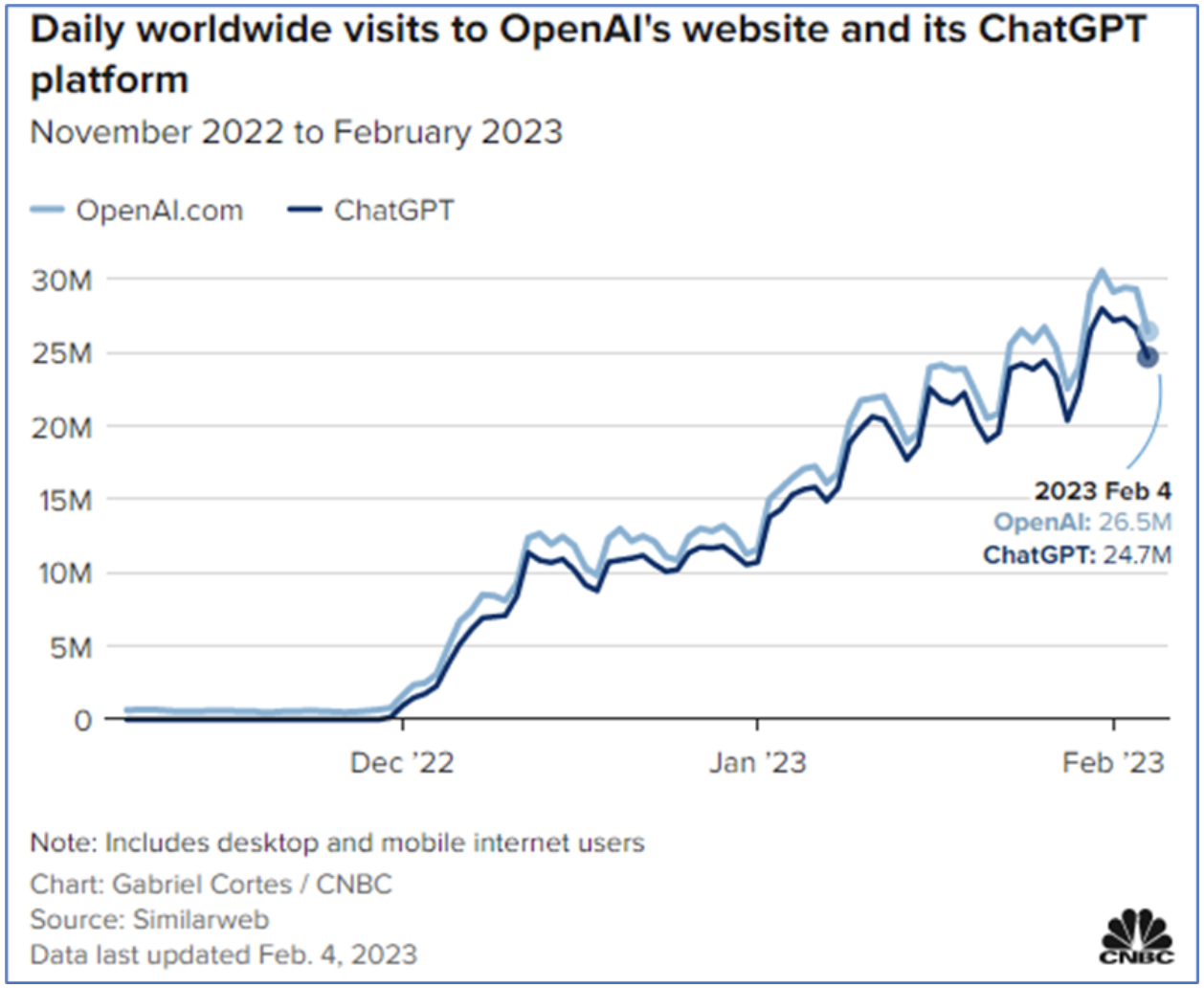
The easily accessible chatbot signed up 1 million users in five days and amassed 100 million monthly active users only two months into its launch.

To put this in context, TikTok, the erstwhile fastest-growing app, took nine months to reach 100 million users.

Daily Visits OpenAI

Source: www.cnbc.com

Many users feel that ChatGPT may eventually have the power to disrupt how humans interact with computers and change how information is retrieved. To make things more interesting, its creator, which has launched the chatbot to demonstrate what it is capable of, is just getting started.

We delve deeper to find out what the hype is all about and how investors and traders may stand to benefit from it. Continue reading "ChatGPT and AI Investing in 2023"

Higher Rates Are Here To Stay

If you believe what the inverted Treasury yield curve is saying, you must believe that, eventually — but probably sooner rather than later — the Federal Reserve will start lowering interest rates in response to the economic recession it will have caused by raising rates by more than 400 basis points in the past year.

But based on the strength of the economy despite those higher rates, it’s looking more like rates well above 4% - and possibly 5% — are going to be around for a long time to come.

But that’s not necessarily such a bad thing. For all those younger than 40, 4-5% long-term interest rates had been the norm for decades.

It’s only in this century that we’ve become accustomed to super-low interest rates, engineered by an activist Fed to insulate consumers and the financial markets from seemingly one financial crisis after another.

But that era looks to be over. And it looks like we’re managing.

Even though inflation appears to have peaked and is moving steadily downward, the Fed is likely to keep rates fairly high for quite a while, certainly the rest of this year and probably 2024 and beyond, absent yet another global financial crisis, to make sure the inflationary beast is truly slayed.

Even on the unlikely chance that the federal government defaults on its debt later this year if Congress can’t agree to raise the debt ceiling, the Fed isn’t likely to start lowering rates for a long time, despite what many investors hope and the inverted yield curve would indicate.

As we know, an inverted yield curve is when short-term rates are higher than long-term rates, which is the exact opposite of the natural order of things.

Long-term debt usually carries higher rates because a lot more can go wrong over, say, 10 or 20 years, than it can over just a couple of years or less. But that’s not what we have now. Continue reading "Higher Rates Are Here To Stay"

What’s the next AMC or GME?

Were you in the action when AMC and GME exploded?

JC Parets of All Star Charts is on the search to find the next set of big squeezes - actually, he may have already found them.

He’s going to show you the tools he’s using in a free, live event on Thursday, February 16, at 1:00 pm E.T.

Just for showing up, he’ll share six tickers that look a lot like AMC and GME did before they posted explosive gains.

Register here FREE

The tickers he’ll share come from his Freshly Squeezed Watch List, with stocks under serious technical pressure right now.

He’ll talk about catalysts, entry points, and price targets for each of them.

And he’ll show you how to get “buy” alerts and “sell” alerts so you can capture major short-squeeze gains.

We're in the very early stages of a new bull market. It’s a period of expanding participation, where just about everything is working.

And we're about to see explosive moves for no other reason than some permabears have overstayed their welcome.

Join JC at 1:00 pm E.T. on Tuesday. Click here to reserve your seat!

The INO.com Team

"Dr. Copper" Prescribes Gold

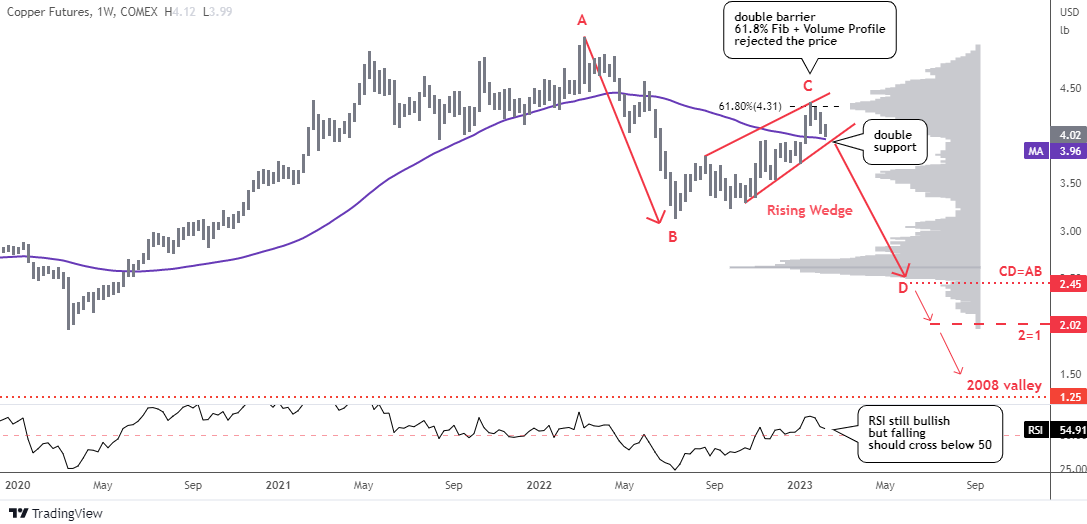
The idea behind "Dr. Copper" is that copper is a reliable barometer of economic growth, as the demand for copper tends to rise when the global economy is expanding and fall when it's contracting.

Last December, I shared my bearish outlook for copper futures titled “Fed Fears Inflation, Copper Fears Hawkish Fed”. It was based on the long term map of downward move with a current pullback playing as a junction between large 2 legs down.

The majority of readers expressed a mildly bullish stance, with the belief that the price of $3 for copper futures should hold.

The second largest group had an ultra-bearish outlook, targeting a price of $1.25 during a potential Great Recession.

Let us see in the weekly chart below the updated map.

Copper Futures Weekly

Source: TradingView

The copper futures price stalled at the same level after an earlier attempt to push below the red trendline support failed. Continue reading ""Dr. Copper" Prescribes Gold"