The Fed Needs To Practice Patience

It’s beginning to look a lot like 50 basis points.

OK, that’s not as catchy as that more famous Christmas tune. But that’s shaping up to be the likely outcome at the Federal Reserve’s next two-day monetary policy meeting December 13-14.

While inflation has slowed only a little bit since the Fed’s last rate hike on November 2 — its fourth 75-basis point increase in a row – the consensus seems to be that the Fed will moderate the size of its next hike to 50 bps, for no other reason perhaps than to see what effect its rate-raising process has had on the economy.

Indeed, the minutes of the Fed’s previous meeting at the beginning of November signaled such an outcome. “A substantial majority of participants judged that a slowing in the pace of increase would soon be appropriate,” the minutes said.

The Fed has now raised its benchmark federal funds rate by a cumulative 375 bps since it started hiking rates back in March, when the rate was at zero. A 50-bp hike in December would put the fed funds’ rate at an upper range of 4.25%.

While a slight moderation in the next increase will be welcomed by just about everyone, from Christmas shoppers to homebuyers to investors, it’s not likely to be the last, and possibly for a while yet.

That was the word handed down this week by New York Fed President John Williams. While he “did nothing to push back against expectations” of a half-point rate rise at the December meeting, the Wall Street Journal’s headline was more hawkish, quoting Williams as saying that “inflation fight could last into 2024,” meaning more rate hikes over a longer period of time than the market expects.

“Mr. Williams said he expected that rates would have to rise in 2023 to somewhat higher levels” than he had estimated back in September, the Journal said.

If the whole point of the Fed’s rate-raising regime is to try to slow the economy and thus reduce the heat under inflation, you don’t have to be a Harvard-trained economist to see that it hasn’t made that much of a dent so far and that it’s a long way from ending its restrictive cycle. Continue reading "The Fed Needs To Practice Patience"

Under $10 Health Food Company With Solid Financials

The latest data shows signs of inflation cooling down. The food index increased 0.6% sequentially in October after a 0.8% increase in September. The food-at-home index rose 0.4% in October, registering the smallest monthly increase since December 2021.

US Food Inflation

Source: Trading Economics

Do you expect food inflation to decline further next month?

View Results

Loading ... Loading ...

Over the recent past, packaged foods have grown in significance due to their easy-to-handle characteristics and hygienic properties. The global packaged food market is expected to reach $4.11 trillion by 2028, growing at a 4.5% CAGR. The market is also concurrently witnessing increased consumption of dairy products.

Packaged food company Lifeway Foods, Inc. (LWAY) produces and markets probiotic-based products internationally. Its primary product is drinkable kefir, a cultured dairy product. The company sells its products under the Lifeway and Fresh Made brand names and private labels.

The stock has gained 34.9% over the past year and 54.6% year-to-date to close its last trading session at $7.11. It is up 29.5% over the past month. Continue reading "Under $10 Health Food Company With Solid Financials"

You Better Know When To Walk Away

This week’s investor insight will make you think twice about the current stock and bond rally as we head into the end of the year.

We get a lot of questions about if the stock market has bottomed or if it is headed lower and how they can take advantage of the next Major market move. Over the next 6 to 12 months, I expect the market to have violent price swings that will either make or break your financial future. So let me show a handful of charts and show what I expect to unfold.

Let’s dive in.

We’re told that “quitters never win.” But is it always wise to stick with something when it no longer serves us or, worse, continues to harm us?

Many years ago, when Texas hold’em poker was big and online gambling was allowed in Canada, I used to run a poker league and build custom poker tables for people across the United States and Canada. I love poker, and I still play it to this very day, but the game does require skill, a proper mindset, and self-discipline. Without all three of these things, poker is pure gambling. It’s the same when it comes to active trading or investing if you lack the skills, mindset, and self-discipline.

Retired professional poker player Annie Duke, who is also a best-selling author, and decision strategist who advises seed-stage Startups, says that learning when to quit is a critical skill, especially for investors.

Annie states, “Quitting is a good thing when applied at the right time.”

If you’ve been following me for any time, then you know I follow a detailed trading strategy with position and risk management rules. As a result, you won’t find me taking random trades or trading based on emotions. Instead, you’ll find me patiently waiting on the sidelines for a high-probability trade signal to reinvest my capital.

I trade differently. I don’t diversify. I don’t buy-and-hope, and I don’t have any positions at certain times.

What I do is reinvest in assets that are rising in value. And when a particular asset stops moving higher, I give up on the position and exit it immediately. Because I use technical analysis to follow price action, we can quickly and easily determine if an asset is rising or falling. Therefore, I can step aside and let the asset fall and look for a new opportunity that is rising, or hold the falling position and ride it lower for who knows how long…

Unfortunately, most traders and investors do not understand how to read the markets, or they don’t have control of their money. They are at the mercy of what the market does or the skills of whoever controls their capital. Continue reading "You Better Know When To Walk Away"

The Thanksgiving Rally Should Not Be Trusted

The market rally during the shortened holiday trading week of November 21st-25th should not be trusted just yet.

The Dow Jones Industrial Average rose 1.78% during the week, the S&P 500 increased by 1.53%, and the technology-heavy NASDAQ grew by 0.72%.

The move higher came for several reasons, but none materially changed the economy's outlook over the coming six to twelve months.

The biggest news was from the Federal Reserve. The Fed's meeting minutes from their November 1st and 2nd meeting pushed prices higher after several Fed members expressed interest in slowing the pace of rate hikes during future meetings.

Just the fact that the Fed is talking about reducing the amount of their rate increases is significant, and many economists applaud this move. Economists are happy with this because the Feds policy changes have a lag, meaning it takes time for rate increases to show in economic data reports.

The concern has been the Fed is raising rates too quickly, and by the time the lag sets in, the economy will be in the dumps. So, slowing the pace today is a possible way the Fed can avoid running the economy into the ground. Not running the economy into the ground is the "soft landing" we often hear about when people refer to the Fed and its current policies.

Another catalyst for the recent move higher was the Consumer Price Index in October, which was up 7.7% from a year ago. This was the lowest CPI reading increase since January of this year. But, let's be honest, a 7.7% increase year-over-year is still ridiculously high inflation.

However, many economists are actually saying they are seeing inflation leveling out. We aren't yet seeing that happen with the CPI numbers because we are still looking at year-over-year comparables before inflation got out of control.

The true sign that inflation has slowed, or is still climbing, will be in 2023 when we see year-over-year comps comparing current inflation measures with the elevated inflation we began seeing in early 2022. Continue reading "The Thanksgiving Rally Should Not Be Trusted"

Crypto Update: This Major Coin Could Bounce

It is time to update the crypto charts as I spotted one strong alert in a major coin for you.

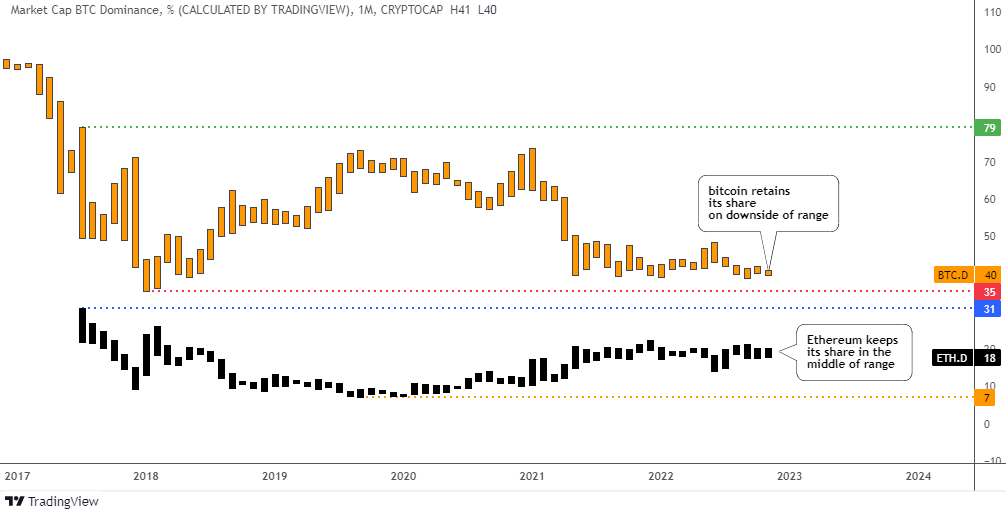
Let me start with the charts showing the balance of power in the crypto-sphere. The two majors will be first.

Bitcoin vs Ethereum

Source: TradingView

In spite of the so-called “crypto-winter” in the market, these two mastodons have kept their stranglehold on both individual and combined market share.

Bitcoin’s market share (orange bars) remains stable at 40% of the market no matter what. However, it is located on the downside of the range as other coins have taken their place in the sun. The all-time low was recorded at 35% in distant 2018.   

Ethereum’s dominance (black bars) is also solid at 18%. It saw a high market share of 31% at the beginning of its life. Currently, it is exactly in the middle of the range. It's worth noting that moving to a new proof-of-stake (PoS) mechanism didn't add power to the second largest coin so far.          

The combined market dominance is solid, hovering around 60%.

Let us move on to the rest of the top ten list excluding stable coins. Continue reading "Crypto Update: This Major Coin Could Bounce"