Growing Dividends is the Secret to Wealth

For the dividend-focused investor, nothing is better than one of your stocks announcing a dividend increase. So you can be assured that this Seeking Alpha headline caught my eye: 100 REIT Dividend Hikes.

Investing for dividend growth is a sure-fire way to build your wealth over the long term. The article explained that 100 real estate investment trusts (REITs) had increased their dividend rates so far in 2022. Last year there were 120 rate increases in the REIT sector.

This many increases bodes very well for one of my favorite investment strategies…

REITs own commercial properties or invest in real estate-related debt securities. The Nareit includes 213 publicly-traded REITs in its All REITs Index. These companies operate as pass-through businesses, which means they don’t pay corporate income taxes as long as they pay out at least 90% of net income as dividends to investors. The REIT dividend rules make the sector a good place to look for attractive dividend-paying stocks.

A few years ago, I researched the returns from growing dividend stocks. I found that investors earn an average annual compound total return that, over the long term, will be very close to the average dividend yield plus the average dividend growth rate.

For example, if an REIT (or shares of any stock with growing dividends) has an average yield of 4% and the dividends grew by an average of 10%, investors in that stock will have seen a 14% compound annual total return.

While the shorter-term market cycles will pull returns above and below the expected results, owning a dividend growth stock for ten years or more will push the returns very close to mathematical expectations.

When researching dividend growth stocks, look first at the historical dividend growth rate. You want to see the average growth rate and how many years the company has been increasing its dividend. For example, industrial property REIT Prologis, Inc. (PLD) has increased its dividend for eight consecutive years with an average of 10.5% dividend growth. Add in the current 2.5% yield, and you have a low-teens return potential. Continue reading "Growing Dividends is the Secret to Wealth"
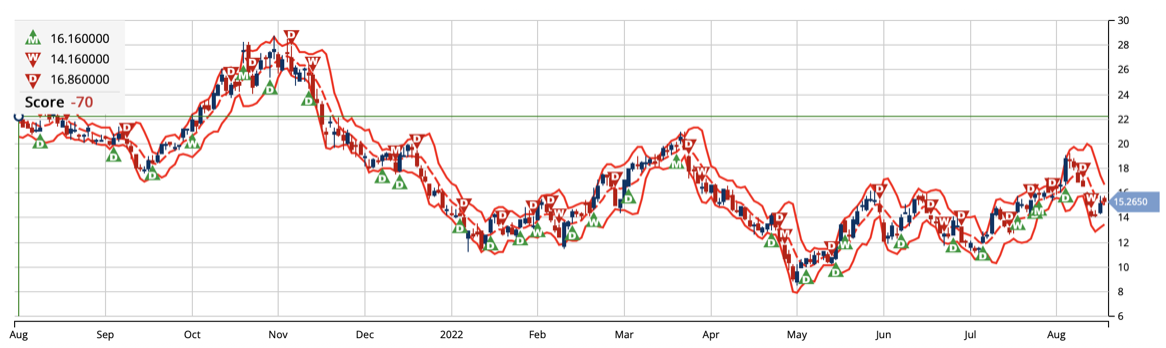
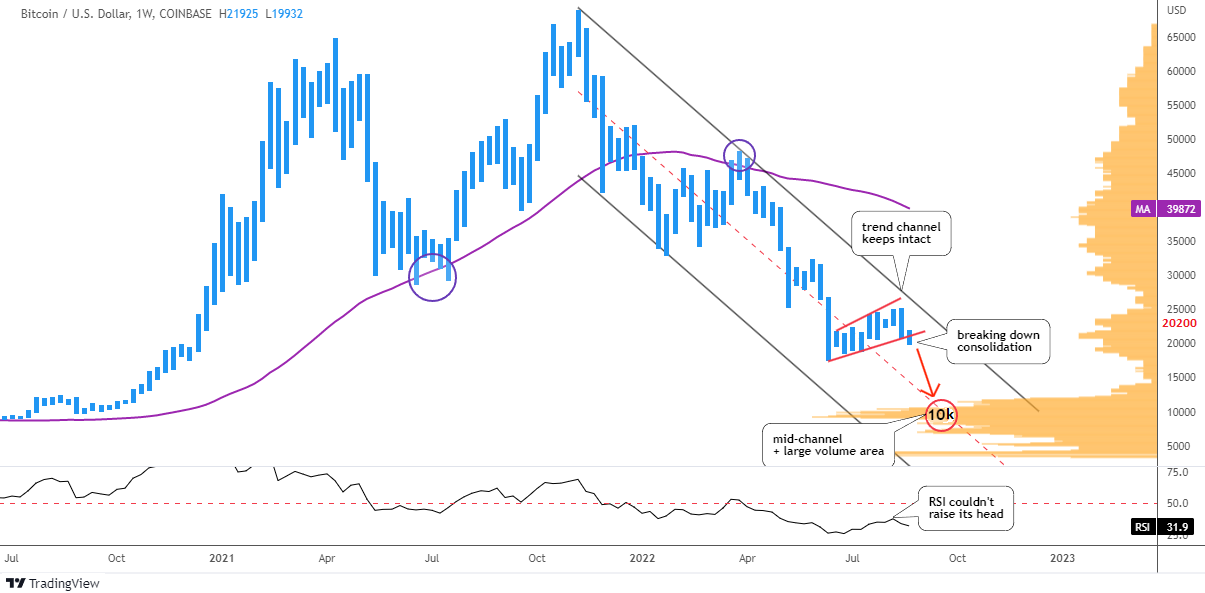
Chart Spotlight: ChargePoint Holdings Inc. (CHPT)

With demand for electric vehicles on the run, investors may want to keep an eye on charging stocks, like ChargePoint Holdings (CHPT).

Remember, not only do global leaders want millions of EVs on the road, California is about to prohibit the sale of gas-powered cars.

“The rule, issued by the California Air Resources Board, will require that 100 percent of all new cars sold in the state by 2035 be free of the fossil fuel emissions chiefly responsible for warming the planet, up from 12 percent today. It sets interim targets requiring that 35 percent of new passenger vehicles sold in the state by 2026 produce zero emissions. That would climb to 68 percent by 2030,” according to The New York Times.

For that to become a reality, we need EV charging stations – lots of them.

In fact, the Biden Administration already announced that all 50 U.S. states, Washington, D.C., and Puerto Rico have all submitted plans for a national EV charging network.

“These plans are required to unlock the first round of the $5 billion of Bipartisan Infrastructure Law formula funding available over 5 years to help states accelerate the important work of building out the national EV charging network and making electric vehicle charging accessible to all Americans,” according to the U.S. Department of Transportation.

ChargePoint Holdings Stock Technically Oversold

It's all part of the reason why oversold shares of CHPT are starting to pivot higher. All after pulling back from about $19 to $14 thanks to a broad market pullback. Even better, the stock is oversold on Williams’ %R, Fast Stochastics, and RSI.

CHPT Chart With Trade Triangles

Source: MarketClub

Continue reading "Chart Spotlight: ChargePoint Holdings Inc. (CHPT)"

Bitcoin and Ethereum: No Safety Net

Earlier this month, I updated on the crypto market with a title, 'It Ain't Over Yet". I considered the recent strength in the main cryptocurrencies a "dead-cat bounce" within a classic sideways consolidation with a high probability of resuming collapse.

This time, I spotted new signals as the chart moves to the right building new bars over time. Let us start with the main coin in the weekly chart below.

Bitcoin Weekly Chart

Source: TradingView

The price of Bitcoin moves within large bearish trend channel (black). The top of above-mentioned sideways consolidation within red trendlines did not even approach the resistance, it stays intact.

The RSI indicator could not raise its head to test the “waterline” of 50 level. This means that the market has considered this short-term strength as a "dead-cat bounce" as well.

The chart bar of last week has punctured below the red support. This is a harbinger of another drop. The main coin indeed is looking into the abyss as the strong support appears only after the price halves down. The largest area of the Volume Profile histogram (orange) is located between $9k and $10k. The mid-channel (red dashed) fortifies that support with its intersection.

Your biggest bet last time was the drop of the Bitcoin down to $12.2k, where the second leg down is equal to the first one. It almost coincides with the above-mentioned double support.
The next volume area is located at the $4k level and this option was your least favorite.

This time I added the simple moving average (purple) covering the preceding 52 weeks (1 year). It has been offering a strong support to the price starting from 2020. This year it has flipped to become a strong resistance after the price has dropped below it. The $40k level is the barrier to break to confirm the new bullish cycle.

A rather interesting situation has developed for the main coin. The price should either half down to find support or it should double up from this level to crack the bearish cycle. Continue reading "Bitcoin and Ethereum: No Safety Net"

3 Well-Positioned Momentum Stocks

The stock market has witnessed significant volatility due to several macroeconomic and geopolitical headwinds this year. With inflation remaining elevated and the possibility of the Fed raising interest rates aggressively, the market is expected to remain volatile.

Amid this uncertain environment, a good strategy could be buying stocks that have gained momentum recently and are well-positioned to maintain the same based on their strong fundamentals and growth prospects, irrespective of the market movements. Investors’ interest in momentum stocks is evident from the Invesco DWA Momentum ETF’s (PDP) 8.2% returns over the past month.

PBF Energy Inc. (PBF), Global Partners LP (GLP), and GeoPark Limited (GPRK) have shown no signs of slowing down and are currently trading at discounts to their peers.

Strong fundamentals should help these stocks maintain their momentum in the upcoming months. So, it could be wise to invest in these stocks.

PBF Energy Inc. (PBF)

PBF is a petroleum refiner and supplier of gasoline, diesel fuel, jet fuel, unbranded transportation fuels, heating oil, petrochemical feedstocks, lubricants, and other petroleum products. The company operates through two segments: Refining; and Logistics.

On July 28, 2022, PBF announced the acquisition of the remaining public stake in PBF Logistics LP. As of July 22, 2022, it owned approximately 47.7% of the outstanding common units of PBF Logistics.

Tom Nimbley, PBF Energy’s and PBF Logistics’ Chairman and CEO, said, “This transaction will ultimately allow us to simplify our corporate structure and eliminate administrative, compliance, and cost burdens of running a separate public company. Following consummation of the merger, we believe that the combined company will have a significantly enhanced financial profile.”

For the second quarter, which ended June 30, 2022, PBF’s revenues increased 104.1% year-over-year to $14.08 billion. Its income from operations rose 1,057% from its year-ago value to $1.71 billion.

The company’s adjusted net income increased 2,416% year-over-year to $1.21 billion, while its EPS grew 2,374.3% from the prior-year quarter to $9.65. Also, its adjusted EBITDA grew substantially from the year-ago value to $1.91 billion.

In terms of forward non-GAAP P/E, PBF is currently trading at 1.95x, 74.9% lower than the industry average of 7.76x. Its forward EV/S multiple of 0.16x is 91.9% lower than the industry average of 1.95x. In addition, the stock’s forward EV/EBITDA and EV/EBIT ratios came in at 1.85x and 2.21x, compared to the industry averages of 5.67x and 8.64x, respectively. Continue reading "3 Well-Positioned Momentum Stocks"

The Excess Phase Peak Pattern

The Excess Phase Peak pattern is a very common transitional phase for the markets where psychology and economic trends shift over time. Global markets typically require periods of pause, reversion, or a reset/revaluation event to wash away excesses.

We’ve seen these types of setups happen near the DOT COM and 2007-08 market peaks. What happens is traders are slow to catch onto the shifting phases of the Excess Phase Peak and sometimes get trapped thinking, “this is the bottom – time to buy.”

The reality is that as long as the individual phases of the Excess Phase Peak continue to validate (or confirm), then we should continue to expect the next phase to execute as well. In other words, unless the Excess Phase Peak pattern is invalidated somehow, it is very likely to continue to execute, resulting in an ultimate bottom in price many months from now.

The 5-Phases Of The Excess Phase Peak Pattern

The Excess Phase Peak Pattern starts off in a very strong rally phase. This rally phase normally lasts well over 12 to 24 months and is usually driven by an extreme speculative phase in the markets.

Once a price peak is reached and the markets roll downward by more than 7~10%, that’s when we should start to apply the five unique phases of the Excess Phase Peak Pattern. If each subsequent phase validates after the peak, then the Excess Phase Peak Pattern is continuing. If any phase is invalidated, then the pattern has likely ended.

For example, if we start by completing Phase #1 & #2, then the market rallies to a new all-time high – that would invalidate the Excess Phase Peak Pattern.

Here are the Phases of the Excess Phase Peak Pattern:

  1. The Excess Phase Rally Peak
  2. A breakdown from the Excess Phase Peak sets up a FLAG/Pennant recovery phase.
  3. Sets up the Intermediate support level – the last line of defense for price.
  4. Price retests #3 support & breaches the support level – starting a new downtrend.
  5. The final breakdown of the price is below the Phase 4 support level. This usually starts a broad market selling phase to an ultimate bottom.

Continue reading "The Excess Phase Peak Pattern"