Is Google A Buy?

Today's post is by Jeff Braun of The Market Guardian. Today Jeff is taking a look at the giant we all know as Google. As hard as it seems to find a long position these days, Jeff thinks there may be one right under our noses. So sit back and enjoy as Jeff analyzes the giant.

===================================================================
Google remains a global leader in search, internet advertising! It was just announced today that Google Inc. (GOOG) expanded its lead in the U.S. Internet search market in February at the expense of rivals Yahoo Inc., Microsoft Corp. and Ask.com, according to data published Tuesday by Hitwise Pty. Ltd. There is only a small amount of non-financial companies with $10+ billion of net cash on the books. The optionality of that war chest in this environment is huge. That plus core business spells attractive here to me.

Google (GOOG) may soon see increased federal sales as one of the beneficiaries of an expected uptick in federal spending on technology. It is well known that Federal agencies are testing Google tools as we speak and a key fan is Obama’s new tech hire!

Google (GOOG) just continues to find new markets to enter and in each new market they find ways to be more efficient and a better value than industry competitors such as print media and ad agencies. They will enable the Internet to compete in markets and methods we haven’t yet conceived. And the markets they are already attacking are huge providing abundant growth opportunities well into the future. I am convinced the conversion process of brick and mortar to digital has just begun.

I am thinking Twitter will get sold for $150m to $250m in the next 24 months. Will Google be the one buying them? Google has a short message for those wondering whether the search giant will soon buy the micro-blogging site Twitter: CEO Eric Schmidt “unlikely”

Here are some facts about Google (GOOG)

The historical high for (GOOG) was 741.79 on the 6th of November 2007. It has been 470 days since the historical high price.

The lowest price was 100.01 on the 3rd of September 2004. It has been 1629 days since that low price.

The largest volume day was the 20th of January 2006 when 41,182,900 shares were traded. It has been 1125 days since that big volume day.

The lowest volume day was the 24th of December 2007 when only 1,628,300 shares changed hands. That was 421 days ago.

Between 275-325 It may be time to start accumulating shares. 2-4 years from now I think you will be VERY happy.

Best of luck in the markets,

Jeff Braun

www.themarketguardian.com

How to tell or refer a friend (short video)

===================================================================

What do you think? Is it time to consider a long position in GOOG? Be sure to comment and let us know your thoughts. For more on Jeff be sure to visit The Market Guardian.
New Downside Targets For Dow, S&P - IBD Article

BY TRANG HO
INVESTOR'S BUSINESS DAILY
Posted 3/9/2009

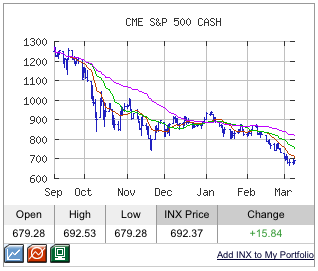
Now that the Dow and S&P 500 have blown through their 2002 bear-market lows and regressed to levels not seen since 1996, technical analysts are revising their targets downward.

Based on Fibonacci and Elliott Wave theory analysis, the next level of chart support for the S&P 500 would be 640, according to Mark Arbeter, chief technical strategist at Standard & Poor's. That's down 5.40% from Monday's close of 676.53.

If the S&P 500 breaks below 600, Arbeter sees the next support level at 557, or down another 17.67%. That level also meets up with an uptrend line connecting the 1932 bear market low to the troughs from 1942, 1974 and 1982.

Although chart support levels show areas of significant buying in the past, and the uptrend line has served as a floor for the past 77 years, Arbeter says the behavior in this market differs from other bears.

"We're not seeing enough fear in the options market. We haven't seen a big increase in the put-call ratio nor a spike higher in the volatility indexes," Arbeter said. "Until we start seeing more fear in the options market, we won't get to the low."

Unlike in the past, the market appears to be a lagging indicator rather than a leading one.

"It's not properly discounting the bad news that keeps coming out," Arbeter added. "All the surprises over the last year have been downside surprises. The fundamental community continues to play catch-up on the downside."

Downside Of Dow

The Dow closed Monday at 6547.05, down 53.89% from its all-time peak of 14,198 on Oct. 12, 2007. The next target for the Dow is 6000, down 8.37% from Monday's close, says Louise Yamada, managing director at Louise Yamada Technical Research Advisors.

Her secondary target is 4000. She sees the S&P falling to 400-600. It could take a week, a month, a year or more to reach the target.

"Our up/down and volume momentum indicators have been oversold since May, which suggests there's still selling pressure coming into the market even when there are rallies," Yamada said. "The market is suffering from deleveraging of 30 to 40 times leverage that took place over the past few years."

The bottoming process between 2002 and 2003 took at least a year, during which technical indicators improved. But there are no signs of such improvement now, Yamada says.

Today's stock market is commonly referred to as the worst since the Great Depression. If the 1930s bear market — in which the Dow plunged 89% — serves as a road map, we're halfway to the light at the end of the tunnel. That bear market lasted 34 months from peak to trough. This bear is in its 17th month.

The market's recent action suggests hope has waned that government stimulus plans will keep this bear market from being as bad or lasting as long as the 1930s bear.

Uptick Rule Consequences

In fact, some government action may be making it worse. Eliminating the uptick rule for short selling on July 6, 2007, has sent the market tumbling harder than in the past, argues Adam Hewison, co-founder of Marketclub.com.

The uptick rule for short selling, established by the SEC in 1934, required that every short sale be entered at a price higher than that of the previous trade. It aimed to prevent short sellers, who make money when stocks fall, from adding to the downward pressure of a falling stock. "With the uptick rule, (short sellers) couldn't pummel companies as quickly," Hewison said.

He projects the Dow will fall to 5000, down 23.63% from Monday's close. He sees the Nasdaq composite at 1000, down 21.18%. He expects the S&P 500 to fall to 500, down 26.09%.

Hewison's long view: The market will sputter sideways until the next super bull cycle starts sometime between 2018 and 2020. "This isn't going to be the V-shaped turnaround that everyone thought it was going to be," he said.

---

See Original Post Here: http://www.investors.com/editorial/IBDArticles.asp?artsec=28&issue=20090309
Investors Business Daily

How to tell or refer a friend (short video)

A Bad Trade Is Like A Dead Fish ...

One of the most important tools that a trader possesses is his or her mind. Attitude can either make or break you as a trader.

To become a successful trader it begins with believing in yourself and having a winning attitude.

Everyone wants to be a winner, at least they think so. Unfortunately, most are not willing to perform the tasks necessary to become a consistent winner.

Winners generally achieve success by being focused on a goal. Being focused allows winners to remain committed to the tasks at hand. Most winners perform a lot of hard work, including a willingness to deal with sometimes mundane duties. Most of all, winners perform with an "I am responsible for both my failures and successes" attitude.

So, where does the would-be trader start to become a success? By focusing on the tasks at hand. Most of all, treat trading as a business. And, as in any business, money management is critical.

Money management, next to trend, is probably the aspect of trading most overlooked by smaller investors. Man, by nature, is an optimistic creature and the amateur trader often acts instinctively. Unfortunately, this instinct or optimism is often the undoing of the smaller trader.

When a person enters a trade, he does so with the hope that it will be a winner. When the position goes against him, he keeps thinking (or hoping) "it will come back." He knows he should have a stop in place, but hope keeps telling him to stay just a little longer since everybody knows, "you always get stopped out the day the market turns." Eventually, hope turns into frustration, desperation and, finally panic which prompts the trader to issue a GMO (get me out) order.

If the trader hasn't learned his lesson by this point, he develops the "I have to get it back" syndrome. He generally rushes into another poorly planned trade, throwing good money after bad.

Winners show several different characteristics. They enter the market knowing they can be wrong and, in fact are wrong as often as they are right. They have learned markets don't run on hope. They understand markets tell them when they are right or wrong. When a trader is losing money and getting worse, the market is telling them to get out.

Bad Trades

A bad trade is like a dead fish:The longer you keep it, the worse it smells.

Good Trades

When a trade is making money, the market is telling them they are right and to let the position ride.

Don't ever do this ...

Winners don't add to, or "average", losing positions. They dump the trade and go looking for a new opportunity. Successful investors may add to the winning trades. When ahead, they press their advantage while remembering that at any time the market can turn on them and prove them wrong.

In trading keep your mind clear and do not get emotional about a trade. Remember you are not married to a stock rather you are in the dating game.

Learn more about common sense trading.

Avoid those dead fish.

Adam Hewison

President, INO.com

Co-creator, MarketClub

How to tell or refer a friend (short video)

Free Video Seminar - "Applying Technical Methods to Today's Trading"

Excerpt from John Murphy's seminar, “Applying Technical Methods To Today's Trading,” offered for on INO TV Free...

---

For those of you that trade the futures markets, there are a lot of other things outside the future markets that you should be following. But, I guess my bigger message is... for those of you that aren't in the futures markets, whether you trade them or not, the futures markets have a tremendous impact on what happens in the other markets.

I keep pointing out to the Wall Street crowd for example, that if you're going to trade stocks, you have to know what's happening in the futures markets, because they affect inflation, they affect interest rates, they affect stock groups, and they play a tremendously important part in the whole financial spectrum.”

---

In this seminar, Murphy shares his non-traditional methods for selecting markets to trade based around commodity trends and leading indicators. His intermarket analysis is put in action to show just how commodities can put a drag or a rocket under a stock.

Murphy is a former CNBC analyst, the principal of JJM Technical Advisors, and author of Technical Analysis of the Futures Markets (1986), Intermarket Analysis (1991), and The Visual Investor (1996).

Don't miss “Applying Technical Methods To Today's Trading.” This seminar is presented by INO TV, click here to watch.

Enjoy,

Lindsay Thompson
Director of New Business Development
INO.com

PS- If you've already signed up for INO TV free, or if you have an account with INO, just enter your email and password into the box to avoid reregistration.

How to tell or refer a friend (short video)