5 ways to improve your trading results

The "90 Second Trading" SeriesTrading videos that teach you how to trade the right way


I created "90 Second Trading" as a quick and easy way for you to understand how you can benefit from my many years of real world trading.
Choose an image then click to play

STOCKS

FUTURES

FOREX

GOLD

CRUDE OIL

Check back for more trading videos on Traders Blog


If you enjoyed this series of trading videos, be sure to check out our next video series titled, "TRADERS WHITEBOARD" In this educational series, we cover the key elements of trading that are based on the core principals of every successful trader.


Watch with our compliments.

Be Our Guest
We welcome syndication of our content in your blog or on your trading website. Please feel free to use our content with attribution -
more details here to syndicate our content

Traders Toolbox: Learning Options Part 2 of 4

Many people like options because they believe them to be less risky than futures. Options sometimes offer reduced risk, but usually at the cost of reduced profit potential.

One drawback of options is that a trader must consider market speed (volatility) as well as direction. Traders who buy or sell options outright to profit from up or down moves in the underlying market can find themselves fighting an uphill battle against volatility and time decay. With futures, if you're right about market direction, you'll win. With options, you can be right about the market and still lose.

If a market is trading at 200 and you buy a 210 call expecting a rally, you'll still lose on the trade if the market only rallies to 205 by expiration; your 210 call will be worthless. The same thing would happen even if the market rises as high as 220, but does so one week after expiration. In each case you would be right about market direction but would not profit.

The advantage of options is their flexibility. Because of the variety of strike prices and expiration dates a trader can choose, options naturally lend themselves to spreading strategies (simultaneously buying an selling different options), accommodating varying views of market direction and risk levels. Traders can design option strategies that will profit if the underlying market goes up or down, moves in either direction by a certain degree or remains unchanged.

Options also allow you to profit without predicting market direction because of time decay and fluctuation in volatility that increase and decrease premium. For example, a trader might sell as out-of-the-money call on a relatively volatile futures contract he thinks will fall. Over then next two months, however, the market does not fall, but gradually moves higher, trading in a narrow range (but still below his strike price). The trader was wrong about market direction, but finds the combination of decreased volatility and time decay has eroded the value of his option to the point that he can buy it back at a profit (or perhaps hold it until expiration).

Part 3 Will Be Posted On November 14th, 2008. So come back soon!

"Saturday Seminars" - Futures Strategies for Stock Traders

In recent years, Charles Le Beau has been doing a great deal of research on stock trading and has found that knowledge of futures strategies can be extremely valuable to stock traders, particularly in today's volatile markets. In his workshop, Chuck will explain how various technical trading strategies, originally developed for futures traders, can easily be applied to short term stock trading. This presentation will present reliable entry methods and emphasize the importance of good exits. Futures traders and stock traders interested in technical analysis should find his ideas to be simple, practical and highly profitable.

Chuck Le BeauFor more than twenty years Chuck Le Beau was employed by E. F. Hutton where he served as Vice President, Regional Futures Director. He is a registered Commodity Trading Advisor (CTA) and a noted developer of trading systems. His book on futures trading, Computer Analysis of the Futures Market, is considered a modern classic. His new video, A New Look At Exit Strategies, reveals the secret to gaining bigger profits in your trading...stocks, futures or options.

---

Saturday Seminars are just a taste of the power of INO TV. The web's only online video and audio library for trading education. So watch four videos in our free version of INO TV click here.

INO TV

How low is low for crude oil?

I'm sure as a trader you've heard the expression, the "trend is your friend." That was never more true than today as crude oil (NYMEX_CL) crashed to new lows and the stock market resumed its downward trend.

Today we are focusing on crude oil and the reason why it fell to new lows. We're also going to be looking at all of the "Trade Triangle" signals that we have received on crude oil since last July. The video is about nine minutes long and I highly recommend watch it, simply because it shows you just how powerful trends can be.

The video also shows you why price action is more important than fundamentals. If you have a few minutes, please take the time to watch the video and learn how the markets really work.

Since Barack Obama was named President elect, we can see how the markets have reacted at least in the short-term. Maybe not a reflection of Obama's potential as a president, maybe a reality check for problems in the economy. Not even the record cut in interest rates by the UK could help the markets today.

Enjoy the video and please let us know if you've found it to be helpful and useful in your own trading plan. You can reach us online or you can call us directly at 1-800-538-7424 and someone from a support staff will be able to answer any questions you might have.

Every success in life and in trading,

Adam Hewison
President, INO.com
Co-creator, MarketClub

Traders Toolbox: Learning Options Part 1 of 4

There are four components to an options price: underlying contract price, intrinsic value ( determined by strike price), time value (time remaining until expiration) and volatility. (A fifth element, interest rates, also can affect option prices, but for our purposes is unimportant.)

Intrinsic value refers to the amount an option is in-the-money. With Eurodollar futures at 95.55, a 95.00 call has an intrinsic value of .55. The more an option is in the money, the greater its intrinsic value. At-the-money and out-of-the-money options have no intrinsic value.

Options are referred to as "wasting" assets because their value decreases over time until it reaches zero at expiration, a process called time decay. Time value refers to the part of an option's price that reflects the time left until expiration. The more distance an option's expiration date, the greater the premium because of the uncertainty of projecting prices further into the future.
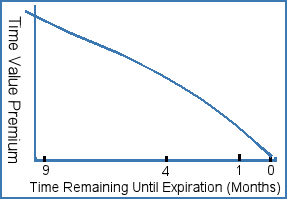
Considering two equivalent call options. With May corn futures at 232 1/4, July corn futures at 236 1/4 and 10 days left until May corn options expire, a May 230 call might cost 2 3/8 while a July 234 call costs 6 1/2, even though they are equally in-the-money.

Volatility, perhaps the most important and most widely ignored aspect of options, refers tot he range and rate of price movement of the underlying contract. The "choppier" the market, the higher the price that will be paid for this unstability in the form of higher option premiums.

Volatility usually is expressed as a percentage, and is comparable to the standard deviation of a contract. Higher volatility means higher premiums. Lower volatility means lower premiums. A trader familiar with the volatility history of a contract can gauge whether volatility at a given time is relatively high or low, and can profit from fluctuations in volatility that will in turn increase or decrease option premium.

The Black-Scholes price model, first introduced by Fischer Black and Myron Scholes in 1973, is the most popular theoretical options pricing model largely because it was the first relatively straightforward arithmetic method for determining a fair value for options.

Part 2 Will Be Posted On November 10th, 2008. So come back soon!