"Saturday Seminars" - Researching Your Trade

Various technical indicators my be used to complement and refine such strategies. One little-known but exceptionally useful technique is Howe's Limit Rule, applicable in especially volatile markets where there is so much opportunity - and risk.

Linda believes strongly in market tendency patterns and the predictability of price direction, though not magnitude. Prices tend to form a distinct three-day swing trading pattern, one which consistently repeats itself in tradable fashion.

Linda will discuss why this swing pattern sets up, how to recognize it, the tendencies of the underlying theories, and the philosophy behind trading it. She will then teach a sound method for trading this cyclic phenomenon, one which builds confidence to trade any market on any day.

Finally, Linda will illustrate how, based on these patterns, you can develop mechanical systems that are applicable to various length market periods. This presentation will give you a new perspective on price behavior and chart patterns.

The study of price behavior lends itself to various avenues of research. Can correlation studies project future price movement? What similarities exist in the price behavior of different markets, for instance, futures vs. equities? This workshop is intended to help the intelligent trader make good decisions.

Rashcke explores the importance of how to research your trades through...

  • Historical (Seasonal) Trading
  • Historical Correlation Studies
  • Researching Derivatives

Linda Raschke has been a full-time professional trader for over 20 years. She began her trading career on the Pacific Coast Stock Exchange and later moved to the Philadelphia Stock Exchange. Linda was written up in Jack Schwager's book, "The New Market Wizards" and in "Women of the Street" by Sue Herera. In 1995, she co-authored the best selling book "Street Smarts - High Probability Short Term Trading Strategies." Linda continues to trade every day.

---

For more audio and video seminars please visit INO TV

Using Ratio Charts to Gain an Edge

Today’s guest blogger comes from Gary of Biiwii.com, a site that provides top notch analysis and commentary on stocks, currencies, commodities and bonds. I'm a frequent reader of the blog and HIGHLY encourage you to check out Gary's site for more analysis.

===========================================================

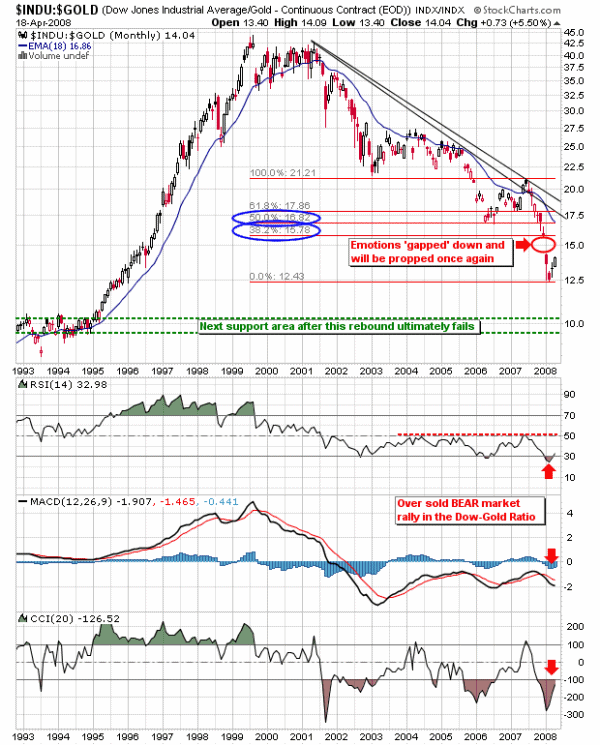
Long time readers of the Biiwii.com blog know that I rely on ratio charts to the max. In fact, I find these ratios between different markets to be absolutely vital to being on the right side of the trade where macro themes are concerned. A recent example is the Dow/Gold ratio, which allowed me to navigate the oncoming - and entirely predictable - rally in stocks (both in nominal terms and in 'real' terms as measured in gold) that began in the fear filled days of March. Our April Letter from the main website, Reset/Recalibrate explained the process by which market sentiment needed to be reset. Here is the monthly ratio chart that was used in the letter:

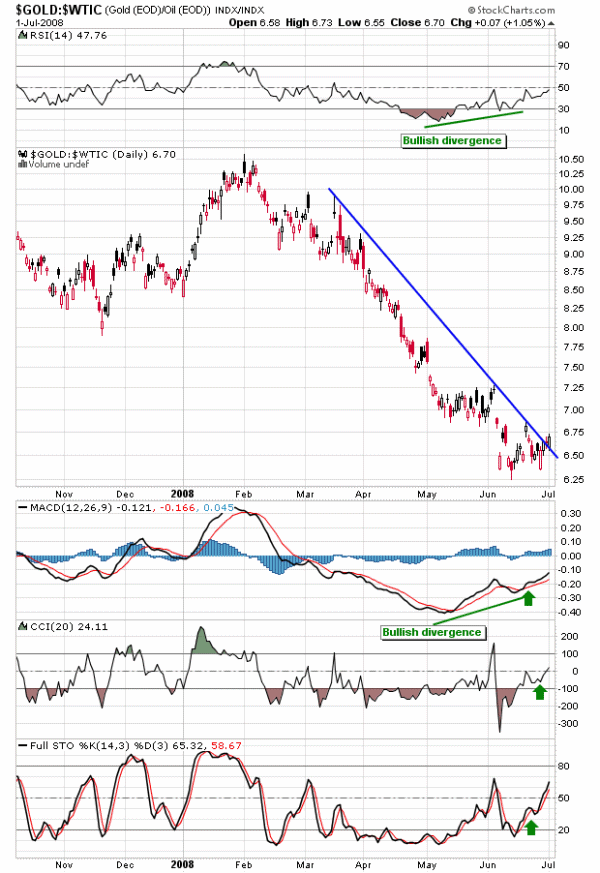
Of interest now is the Gold/Oil Ratio, which appears to be in the bottoming process amid bullish divergence by RSI & MACD. This is an absolutely vital ratio to gold stock traders as oil is a major cost input to mining operations and with the likelihood of the ratio bottoming, gold miners' bottom lines stand to benefit as their product (gold) begins to outperform one of their major cost drivers (oil). Here is a current daily chart showing the status of the ratio. Gold, while having been pummeled in oil terms recently (along with nearly everything else), may well turn up from here in terms of crude:

I also routinely use the Gold/Silver Ratio to gauge general market confidence or lack thereof, along with more traditional sentiment indicators like the VIX and Put/Call Ratios. Other ratios which have appeared on the blog have included the S&P500/Nikkei Ratio, NDX/Dow and even SOX/NDX. All provide hints as to sentiment and/or macro-fundamentals and hence future market direction.

To summarize, you can trade any market but it is very important to be aware of the major trends and turning points between different markets and assets classes so that you may be aware of whether or not you are on the right side of the trade in the bigger picture. As traders and investors, we need every edge we can get.

===========================================================

Read more Biiwii.com TA & Commentary by Gary at Biiwii.com

The Symmetry In The Market Is Incredible

Today's guest blogger comes from the popular MYSMP.com site and it's creator Kunal Vakil. Kunal is a man who is plugged into the market literally!! I asked him to give his unique perspective on the market...and it's symmetry.

===========================================================

First off, I want to thank Adam and Trader's Blog for allowing me to post my materials on Trader's blog.

Today, I want to share my thoughts on the S&P 500 and where I see it heading before this bear market is over. And, yes, we are in a bear market. Not only has the Dow Jones already fallen 20% off its highs of last year with the S&P 500 nearly there as well, but the price action in the broad markets has been that of a bear market. It is typical to see sharp sell-offs and ferocious bear market rallies which make even the bears capitulate, all before the market begins a move lower again. Big volume down, and low volume up. This is precisely what we have seen since the top at 1576.09 on the S&P back in October of 2007.

Now, let's talk about the culprit a little. We know that the banking index has been decimated with the exacerbating write-downs and credit quality issues due to the unscrupulous practices of many bankers and loan brokers. Many banks have lost over 50% of their value, and the beating continues. As we review the daily charts of the major banks, one can easily see a pattern that is definitive of a bear market, lower highs and lower lows. From looking at these charts, it is my firm opinion that the worst is not over yet. We are probably half way through the write-down cycle. Now what does this mean for us as traders?

Well, here is what I am watching very carefully. I want to see some of the major banks (ie. C, LEH, MER, MS, GS, FNM, FRE) start to show signs of strength relative to the entire market. I want to start seeing them make higher lows and higher highs. I want to see a base building process develop within these stocks. I want to see volume lighten up to the downside and increase to the upside. When these developments start to take place, we can start to look for long entries in these stocks. Is the US banking sector going to fall to 0? NO!, but don't try and catch a falling knife, stay patient. Remember, Cheap can always get cheaper...and it has.

Moving back to the S&P 500, I want to now walk you through a few charts that will illustrate where I think this market is headed by the Sept./October timeframe. This period historically provides some dynamite buying opportunities and it looks like this year wont disappoint.

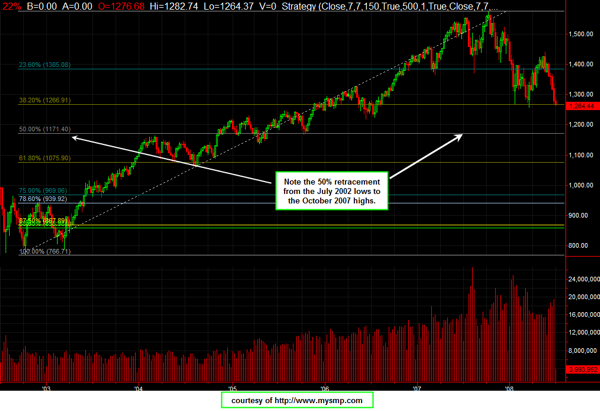
On longer term charts, especially index charts, Fibonacci retracements and extensions offer good points of support and resistance. Here you can see that the S&P has a major support area at the 1171 area. I will show you why this is a very important level.
Our next chart is another weekly chart of the S&P, however, this time notice the Fibonacci extension. Notice the initial move off the top and the subsequent rally off that reaction low created an extension target between 1353 to 1248. Notice how the 1.382 and 1.618 levels held the two lows set in January and March and the market showed its weakness by extending down to the lower end of that zone.
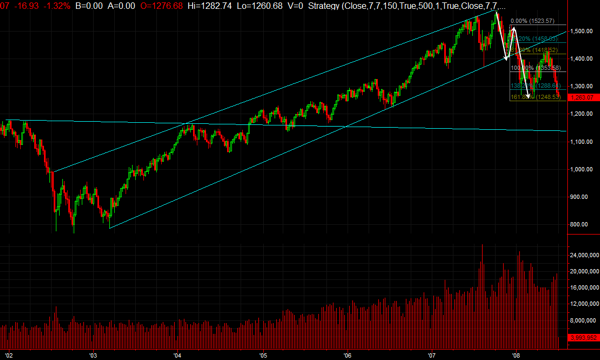
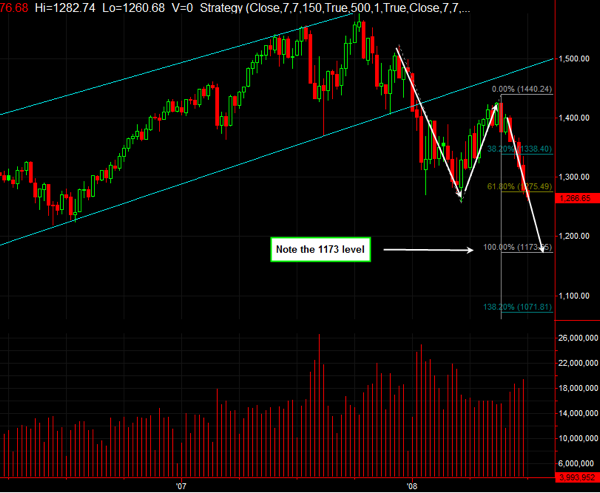
The next chart shows you the current extension that we are watching now. It starts with the December 2007 highs going down to the March lows and the retracement up is at the May highs around 1440. Now, notice the extension targets. The 100% extension takes us down to 1173.65, very close to the 50% Fibonacci retracement level in our first chart.
One final point in terms of symmetry that I want to make here. Back in 2003 when we were looking for a breakout in this market, the 1165 to 1175 range was a key pivotal area we watched. It represented the neckline of a massive W bottom, which some would call an inverted head and shoulders. This area is going to provide massive support on the way down.
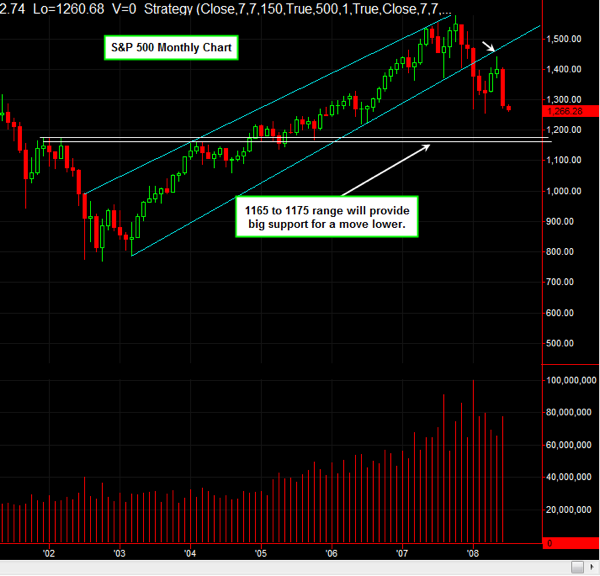
All things considered, I am looking for another 100 point drop in this index before I can see a true bottom being put in. Remember, you want to watch the leaders on the way up and the way down. The banks have been providing that leadership and are showing no signs of letting up. Therefore, we are not bottom picking here. The speculative soul in me believes that the shoe is going to drop with one of the big banks out there. Time will tell but until then, be safe and protect your downside risk.

All the best,

Kunal Vakil

MYSMP.com

How to trade successfully in any market

Happy Q3.

In this short video we will be looking at five key components that you need to be successful in your trading in Q3. The ones we have picked out today are not on every pro trader's list, so I think they will surprise you.

We consider these five components to be incredibly important to anyone's trading success, most of all yours.

If you have the time check out our other Traders Whiteboard lessons. We now have a total of eight lessons that you can benefit from and they're available here.

All the best in trading,

Adam Hewison