Traders Toolbox Lesson 3: Change is inevitable

The most powerful ally you can have in trading and analysis is the trend. A market may stay in a given trend for a long period of time, but change is inevitable.

Since change is inevitable, it is important to be able to identify when or where a market may turn. I use an analytical tool called terminal areas to identify a time or a place in the market where a trend potentially may change. Terminal areas are the single most powerful tool I possess.

The word "terminal" is defined as, at or reaching an end. It can also mean a stopping point. The importance of terminal areas is that these are the only places where a market can make a major turn. Very simply, a market cannot make a major change in trend unless it is in a position to do so. When a terminal area is reached, and if the end of the trend is at hand, the old trend will die and a new trend will be born. However, reaching a terminal area does not mean a trend change is automatic. Since terminal areas also serve as a stopping point, a market may experience an interruption of trend instead of a change in trend. An interruption of trend will develop as a congestion area or a sideways pattern, preceding continuation of the trend.

There are six primary areas which can be termed terminal. These are: 1) Major retracement levels, primarily 25%, 38%, 50%, 62%, and 75%; 2) congestion or sideways areas of the past, preferably from weekly, or even longer-term, charts; 3) old highs and lows, again from longer-term charts; 4) trendlines  natural trendlines, Andrews lines, Gann angles or whatever your preferred method of drawing trendlines; 5) gaps caused by market action, not those created by the changing of contract months on a continuation chart; and 6) critical points in time, such as cycle turns, anniversary dates, Fibonacci counts, etc.

The combination of several terminal areas greatly enhances the probability of a major turn. Combine two terminal areas and you have a point which has as much as three times the influence of a single terminal area. Three converging terminal areas have the potential to be as much as nine times more powerful than a single area. Occasionally, a convergence of four legitimate terminal areas will occur. This development can evolve into the "home run" type of move.

Terminal areas which have the greatest impact for a major trend change are found on long-term charts. Also, I have found the combinations which have the highest reliability in forecasting a turn usually include a major time point.

Initial Public Offerings (IPOs) – Removing the Mystery

Today we have the special honor of learning about IPOs from Zachary D. Scheidt who runs a fund that focuses on IPOs and their effect on the markets. His analysis is sought after daily with new IPOs and historic IPOs. Please take the time to read his article prepared just for Trader's Blog readers. Have a great Sunday.

-----------------------------------------------------------------------------------

When I tell people that I run a fund that primarily trades IPOs, I often get a blank stare. It’s a bit of a shame that some of the more profitable opportunities on the street are often unrecognized and passed over by many individual investors.

Ironically, one of the reasons many people are not aware of a newly issued stock is because of restrictions placed on research firms who may know the very most about the new company. The regulations are actually in place with the intent of protecting investors from conflicts of interest, but even the best set of rules sometimes have unintended consequences. To understand how the process works, let’s start at the beginning and explain the complete IPO process.

Imagine you started a new company based on a new invention you created. You put your life savings into getting the patent, creating a prototype, and you have begun to sell this invention to a few retail shops around your hometown. The company is successful, but in order to truly realize its full potential, you need to build a factory for mass production, hire a bigger sales-force to market the product nationally, and you would like a way to get your capital back when you are ready to retire. Well you are probably a prime candidate to sell a portion of your company in an IPO.

Now an IPO is simply an Initial Public Offering – or the first time a stock has been offered to investors and traded on a public market. Typically, the business owner will offer only a portion of the company (for example lets use 30%) and keep the rest of the company as his own position. So we might assume that there are 300,000 shares being offered to the public and an additional 700,000 held by the business owner.

Typically, a business owner will go to an underwriter (you would recognize some of these firms such as Morgan Stanley, Goldman Sachs, Merrill Lynch or Lehman Brothers. An analyst at one of the underwriting firms would take a look at your business model, asses what he thinks it might be worth, draw up the legal papers (called a prospectus) and then begin to search for buyers who are interested in owning a piece of your company.

The underwriter may face challenges in finding buyers for your firm. After all, there is no history of this company trading, and investors would be taking a bit more risk on this relatively unproven company. Usually the underwriter tries to set a relatively attractive price on the issue so that he can find enough willing buyers and so that those buyers actually are likely to realize a gain once the stock starts trading. So lets assume that the underwriter believes the company is worth a bit more than $10,000,000 and we have already assumed there will be 300,000 shares offered and another 700,000 shares held by the entrepreneur.

After speaking with many clients about the offering, and possibly introducing management to some of these key clients, the issue is placed on the calendar and expected to begin trading on a certain date. Now its time for investors to put their money where their mouth is. The underwriter takes Indications of Interest (IOIs) from clients which means that the client actually tells the underwriter how many shares he would like to buy. If the deal has a lot of demand, it is considered to be “oversubscribed” and most clients will only get a portion of the stock they indicated for. However, if there is a smaller amount of demand, clients will likely get “allocated” the entire amount that they asked for.

Sometimes the price has to be adjusted as well to fit with the demand (if there is not enough demand, they may price the IPO stock below expectations in order to find enough buyers for the 300,000 shares being offered. If an IPO prices below the expected range, that is usually a pretty good indication that demand is light, and investors should be cautious as the potential for further weakness is much higher. Conversely, if underwriters sense strong demand for an IPO, they may actually price the deal above the range published in the preliminary documents. This is definitely a positive for the business owner who is receiving more for the 30% of the company he is selling. Ironically, investors who pay higher prices for the IPO have a better chance of making strong profits because the higher price points to extreme demand in the marketplace.

Once all the shares have been allocated and the wrinkles are ironed out, the stock starts trading in the open market and investors can buy and sell shares. At this point there is nothing different between buying this stock or any other public company. Often, there is great opportunity for trading gains as the company is less well known than existing stocks that have been trading for a period of years. This means that someone who is willing to roll up his sleeves and research the true value of the company may be able to uncover issues that are not yet fully discounted in the stock price.

The reason the market may not have all the fundamental facts priced in is because analysts associated with the underwriting firm are technically barred from issuing an opinion for a period of time after the deal is brought to the public. The rule is in place because there would be a conflict of interest between the underwriting firm and the business owner as the stock is being issued. It would be tempting for an underwriting firm to agree to publish an overly optimistic report in order to drive demand for the deal.

To counter this conflict, the SEC has required a “quiet period” during which an underwriting firm (who ironically knows more about the newly issued company than anyone) may not publish a recommendation. In the mean time, it is possible for individual investors to do their own homework and possibly buy into a company before the official analyst issues a report later. If the analyst is positive on the company it will likely drive the share price higher as the underwriting firm’s clients begin to buy the stock in earnest.

So for individual investors, the challenge is where to find IPO information in order to make an educated decision on whether to invest or not. I have found that a small website called morningnotes.com does a very good job of giving an overview of upcoming IPOs and how they will potentially trade in the open market. Secondly, Investors Business Daily keeps a running table of soon to be priced companies as well as recent IPOs. Finally, the SEC has all the formal documents that are issued by companies in the IPO process. While some of these reports will put you to sleep, there is good information as to the nature of each business, the balance sheet and income statement, and interestingly, who owns the bulk of the remaining shares.

Investing in IPOs should not be a mysterious process. There is ample opportunity to uncover hidden growth companies, and the information is available and is often free of charge. It just takes a bit of homework to determine the best companies.

Zachary Scheidt is the Managing General Partner of Stearman Capital, LP. The fund focuses on recently issued securities and companies issuing IPOs. Mr. Scheidt received his MBA from Georgia State University and has earned the Chartered Financial Analyst (CFA) designation. He authors a blog at www.zachstocks.com highlighting stock ideas for individual investors to pursue.

"Saturday Seminars" - Avoiding Trading Mistakes

Whether you are a novice or an experienced trader, sometimes the markets leave you feeling like either an idiot, a moron or both. Trading professional Mark Cook shows you how to conquer trading mistakes and get back on the right track.

In his workshop he shows you what to do when your winning percentage drops, how to adjust position size for different trading environments and how to build your confidence. His methods will help you achieve trading consistency but, should your capital erode, his insights will also show you how to rebuild your capital base.

Mark will explain the importance of knowing...

  • Your Market Environment
  • Your Unique Trading Style
  • The Speed of the Horse
  • The Capital Needed

A trader for twenty-two years, Mark Cook operates from his family's 1870s farmhouse in East Sparta, Ohio. He manages his own and client's accounts and offers a fax advisory service, Mark D. Cook's Trader's Fax, on S&P and T-Bond futures and OEX options, that is specifically dedicated to helping people become better traders. His own early trading years were difficult, but as he struggled for success, he gained valuable experience and learned what makes - and breaks - a trader. Mark developed the Cook Cumulative Tick™ Indicator and gained acclaim by winning the 1992 U.S. Investment Championship with a 563.8% return. He has written numerous articles for industry publications including Futures magazine, Financial Trader and Barron's and was featured in Forbes magazine (January 1994). In addition to his trading activities, he conducts workshops and teaches traders from around the globe, helping them learn how to make the most of their natural talents. Mark D. Cook was selected for Jack D. Schwager's new book, Stock Market Wizards, due for release shortly. Mr. Schwager previously wrote the best selling books, Market Wizards and The New Market Wizards. Now Mr. Schwager is placing emphasis on traders proficient in the stock market with years of successful track record, which characterizes Mark D. Cook's market timing techniques.

---

For more audio and video seminars please visit INO TV

"What is good for General Motors is good for America"

"What is good for General Motors is good for America"

Back in 1955, Charlie Wilson, then chairman of General Motors Corp. made this somewhat pompous statement. Here we are, some 53 years later and look what is happening to the stock of General Motors (NYSE_GM). This stock is at a 53 year low and shows no signs of turning around.

So the question becomes, what happened to America and General Motors? How did this company lose its edge in the marketplace?

HOW DID GM GET IT SO WRONG?

Digging through the history of GM, I found one fascinating item. GM developed an electric car back in 1996 when gas was $1.28 a gallon! They named the battery powered car the EV1 and then basically scrapped it in 2002.

Today there is very little evidence that this car was ever in existence. I am sure you're thinking right about how we could sure use a car like that today with gas prices trading over $4.00 a gallon.

When you look at the stock of General Motors, you'll see that the high for the stock in the last eight years was around $68 in 2002. What's interesting is that high point in the stock was right around the time GM scrapped its EV1 car.

So what happened to GM's first electric car? GM claims there was not enough public demand. That could be, but I think the story is a lot more complicated than that.


You can see all the GM - Big Oil conspiracy theories in the movie

"Who Killed the Electric Car."

(Next Video)

WHY KILL THE GOLDEN GOOSE?

From a business standpoint, why would GM want to improve something that would kill the goose that lays the golden egg? General Motors tends to make most of its money on sales of replacement parts. Up to 40% of its profits come from selling replacement parts for existing GM automobiles, so why would they sabotage their own cash flow?

Unlike a gasoline driven car, which has many moving parts, an electrical car like the GM's EV1 has very few parts to go wrong, so therefore part sales and cash flow would go right into the tank for GM. The other perception problem GM has with an all electric car with zero emissions is this: if GM produces an all electric clean car with zero emissions, it's making an admission that all of their other cars are dirty, spew out harmful emissions and pollute the planet.

But look at how GM got it wrong. This may be one of the biggest blunders ever in American corporate history. GM took the lead in electric car technology (smart move), but was not convinced that they as a company could be profitable selling electric cars.

WHO OWNS THE MOST ADVANCE BATTERY TECHNOLOGY?

One fascinating piece of information is that GM acquired advanced battery technology from Ovonic's in the form of a NiMH battery. This battery produces a stronger, longer lasting charge, and was the ideal battery for their second generation of EV1 cars. What came out later was truly a shocker, GM sold this amazing battery technology along with the patent (dumb move) to Texaco who was later taken over by Chevron. Now Chevron owns the technology and the patent!

You have to ask yourself the question... why would an oil company be interested in purchasing advanced battery technology from a major car producer like GM?

I'll let you draw your own conclusions.

Fast forward to 2008 when everyone is mad as H#LL for having to pay over $4.00 for a gallon of gas. Back in 1996 when GM launched the EV1 with very little fanfare, the cost of gas was around $1.28 a gallon.

Why GM decided to scrap the EV1 and look for short-term profits in big cars as opposed to building and preparing to adopt a different business model is still a mystery and one that has decimated GM's stock price in the last five years.

The automobile business has not changed in almost a century and the industry appears reluctant to embrace change. It would now appear that GM's business model like many of its big cars is rapidly becoming outdated and destined for dinosaur land.

LET'S LOOK AT THE STOCK OF GM

Let's take a look at the GM stock chart and see how you would have fared had you purchased GM stock at $68 in 2003. Then let's look at the same stock using a MarketClub's proactive approach. As you can see the results of a buy and hold strategy have been a disaster losing 79% of its value for all share holders while the proactive results have been quite stellar.

If a major company like General Motors can fall to a 53 year low, so can any stock on the big board.

Readers of this blog know that MarketClub uses a proactive approach when taking positions in the marketplace. The world has changed, and it has changed not only for GM but for many other mature companies that are using business models and products that are rapidly becoming outdated and will prove to be noncompetitive in the long run.

Learn how to trade crude oil

Learn how to trade stocks

I'll finish by saying: "What is good for America in the long run, are smart businesses that embrace change." Maybe General Motors will get it, maybe they won't. The market will decide that one.

Adam Hewison

Co-Founder MarketClub.com

Forex Trading with the MACD

After receiving many requests, I've contacted the team from DayTradeology to help explain how to use MACD AND Forex. Please let me know what you think of the Guest Blog spot.

=================================================================

The MACD (Moving Average Convergence Divergence) is a trend-following momentum indicator that shows the relationship between two moving averages of prices. The MACD is calculated by subtracting the 26-day exponential moving average (EMA) from the 12-day EMA. A nine-day EMA of the MACD, called the "signal line", is then plotted on top of the MACD, functioning as a trigger for buy and sell signals when trading the forex market.

First Some History

Developed by Gerald Appel, Moving Average Convergence/Divergence (MACD) is one of the simplest and most reliable indicators available.

MACD uses moving averages, which are lagging indicators, to include some trend-following characteristics.

These lagging indicators are turned into a momentum oscillator by subtracting the longer moving average from the shorter moving average. The resulting plot forms a line that oscillates above and below zero, without any upper or lower limits.

Benefits of the MACD

One of the primary benefits of MACD is that it incorporates aspects of both momentum and trend in one indicator. As a trend-following indicator, it will not be wrong for very long.

The use of moving averages ensures that the indicator will eventually follow the movements of the underlying security. By using exponential moving averages, as opposed to simple moving averages, some of the lag has been taken out.

MACD Setup

The default settings for the MACD which we will use are:

Slow moving average - 26 days
Fast moving average - 12 days
Signal line - 9 day moving average of the difference between fast and slow.
All moving averages are exponential.

Although there are three moving averages mentioned you will only see two lines. The simplest method of use is when the two lines cross. If the faster signal line crosses above the MACD line ( The MACD line is calculated by the difference between the 26-day exponential moving average and the 12-day exponential moving average) then a buy signal is generated and vice versa.

The higher above the zero both lines are the more overbought it becomes and the lower below the zero line both lines are the more oversold it becomes.

It may also lead to a stronger signal if the signal line crosses down when it is overbought and crosses up when it is oversold.

The last common use of MACD is that of divergence.

If the MACD has made a new low and starts to head up but price continues dow making new lows that is one form of divergence (BULLISH Divergence).

Also, if the MACD has made a high and starts to head down making new lows but price continues up making new highs that is another type of divergence (BEARISH Divergence). This is also referred to as Negative Divergence and is probably the most reliable of the two and can warn of an impending peak.

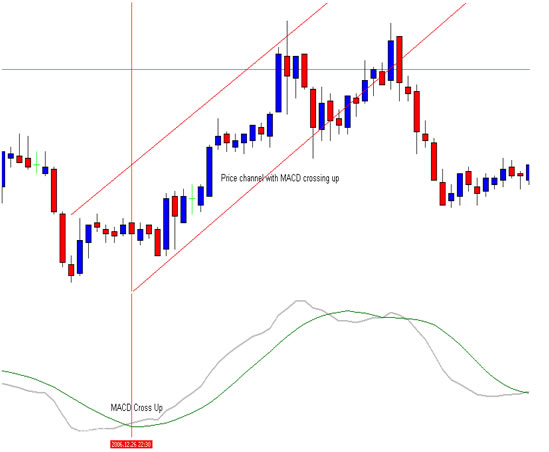
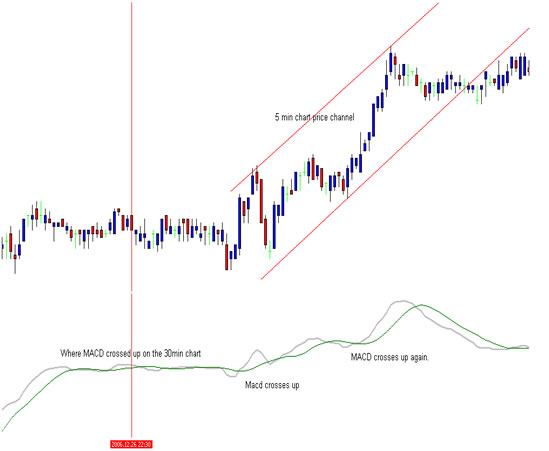
There are many ways to trade the MACD but one of our favorites are too use two different time frames. All we do is establish a trend in a higher time period than the one we intend to trade. For our higher time frame we like to use the 30 min chart and then drop down to the 5 min chart when conditions have been met on the 30 min chart.

On the 30 min forex trading chart below there was a typical buy signal. The chart below (red arrow) shows the fast 9-day signal EMA (gray line) crossing over the MACD line EMA (green line).

After confirming the signal on the 30 min chart we then dropped to the 5min chart and bought the rallies wherever the MACD crossed up, confident to stay long (to buy) as long as our higher time period MACD trend in the 30 min stayed intact. If the 30 min MACD signal line were to cross down we would have closed all long positions.

Conclusion

The MACD is not particularly good for identifying overbought and oversold levels even though it is possible to identify levels that historically represent overbought and oversold levels. The MACD does not have any upper or lower limits to bind its movement and can continue to overextend beyond historical extremes.

Also the MACD calculates the absolute difference between two moving averages and not the percentage difference. The MACD is calculated by subtracting one moving average from the other. As a security increases in price, the difference (both positive and negative) between the two moving averages is destined to grow. This makes its difficult to compare MACD levels over a long period of time, especially for stocks that have grown exponentially.

With some charts you can set the MACD as a histogram. The histogram represents the difference between MACD and its 9-day EMA. The histogram is positive when MACD is above its 9-day EMA and negative when MACD is below its 9-day EMA.

That having said, the MACD still is and will always be one of the few indicators that all traders love and use daily and in many ways it is an old familiar friend you know you can rely on.

Thank you for joining us in this forex trading lesson.
http://www.daytradeology.com/