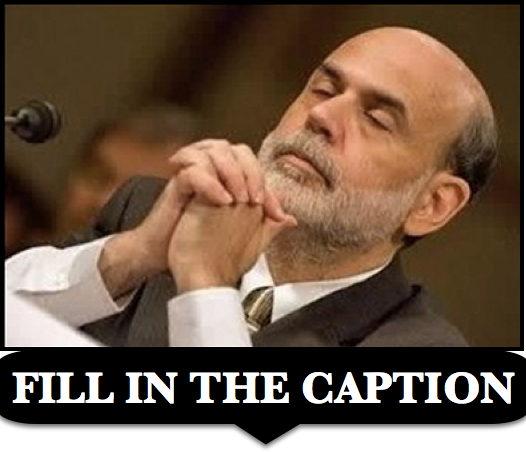
Help Us Pick A Winner


Last week, we had a contest for the best caption of the picture to the left. After a bunch of debating here in the INO offices, we couldn't pick the top three winners.

So we decided that you, our readers, should have the final vote.

And the winner is....

View Results

Loading ... Loading ...

We'll keep the poll up until tomorrow at 5pm ET to determine the top three quotes.

Every Success,
The INO.com team

AAPL, NFLX, FB, YELP, all in today's update

Hello traders everywhere! Adam Hewison here, President of INO.com and Co-creator of MarketClub, with your mid-day market update for Monday, the 21st of October.

In today's report, I will be covering many of the major markets that have been pushing the indices to new highs.

I'll start with Apple (NASDAQ:AAPL), who is rolling out new products tomorrow at 10am PT/1pm ET at San Francisco’s Yerba Buena Center. The slogan for the Apple roll out is, "we still have a lot to cover," so it should be a market mover.

I will also be looking at Netflix (NASDAQ:NFLX), which has turned out to be a big winner for us this year. Netflix is reporting earnings today after the bell. Continue reading "AAPL, NFLX, FB, YELP, all in today's update"

Twitter vs. Facebook: By The Numbers

The bungled initial public offering (IPO) for Facebook (Nasdaq:FB) was a real eye-opener for any company looking to go public.

Facebook's shares famously plunged soon after they started trading, in large part because the $16 billion offering was so large that it created a great deal of investor confusion as share allocations were misdirected.

Lesson learned. Twitter's imminent IPO will be for just $1 billion, leaving most of the company still in private hands. Look for Twitter to slowly offer more shares in various secondary offerings, but the initial scarcity factor is going to make huge instant profits for some investors.

If you can get a piece of this deal, buy it. But if you plan on buying shares only after they have started trading, you'll be making a big mistake. The relatively few shares means that shares are likely to be wildly overvalued -- at least at the start.

By The Numbers Continue reading "Twitter vs. Facebook: By The Numbers"

How to Find Trading Opportunities in ANY Market

Learn ways to spot trading opportunities using wave analysis and other technical analysis methods

By: Elliott Wave International

Senior Analyst Jeffrey Kennedy is the editor of our Elliott Wave Junctures and one of our most popular instructors. Jeffrey's primary analytical method is the Elliott Wave Principle, but he also uses several other technical tools to supplement his analysis.

In this trading lesson, Jeffrey demonstrates how to determine when an Elliott wave trade setup becomes a trade.

You can apply these methods across any market and timeframe. Continue reading "How to Find Trading Opportunities in ANY Market"

Federal Reserve Policy Failures Are Mounting

By Lacy H. Hunt, Ph.D., Economist

The Fed's capabilities to engineer changes in economic growth and inflation are asymmetric. It has been historically documented that central bank tools are well suited to fight excess demand and rampant inflation; the Fed showed great resolve in containing the fast price increases in the aftermath of World Wars I and II and the Korean War. In the late 1970s and early 1980s, rampant inflation was again brought under control by a determined and persistent Federal Reserve.

However, when an economy is excessively over-indebted and disinflationary factors force central banks to cut overnight interest rates to as close to zero as possible, central bank policy is powerless to further move inflation or growth metrics. The periods between 1927 and 1939 in the U.S. (and elsewhere), and from 1989 to the present in Japan, are clear examples of the impotence of central bank policy actions during periods of over-indebtedness.

Four considerations suggest the Fed will continue to be unsuccessful in engineering increasing growth and higher inflation with their continuation of the current program of Large Scale Asset Purchases (LSAP): Continue reading "Federal Reserve Policy Failures Are Mounting"