Apple Inc. (AAPL) Unbeatable Buy for 2024, Set to Skyrocket 37%?

According to a recent note from Fairlead Strategies, technology and consumer electronics giant Apple Inc. (AAPL) could witness a major upside in its stock. According to the agency, the stock has confirmed its breakout above the record high of $183. Consequently, its shares could jump to $254 by the end of 2024.

Given that this is one of those relatively-rare occasions in the world of investment research in which a forecast has been accompanied by a time horizon, in this piece, we evaluate the likelihood of this upside which could elevate iPhone maker’s market capitalization from its current levels of $2.96 trillion to $4 trillion.

AAPL has a lot going for it at this point in time. Its fiscal second-quarter earnings exceeded Street expectations, driven by stronger-than-expected iPhone sales.

The company, which has a history of revolutionizing products like the personal computer, smartphone, and tablet, has begun scripting the next key chapter in its success story with the announcement of its first product in the AR/VR market, the Apple Vision headset, which will sell for $3,499 when it is released early next year.

In addition, AAPL also announced its partnership with the game-development software maker Unity and unveiled a slew of other new products. Its year-ahead product roadmap includes the new Apple Watch Ultra along with the traditional fall launch lined up for the iPhone 15.
The company is also reportedly beginning work on two new and bifurcated product lines, one second-generation high-end model that will be the continuation of the original Vision Pro and the other a lower-end version. It is also expected to ship new M3-powered laptops, and new OLED-screen iPads will ship by next year.

The Catch

With a strong product portfolio and a healthy pipeline, there seems to be little, if any, that can hinder AAPL’s progress from strength to strength. However, the company isn’t immune to macroeconomic headwinds.

AAPL reported $24.16 billion in net income during the quarter compared to $25.01 billion in the previous-year period. Moreover, sales have declined for two straight quarters, with total revenue down 3% from $97.28 billion in the prior quarter.

With macroeconomic challenges in digital advertising and mobile gaming, part of AAPL’s services business, finance chief Luca Maestri said the company expects overall revenue in the current quarter to decline about 3%.

Hence, brand equity apart, AAPL is quite an expensive stock to own based on fundamental financial performance.
Pros Outweigh Cons

Regardless of the near-term and temporary softness and slowdown, traditional valuation metrics seem inadequate to gauge the quality of a compounding machine such as AAPL, which boasts a sticky user base with a retention rate of over 90% that assures the company adequate cash flow through repeat purchases and upgrades.

Moreover, AAPL’s board authorized $90 billion in share repurchases and dividends. It spent $23 billion in buybacks and dividends in the March quarter and raised its dividend by 4% to 24 cents per share.

Through relentless share repurchases, the company increased the existing shareholders' stake by decreasing its float.

By decreasing the number of outstanding shares, AAPL has been increasing the remaining shares' intrinsic value (and consequently the price) without a proportional rise in market capitalization. AAPL’s current market cap is $2.96 trillion, with 15.79 billion shares outstanding, compared to a market cap of $2.97 trillion, with 16.33 billion shares outstanding as of January 3, 2022.

Bottomline

Given the above, if the Federal Reserve and other major central banks manage to engineer the much coveted ‘soft landing’ and all else remains (at least) equal, there is a significant likelihood that AAPL can achieve a record share price by the end of 2024.
Battle for AI Supremacy: Analyzing NVIDIA (NVDA) and Intel (INTC)

Being in the semiconductor business is like owning a plantation of Chinese bamboo. Small incremental steps that often seem too insignificant and inconsequential, especially to unsuspecting investment research analysts like us, compound over time to reach an inflection point and give a company’s stock the kind of moonshot like the one that NVIDIA Corporation (NVDA) experienced after its earnings release on May 24.

The Santa Clara-based graphics chip maker has stolen the thunder over the past week by becoming the first semiconductor company to hit a valuation of $1 trillion, albeit briefly, boosted by the interest in AI and its launch of new partnerships.

However, the seeds of this breakout were sown by the company, which went public in 1999 and occasionally flirted with bankruptcy, back in 2006 when the company took the first steps to raise accelerated computing to a whole new level by making its foray into parallel (and consequently faster) computing with the release of a software toolkit called CUDA.

Parallel computing was ideal for artificial neural networks' deep (machine) learning. Hence the kit was first used in AlexNet, a revolutionary AI then. This set off a chain reaction that has propelled the company to the center stage of the AI boom.
Fast-forward to today, and NVDA is reaping the rewards for all that invisible work as its A100 chips, which are powering LLMs like ChatGPT, have become indispensable for Silicon Valley tech giants.

To put things into context, the supercomputer behind OpenAI’s ChatGPT needed 10,000 of Nvidia’s famous chips. With each chip costing $10,000, a single algorithm that’s fast becoming ubiquitous is powered by semiconductors worth $100 million.
Now let’s pivot to the company that put Silicon in Silicon Valley. Intel Corporation (INTC), the pioneer of modern computing, has fallen behind the law attributed to one of its founders, Gordon Moore.

The company, going through a turbulent phase, reported its largest quarterly loss in history in the first three months of 2023, with revenue down 36% and a 133% decline in earnings per share compared to the same period last year. Moreover, its expectations for the second quarter also fell short of analyst expectations.

“We didn’t get into this mud hole because everything was going great,” was the honest assessment by CEO Pat Gelsinger, who also took a pay cut along with other executives as INTC also kicked off cost-cutting measures as it is hustling to catch up to, and hopefully surpass, its more accomplished rivals such as TSMC and Samsung.

However, in its long and eventful history, the company has been here before. The memory chip pioneer, which saw its market share eroding away to oblivion, made a drastic pivot to microprocessors in 1984 at the onset of the PC boom, only to miss the bus on smartphones in 2011 by turning down an early offer from Apple Inc. (AAPL).

Road Ahead

The optimism surrounding NVDA is justified. With the company’s presence in data centers, cloud computing, and AI, its chips are making their way into self-driving cars, engines that enable the creation of digital twins with omniverse that could be used to run simulations and train AI algorithms for various applications.

Even its previously unsuccessful Tegra processors have found a new lease of life in logistics robots and driverless cars.
However, the seeds of chaos are sown at times of unbridled optimism and willful suspension of disbelief. At the risk of spoiling the mood, at the end of the day, the company is primarily a chip designer that is committed to remaining a fabless chip designer to keep capital expenditure low.
Hence, NVDA faces risks of backward integration by companies such as Apple Inc. (AAPL) and Tesla Inc. (TSLA) with the capability to develop the intellectual capital to design their own chips.

Moreover, almost all of the manufacturing has been outsourced to Taiwan Semiconductor Manufacturing Company Ltd. (TSM), which has yet to diversify significantly outside Taiwan and has become the bone of contention between the two leading superpowers.
In contrast, INTC is an Integrated Device Manufacturer (IDM) which designs as well as manufactures semiconductor chips in 15 fabs worldwide and assembles and tests them in Vietnam, Malaysia, Costa Rica, China, and the United States. The company is in the middle of a turnaround and focused on reinforcing its moat by doubling down on the Fab business.

With the aim to surpass the chip-making capabilities of both TSMC and Samsung, INTC is pursuing an aggressive IDM 2.0 road map with new manufacturing facilities in Oregon, New Mexico, Arizona, Ireland, and Israel in the pipeline.
Among those, the new facilities in Arizona would not just be manufacturing chips for the company but also for customers such as Amazon, Qualcomm, and others as part of Intel Foundry Services. While the company still depends on TSMC for 5nm chips that are used for AI applications, it is aiming to take a quantum leap in that direction with even smaller 18 A chips.

The company’s efforts are also receiving much-needed political encouragement in the form of the Chips and Science Act, which is aimed at on-shoring and de-risking semiconductor manufacturing in the interest of national security.

Bottom Line

After weighing the pros and cons of both semiconductor stocks, we conclude that NVDA’s and INTC’s prospective risk-adjusted returns are not as high or as low as their respective stock prices suggest.

Market Anticipation Builds as 3 Key Companies Prepare to Announce Earnings

Corporate America was bracing itself to report the biggest drop in earnings since the pandemic began three years ago, with profits for S&P 500 companies expected to fall by as much as 8% due to inflation, increased borrowing costs, and other headwinds.

However, businesses appear to be blowing past these low expectations, with 77% of reports beating analysts' estimates, with reported earnings being 7.2% above expectations.

A relatively weak dollar due to the trend of de-dollarization gaining momentum and the looming crisis over raising the debt ceiling due to political differences regarding government expenditure on both sides of the aisle might also have been unwitting tailwinds that have helped the likes of Apple Inc. (AAPL) keep the mood buoyant on the Street

After reporting stronger-than-expected results, the tech giant’s shares surged by 4.8% on May 5.

However, the first quarter still would mark a second straight quarterly fall for U.S. corporate earnings after COVID-19 hit corporate results in 2020.
Given this backdrop, let’s look at the prospects of three stocks ahead of their earnings release this week.

The Walt Disney Company (DIS)

DIS has recently been in the news for being on a legal collision course with Florida Governor Ron DeSanctis. Differences between the company and the governor began with DIS’ opposition to the Parental Rights in Education Act, which prohibits lessons on sexual orientation and gender identity in public schools through the third grade.

In an alleged retaliation, the Florida Senate approved the Disney Special Tax-District Bill, which would seek to move the control of the Reedy Creek district from the company back to the state. DIS has expanded the lawsuit contesting this move to include new regulations passed by the state’s legislature that allow officials to nullify development agreements brokered by the company. Continue reading "Market Anticipation Builds as 3 Key Companies Prepare to Announce Earnings"

Subpoenas to Biden Agencies Over Social Media 'Censorship': Impact on Big Tech and Stock Market

Holocaust survivor Susan Sontag, when asked, summed up her lesson from her struggle with a simple yet profound observation that 10% of any population is cruel, no matter what, and that 10% is merciful, no matter what, and that the remaining 80% could be moved in either direction.

The above observation has not just stood the test of time; it holds true for political ideologies and economic doctrines as well, as revolutionaries and public enemies over the ages have found out to their respective triumphs and desolations.

However, in the age of information and the Internet, social media has become the new battleground for conflicting subcultures to shape narratives and influence the 80% to write a preferred version of history.

This ongoing and intensifying conflict reached another flashpoint when House Judiciary Committee, chaired by Republican Jim Jordan, subpoenaed three government agencies on Friday, April 28, as part of investigations into alleged censorship.

This has followed subpoenas sent in February to chief executives of Alphabet Inc. (GOOGL), Amazon.com, Inc. (AMZN),Apple Inc. (AAPL), Meta Platforms, Inc. (META), and Microsoft Corporation (MSFT) demanding information on how they moderate content on their online platforms.

In this article, we will get into the details of the subpoena, followed by an exploration of what regional and temporal differences in the definition of appropriateness and appropriateness in the limits of free speech mean for the business prospects of big tech companies. Continue reading "Subpoenas to Biden Agencies Over Social Media 'Censorship': Impact on Big Tech and Stock Market"

Bitcoin Buy Setup, Apple Is On Alert

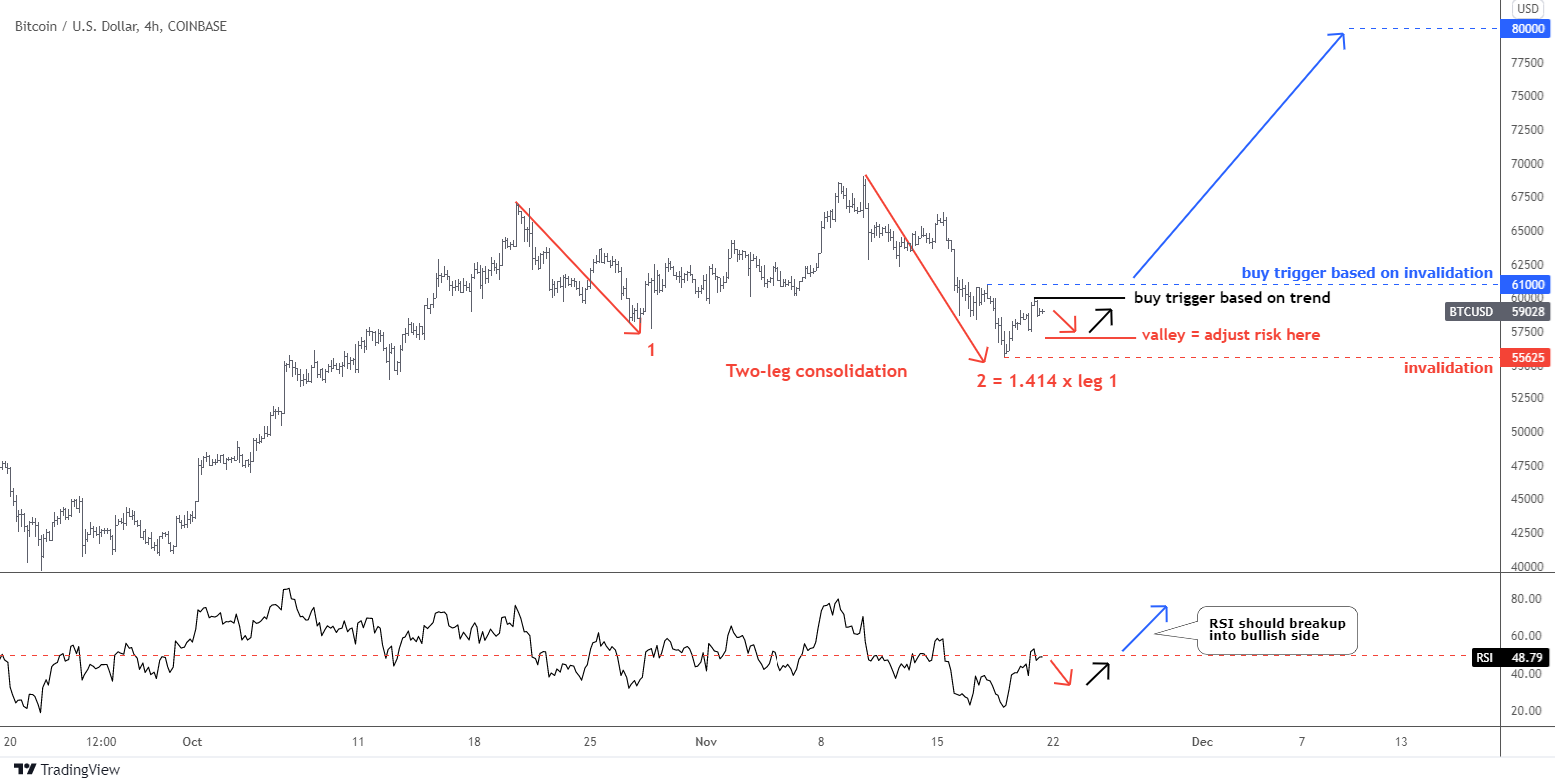
The knowledge of chart structure helps to navigate the market even when the latter surprises traders.

Bitcoin Chart

Bitcoin dropped a little bit later than I expected, creating a complex structure. The main coin updated the all-time high as it hit the $69k mark. If we look deep into the structure in the 4-hour chart above, we find that it was a part of a large two-leg consolidation (red down arrows). The new record high was established within a "joint" connecting two legs down. Continue reading "Bitcoin Buy Setup, Apple Is On Alert"