"Saturday Seminars" -Pattern Probability Used in a Unified System

The new trader should have no difficulty following this presentation. Concepts progress logically from the basic to the more complex. There are no abstract theories that the trader must accept on faith or complex formulas to intimidate the new practitioner. Step by step, Curtis proves that any trader can duplicate his personal trading success by approaching trading as a business. A trader must have a consistent approach and a long-term perspective and must adhere to the four basic tenets of trading: trade with the trend, cut losses short, let profits run, and use good money management.

Curtis explains why most traders lose and why success depends upon long-term thinking. Curtis shows a simple way to define a trend and describes nine specific patterns that allow you to follow any trend with minimal risk. You will learn to recognize the most powerful pattern found on a chart and ways to avoid missing a major move.

Curtis teaches you how and when to move your stop to break-even and how to combine two powerful exit systems to ensure that you never again give back your open profits. Curtis also discusses some of the additional considerations that allow a trader to adopt a more aggressive stance when appropriate, including basis relationships, options expiration, and first notice days. Finally, Curtis teaches you a proven money management system using a fixed fractional approach to boost your performance and reduce your longest string of losses.

Curtis Arnold is a veteran of the stocks and commodities markets. His first book, Your Personal Computer Can Make You Rich in Stocks and Commodities, sold over 50,000 copies and contained the actual code for twenty-five programs that would create and plot technical indicators. His next book, Timing the Market (1984), sold nearly 70,000 copies worldwide. Changing Times magazine chose Timing the Market as the best investment book of the year in 1992. In 1994, the book made the best-seller list in India. Curtis developed the Commitment of Traders Index, a tool that allows traders to spot imbalances in futures open interest among small, large, and commercial speculators. In 1987, Curtis' research led him to quantify and classify classical chart patterns, then produce accurate statistics, rating each for its probabilities of success. This led Curtis to develop his PPS System (Pattern Probability Strategy), one of today's more successful and popular trading systems. After tripling his personal account in 1988, Curtis began training a limited number of students in his methodology. In 1992, one of his students became the number-one-ranked CTA in the country. That same year, a first-year PPS student won the United States Investing Championship with a return of 216.1 percent. Supertraders Almanac then chose PPS as "Trading Methodology of the Year."

---

Saturday Seminars are just a taste of the power of INO TV. The web's only online video and audio library for trading education. So watch four videos in our free version of INO TV click here.

INO TV

Gold ends down but off 5-wk lows, eyes US data

By Frank Tang & Jon Harvey

NEW YORK/LONDON (Reuters) - Gold ended 1 percent lower on Wednesday as the dollar climbed, oil prices feel and U.S. stocks rose, denting the precious metal's appeal.

Gold was at 918.80/920.30 by New York's last quote at 2:15 p.m. EDT, down from $928.45/929.65 late in New York on Monday.

Gold's decline was "pretty much forex related, and oil is coming down," said senior Commerzbank trader Michael Kempinski. "We need to see come stronger commodities in general, and a stronger euro, to push gold higher again."

The dollar rose to its highest level in a month against major currencies, pressuring bullion prices. Gold tends to move in the opposite direction of the U.S. currency, as it is often bought as an alternative investment.

Declining oil prices also dragged gold, as signs of weakening demand for crude and a rising dollar outweighed the supply threat linked to tensions in Iran and Nigeria. U.S. crude futures ended $2.54 lower at $122.19 a barrel.

Gold also dipped as U.S. stocks ticked up, dampening interest in the precious metal as an alternative investment.

"When crude oil goes down, gold also goes down with the stock market going up. Everyone is watching that correlation," said Adam Hewison, president of MarketClub.com in Annapolis, Maryland.

Hewison said gold should find support at current levels, but the $905 to $912 an ounce area represented a key support area. Should bullion fail to hold there, prices could test the lows set in June below $860 an ounce, he said.

Absent significant moves in oil and the dollar, gold prices should remain rangebound, analysts said, with physical buying muted during the low-demand summer season and exchange-traded funds' holdings steadying after recent gains.

U.S. gold futures for August delivery settled down $11.20, or 1.2 percent, at $916.50 an once on the COMEX division of New York Mercantile Exchange.

Gold traders awaited release of U.S. economic data this week, including GDP numbers on Thursday and nonfarm payross, construction spending and auto sales data on Friday. These reports could have a significant impact on the dollar.

Traders also looked ahead to Wednesday's oil inventory data from the U.S. Department of Energy.

"The consensus is looking for another drop of crude oil inventories, which might provide some support for crude oil and thus also for gold," said Dresdner Kleinwort analyst Peter Fertig.

Among other precious metals, spot platinum hit its highest level in almost a week at $1,775 an ounce, then retreated to end at $1739.00, down from $1,739.00/1,759.00, down from $1,763.00/1,783.00 late in New York on Monday.

Spot palladium was at $380.50/388.50, unchanged from late in New York on Monday. Silver fell to $17.35/17.41 an ounce from $17.46/17.52 late in New York on Monday.

---

See original Reuter's article here: http://www.guardian.co.uk/business/feedarticle/7690017

Straddling Options

The post below is from Eric at The Stock Market Prognosticator. Free free to leave a comment or let him know if you have any other option tips you would like him to write about.

---

It is important for investors not panic during the current market volatility. Money can be made on both the upside and downside. One of the strategies I employed recently involves using options to take advantage of this volatility. During the month of July, I opened "straddle" positions on six different stocks and ETF's. I closed all of them out at a profit within two weeks.

So here is how it works, a straddle is the simultaneous purchase of an equal number of both calls and puts on the same underling stock, ETF, or index. Both the calls and the puts should have the same strike price and same expiration.

What I am looking for is a large move by the stock before the options expires. I am indifferent as to which way the market moves, as long as the combined premium when I close it out is more than the combined premium that I paid.

Here are some other things to know:

1) Make sure that the options have several weeks to expiration so there is time for the underlying instrument to move.

2) Pick only options with large volume and narrow spreads, a few pennies per contract is best.

3) Be careful about using this strategy when the underlying instrument has very high-implied volatility, as all other things being equal, a high implied volatility leads to a higher option premium. If this implied volatility suddenly dissipates then one side of your position may drop sharply in price.

4) I usually wait until the underlying instrument is trading right at the strike price, so the options cast per contract is roughly the same.

Here is an example of one of my trades:

I purchased the Financial Select Sector SPDR (XLF) July 21 Calls and July 21 Puts at a price per contract of $1.14 and $1.13 respectively. This position was opened prior to the huge rally in financials last week. Four days later I closed the position out, selling the calls at $2.28 and the puts at $0.51 per contract. The profit before commissions per contract was $0.53, or $53.00. So a round lot of 100 contracts would have yielded a profit of $5,273 in less than a week.

Investing in options carries a lot of risk, so please decide yourself whether a strategy like this is correct for you as an investor.

---

If you would like to learn more about my investment philosophy, then please visit The Stock Market Prognosticator.

"Saturday Seminars" - Keep It Simple Stupid: Trading with the Elliott Wave

Using Elliott Wave successfully means using it simply. Mark designed this session to provide you with the basic tools needed for a solid understanding of basic Elliott Wave structures: the 5-wave (impulse) pattern and the 3-wave (corrective) pattern. Specifically, Mark believes that you can successfully trade using Elliott Wave analysis by following only three basic rules accompanied by a handful of guidelines.

Each Elliott Wave structure defines the trend and the market’s next likely move. With a solid understanding of these simple rules and guidelines, you will gain confidence in counting a chart, which can result in a positive balance sheet. Along with the basics, Mark shares several trading approaches to the Elliott Wave sequence. These include deriving likely targets for the next move, assessing risk/reward parameters and using the Wave Principle to minimize risk.

Mark A. Schimmel is a senior market analyst with Elliott Wave International (EWI), the world’s premiere Elliott Wave organization. He provides real-time commentary on dozens of global equity, bond, currency, and commodity markets for professional and private investors around the world. Mark teaches EWI’s comprehensive tutorial on the Elliott Wave Principle and conducts seminars and workshops to retail and institutional investors worldwide. He has served as the editor of The Elliott Wave Theorist Short Term Update, an adjunct service offered to subscribers of Robert Prechter’s Elliott Wave Theorist newsletter. Mark also provides EWI subscribers with live telephone market opinions on all w..
---

Saturday Seminars are just a taste of the power of INO TV. The web's only online video and audio library for trading education. So watch four videos in our free version of INO TV click here.

INO TV

Bear Market

Today I have the opportunity to introduce Brian Shannon from AlphaTrends.net. Brian is the author of "Technical Analysis: Using Multiple Time Frames." I had the chance to read this book on a flight form Maryland to California and I can tell you that I didn't put it down. The insights and strait forward analysis made me come home and rethink my positions and methodology. Brian takes what he's learned as a broker, hedge fund manager, speaker, and writer to really convey his knowledge. Enjoy his post below.

===

For the majority of market participants, the stage four bear market decline is a dark, scary period that they wish didn't exist. Whether you are a died-in-the-wool bull or someone who feels trapped by the long-only choice of your 401K, a bear market is most participants least favorite time to be involved in the markets. Unfortunately, it is a painful time for many market investors who try to catch a falling knife, rather than wait for it to drop and then pick it up.

For the perennial doomsayers of the world, a bear market is their time to say "I told you so" as they endlessly preach their pessimistic viewpoints.

The fact is declining equity prices bring about the strongest emotional response -- annoyance from longs to jubilance of shorts -- from the average participant. However, if you are an objective trader who understands the cyclical nature of the markets, a bear market can represent a terrific opportunity for your short-term profits.

There have been many attempts to classify exactly what constitutes a bear market, but it simply boils down to this: It is an environment where the path of least resistance is lower for the market being studied. The sellers are clearly in control and are able to create a condition where lower highs and lower lows prevail. The supply of stock offered to the market is greater than the demand can absorb at current prices, which forces a move lower in search of liquidity. That's it.

The stage three distributive action which precedes a downturn robs the market of further upside as sellers gradually wrestle control from buyers. When prices break below the lows of stage three and establish the first evidence of lower lows and lower highs a new downtrend has begun and ensuing rallies should be treated as "guilty until proven innocent."

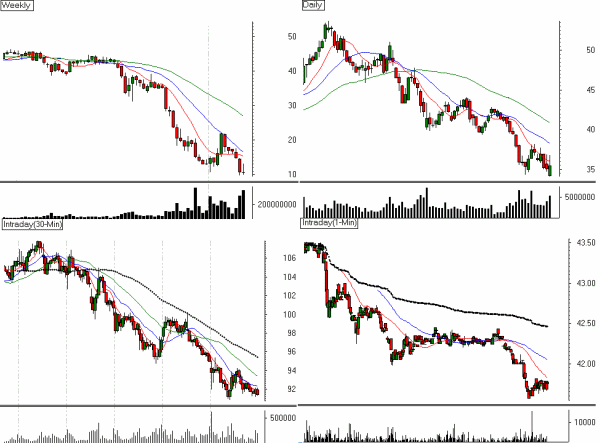
Note that trend reversals can occur early on. However, as more long participants are trapped with losses, fear-driven liquidation is more likely and typically will play out in multiple waves. Not only is there an absence of buyers; there is also an increasingly aggressive source of supply from who short sellers apply further pressure to the market. The obvious resulting technical signs of bearish enviornment take the stage -- lower lows which form below declining longer-term moving averages.

The stage four decline is market by lower lows and lower highs, regardless of time-frame. Notice the direction of the moving averages, they can be used to quickly identify "the path of least resistance."

It is easy and tempting to look at bounces in a primary downtrend and think there is an opportunity to make money form the long side, but simply math favors trading the short side. For example, when a stock drops three points, the only way it can remain in a downtrend is to rally less than three points as a counter trend rally ensues. On other words, the sum of the declines will always be greater than the sum of the rallies in a downtrend. Understanding the basis of trend trading (once a trend has been established, the more likely it is to continue than to reverse) increases the likelihood of further downside, and the declines will travel further than the corrective rallies within a downtrend. This creates a powerful reason to embrace short selling.

Picking bottoms is the hardest job on Wall Street, and frankly, nobody rings a bell at the market bottom. Yet for some reason there seems to be an attraction to declining prices among most participants. Natural human optimism and learned behavior of hunting for bargains in a retail environment provides a "slope of hope" along which stage four stocks, decline, crushing the dreams and finances of bewildered longs in its path.

We have all experienced the helpless feeling of searching every new source for a shred of bullishness to justify holding onto a stock in the face of declining prices. This fruitless action only delays the inevitable recognition of truth. It does not delay your losses. The is said that "it is better to be in cash wishing you were in a stock than it is be in a stock and wishing you were in cash." This is perhaps never truer than the point at which you are "foraging" for a reason to continue on a course that offers little promise.

For long participants, the stage four decline is market by two brands of fear:

  • Fear that the stock's descent will continue to wipe out their equity (a good fear to have as it may portend a proper action into cash).
  • Fear of feeling stupid for selling "the loser" at a point just before the stock turns higher (a bad fear to have). Do not fall prey to the short-term pauses in a primary downtrend; the short term action will typically be resolved in the direction of the larger, more powerful trend of the longer time-frame.

See the rest of this post by clicking HERE.