A Different Type of Moving Average Cross

I've been trying to convince our next guest blogger to write for us since we first started these...but he's been way too busy. Well I FINALLY caught him and I think you'll agree that it was worth the wait. I'd like to introduce Mark McRae from Traders Secret Code. Mark has been a friend to INO and MarketClub since 2001 and I can personally say that his insights and knowledge have become a crucial point in my trading. His focus has been the same as Adam...teach a man to fish (trade) he'll eat (profit) for a lifetime. Now please enjoy Mark's lesson on "A Different Type of Moving Average Cross".

====================================================================

Virtually every trader has dabbled with or experimented with some sort of moving average. What I want to introduce you to in this lesson is a different sort of moving average cross method, which I have found to be very good at identifying short term trend changes.

As we know a moving average is normally plotted using the close of a bar e.g. if you were plotting a 3 period moving average, then you would add the last three closes and divide the total by three to get a simple moving average.

This is where I want you to think a little differently. I have always been an advocate of taking traditional thinking and changing it around. What if you used the open instead of the close? What if you used the close of one period of a moving average and the open of another?

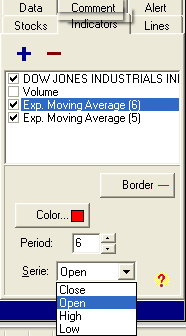
First, most charting packages will allow you to use the open, high, low or close to plot a moving average.
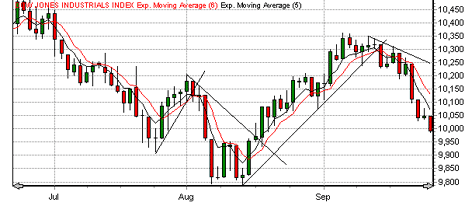
In the example below of the daily Dow Jones, I have used a 5 period exponential moving average of the close and a 6 period exponential moving average of the open. As you can see it catches the short term trend changes really nicely.
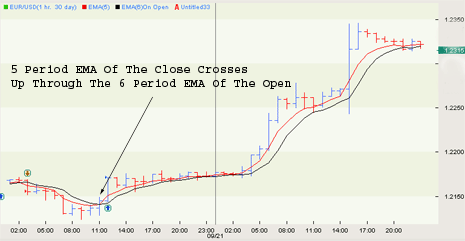
In the next example of the 1 hour EUR/USD, you can see that the close/open combination worked really well. Of course you will go through periods of consolidation with any market and any moving average method you use will be whipsawed. To get around this you need some sort of filter or approach that helps you keep out of the low probability trades.

You could use ADX, Stochastic or MACD to help filter the noise but I also like to add a time frame.
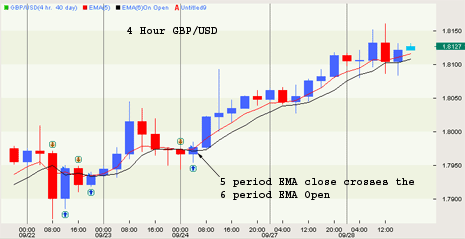
In the next example of the 4 hour GBP/USD you can see that on the 24th September 04 at 4:00 there was a cross of the 5 period exponential moving average of the close above the 6 period exponential moving average of the open. This signal has remained in place until today as I write on the 27th September.
Although there was a signal on the 4 hour, to help identify even better entry points you can drop down a few time frames to the 30 minute chart. As you can see from the 30 minute chart there have been quite a few crosses of the 5 period exponential moving of the close above or below the 6 period exponential moving average of the open.
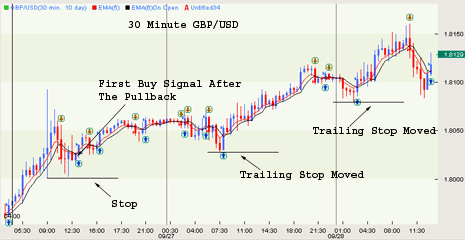
There are lots of ways to trade this but a neat little trick is to wait for the signal on a higher time frame and then drop down a few time frames and wait for a pullback. The first signal after the pullback on the lower time frame is normally a pretty good entry point e.g. If there were a cross up on the large time frame then drop down to a lower time frame and wait for the market to retrace and then give another buy signal (cross up). The opposite is true for short signals.

Once you get the signal on the shorter time frame depending on where support is you can usually place your first stop loss under the nearest support area (valley). If the market begins to make progress you can move your stop so that it trails the market by moving your stop to just under the most recent support area.

In this lesson I have use an exponential moving average but experiment with different types of average such as weighted, smoothed or simple. You can also experiment with different lengths of moving average.

Good Trading.

Best Regards
Mark McRae

Traders Secret Code

=================================================================

Please take time today and visit Mark's site Traders Secret Code as I believe the information there would be of good use to you!

What Goes On Inside the Dow?

Today I've invited Don Heggan from Dynamic Stock Market Strategies to discuss his insiders knowledge on what's really behind the DOW. Please take time and read the post and comment for Don to discuss.

===================================================================

If you’re a trader and you don't know what’s going on inside the Dow, you don't know anything worth knowing. Learn to penetrate the smoke screen that the Dow-Jones Industrial Average has become.

The complex formula used to compute this monstrosity, called price-weighting, goes far beyond simply adding up the individual prices and dividing the whole thing by thirty. It, instead, employs a divisor designed to compensate for dividends and stock splits.

The effect of all this not only gives the higher priced issues more weight in the average but accounts for the incredibly high valuation of the average itself. Confused? Good! You're supposed to be. You see, dividing a number by a value less than one actually turns it into a multiplier!

The current divisor, as of this writing, is approximately (are you ready for this???) 0.122834016 which is the same thing as multiplying by 8!

That means a one point move in a stock is good for an eight point move in the average.

It also allows a few higher priced issues to give the illusion that the average stock is moving up when, in fact, the majority are moving down.

Imagine thirty men carrying a heavy load up a mountain. In the beginning all is well; each member is bearing their fair share of the load. As the climb continues, visualize one member at a time becoming exhausted and, unable to continue, dropping out. This means the heavy load, shouldered by a constantly shrinking number of remaining members of the climb, eventually collapses under its own weight.

If you were keeping track of the climbs' progress and noted that what started out as a 30 man team was now down to fewer than 15, what would be your prognosis?

What would be your prognosis if all you saw was the average moving higher and higher and were completely unaware of what was going on inside?

Inside the Dow: Ignore it at your peril.

Don Heggen

Publisher

dynamic-stock-market-strategies.com

How to create an objective trading plan

Today I'd like everyone to welcome back Dr. Barry Burns. He was a guest blogger a few weeks back and the overwhelming response was "we want him back"! So you asked for him, I called in a personal favor, and here he is again to help teach us.

================================================================

Traders who use technical analysis rely on charts to help establish a probability scenario for entering a trade.

We generally look at 3 things:

Price patterns.
Volume patterns.
Indicator patterns.

There have been countless books written and courses sold on how to use these things to predict future market movement. Despite this, countless traders continue to fail in their attempts to become profitable.

Why?

After years of watching my father trade (he had 70 years of experience in the markets) and many years of my own experience, I’ve come to this conclusion:

None of it works!

That’s right. I haven’t found a single price pattern or indicator that could accurately predict the future of the market with enough probability to make any money.

So, is technical analysis an exercise in futility?

Although I haven’t found any one single thing to prove profitable, favorable probability scenarios can be found by combining several indicators. However this has to be done in the right way.

I identify what I call the “energies” of the market, and have selected certain indicators to measure those energies.

5 of the energies are:

Trend.
Momentum.
Cycles.
Fractals.
Blockages.

The key to success is to wait until all 5 of these energies align telling you the same thing (“go long” or “go short”) at the same time.

Indicators measure these energies. Again, I don’t have much confidence in any single indicator. After all, they only do what their name says: They “indicate;” they don’t “tell” you what the market will do next.

However, when all 5 indicators align, and they each measure a different energy, then this is a time when the probability is now on your side.

You can even use this to “score” a trade on a scale of 1-5 depending on how many “energies” (indicators) align in the same direction.

You may choose to be very conservative and only take trades that are very high probability – so you’ll wait until all 5 energies align. The downside of this is that it doesn’t occur very often and therefore you won’t be very active in your trading.

You may decide you need more trades to be psychologically satisfied and keep your interest and focus on the market. In this case you could take trades that rate a 4 (4 of 5 energies align in the same direction at the same time). You will get more trades, but your
win/loss ratio will be slightly lower.

You can choose your favorite indicators to measure these 5 indicators. Which ones you use isn’t the most critical factor … as long as you know how to use them properly.

Using this approach gives you a very measurable and objective way to make decisions and track your trades.

BIO:
Dr. Barry Burns is the owner of Top Dog Trading which teaches people how to avoid the long learning curve in day trading, swing trading and investing.
He started his study of the markets under the direction of his father, Patrick F. Burns, who became independently wealthy through trading and had over 70 years of trading experience before passing away in 2005.
He has been the featured speaker at DayTradersUSA, and developed a 5 Day Course for WorldWideTrders.
Dr. Burns has been a headlining guest speaker for the Market Analysts of Southern California, given seminars around the country at many Wealth Expos as well as many Traders Expos, been interviewed on the Robin Dayne "Elite Masters of Trading" Radio Show, and is the former moderator of the FuturesTalk chat room.
He has a doctorate in Hypnotherapy and is a certified NLP practitioner, and therefore able to help people with the psychology of trading.

Are you master of your domain?

With Crude taking a dive this week (our MarketClub Trade Triangles getting short at the PERFECT price) I wanted to bring in Jeremy Ascher from ChartWhiz.com to bring a little insight into what he's seeing in the energy markets as we've gotten a ton of emails regarding pulling profits and controlling losses. Please enjoy the post...and take a look at our most recent signals for Crude Oil (CL.V08) if you're a MarketClub member.

==================================================================

I’ve been analyzing and trading the energy markets for more than 10 years and I continue to see beginner traders make the mistakes over and over again. I know this because I made the same mistakes when I was a rookie trader. It goes something like this…you start the day with a good trade and lock in some nice profits. Then you make another and your having a pretty decent day, one in which you could easily call it a day. Let’s say for example you’re up $800 on the day. But then the greed kicks in and you want more. Ok, one more trade, let me hit that $1000 mark. Now you place a losing trade and you’re up only $600. Now you think to yourself “I should have just closed the books. Ok, let me try to make that $200 back and call it a day”. You lose again, up only $350 now. Now you’ve turned a triple into a single. Now you’re angry. That’s it, it’s all or nothing. I have $350 to risk and I’m done. This is where it gets ugly, usually turning an $800 winning day into an $800 loser, a $1600 swing.

Sound familiar? You bet it does.
Why does this happen? The answer is simple-you are not master of your domain. In other words it’s a lack of discipline. Without discipline it will be very difficult to become a successful trader. So I’ve come up with a few simple “post it” notes that should help you overcome this hurdle. I have these notes posted to my monitor in big letters to keep a constant reminder. Here they are:
1. Trade the numbers, not opinion. Before you trade you should always do your homework. I analyze the charts to derive support and resistance numbers. These are the only areas that I am willing to place trades. Anything else to me is gambling. If you have support you are buying against, you trade that number until the market tells you otherwise.
2. Patience. It is extremely important to have patience when trading. Use your support and resistance as guide lines. Do not chase the market and force trades; let the market come to you.
3. No Emotion. It is virtually impossible to not have any emotion when trading, but it can be reduced drastically. To do this, trade with a systematic approach. Determine a comfortable risk threshold to use on every trade. If you’re wrong and get stopped out, wait for the next trade with the same risk parameters. Trading a system day in and day out will help keep you off the emotional rollercoaster that so many of us experience.
These may sound too simple and basic to work, but sometimes it’s the simple things that work best. And believe me, these do. After all, not trading your numbers will lead to impatience which will lead to emotional trading. And that my friends, is a recipe for disaster. So get out your sticky notes, write these down, and stick them on your monitor and become master of your domain today.

Jeremy Ascher
www.chartwhiz.com

Trader's Blog First Ever CONTEST!

We've all been there....looking at a chart a year later and saying to ourselves "WHY, OH WHY, didn't I just pull the trigger!?!?!" The chart shows us the sad truth that if only we would have gotten long, we would have had 500% returns, an island in Fiji, and 6 cars!

But we didn't...

We here at The Trader's Blog, would like to know what trade would have been your best...if only you would have taken it? Did you see something special in Google at 100.00 in 2004? Was Spot Gold primed at 256 in 2001? What made you stay out of Wheat around the 500.00 mark? Whatever your story we want to hear about it!

We'll be giving away an Apple iTouch!

How you enter:

Comment today and tell us what that trade would have been...and what you would have bought with the returns!! Here are some trades that we in the office wished we would have done:

Bob F. "I wish I would have gotten long USO February of 2007, when Crude just started to move!"

Melissa P. "Playing the AMEX_SKF which is an ultra short financial ETF around April when Bear's crashed."

Lindsay T. "Shorted NASDAQ_TRMP on our last monthly Trade Triangle at 16.51 in January of this year...that would have been huge!"

---

Here are the details:

1. This contest open for 2 WEEKS!

2. Winner will be picked randomly by software to remove human errors.

3. One entry per person!

4. Winner will be contacted via email.

5. No wrong answers, participation counts as an entry.

---

iTouch and Apple are a registered trademark of Apple, Inc. All rights reserved. INO.com is not partner with Apple for this contest and do not hold any type of partnership.