Overly Pessimistic Market Conditions?

April – Worst Month Since 2008 Financial Crisis

As April ended, the Nasdaq logged its worst month since the 2008 financial crisis, while the S&P 500 logged its worst month since March of 2020 during the depths of the Covid pandemic. No company has been immune to the onslaught of the macroeconomic environment as many household names have seen their market capitalizations cut by 30%-60%, such as Meta (FB), Amazon (AMZN), Netflix (NFLX), Adobe (ADBE), Nvidia (NVDA) and PayPal (PYPL) to name a few. The Nasdaq and the S&P 500 finished out April at fresh lows for 2022, taking out their previous low in March, selling off 13.3% and 8.8% during April alone. The Dow Jones fared better, only selling off 4.9% for April.

There’s an array of macroeconomic headwinds that have underpinned this downturn. The Federal Reserve withdrawing monetary stimulus, continued supply chain challenges, rising rates throughout the remainder of 2022, chronic inflation, Covid-induced lockdowns in China, and the geopolitical crisis in Ukraine. As such, The Nasdaq and S&P 500 are off 23.9% and 14.3% from their all-time highs. These elements have potentially culminated in an overly pessimistic market, and great entry points are available for patient investors.

Google and Amazon Proxies

Both Amazon and Google closed out their largest monthly losses since the 2008 financial crisis. After earnings, Amazon dropped nearly 14%, leading to its largest one-day drop since 2006. This was on the heels of reporting a loss and issuing weak revenue guidance for the second quarter. Continue reading "Overly Pessimistic Market Conditions?"
Gold Bounces But Couldn't Hold Friday's Highs

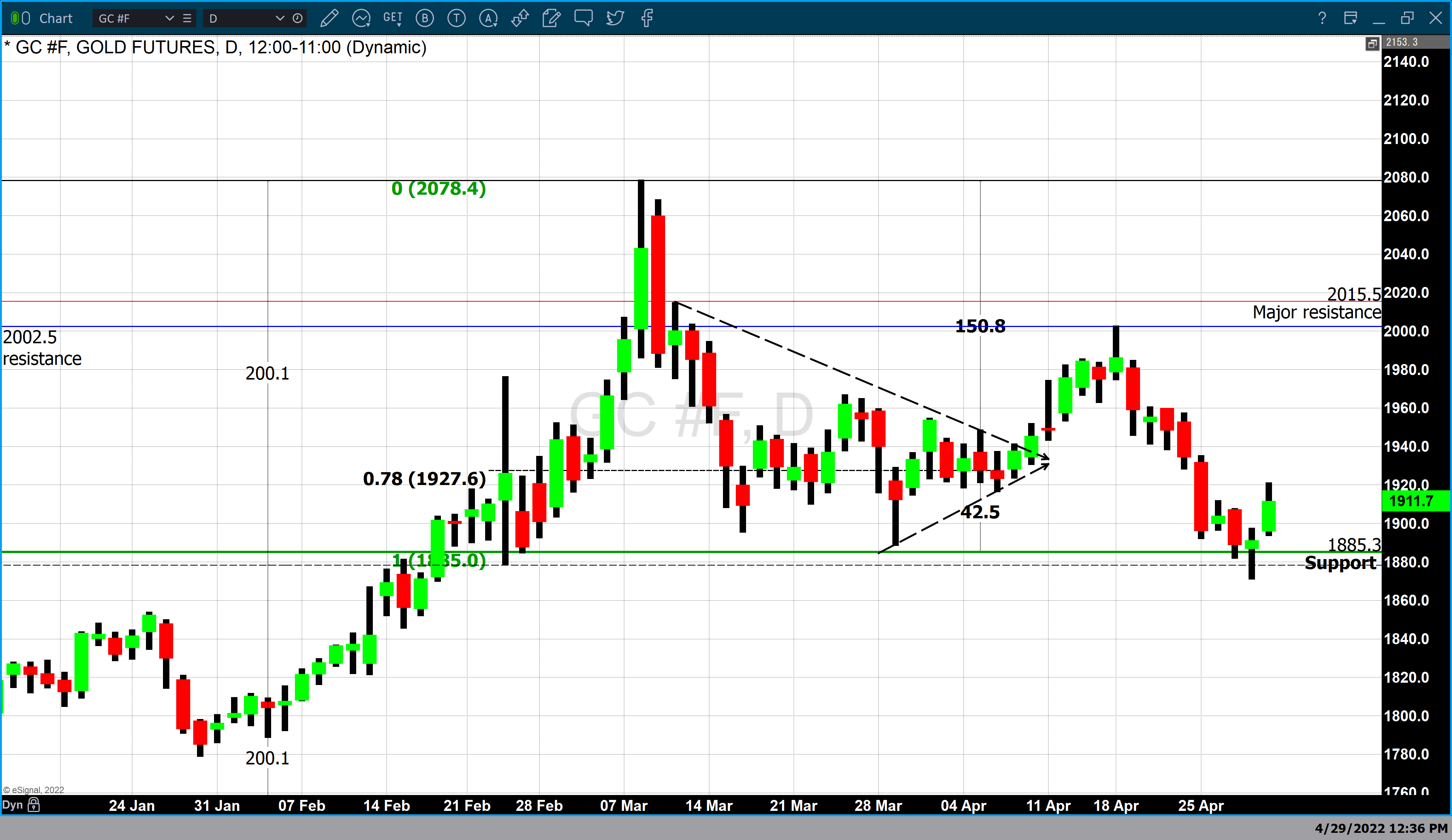
June 2022 gold futures opened Friday morning at $1895.80, far above Thursday’s low of $1871. Trading to a high of $1921.30 and settled in New York up 1.1% at $1911.70. However, on Fridays, Globex trading remains open until 6 PM EDT before closing for the weekend. As of 5:10 EDT, gold has moved back below $1900 and is currently fixed at $1896.90, a net gain of $5.60 or 0.30% in after-hours trading.

Gold Futures Daily Chart

The tremendous price swings evident in gold over the last couple of days likely resulted from multiple factors influencing gold prices. Investors continue to focus on next week’s FOMC meeting. It is widely anticipated that the Fed will enact a .50 percent interest rate hike which will go into effect at the end of next week’s meeting. Concurrently it is widely believed that the Federal Reserve will begin to reduce its balance sheet assets over the next three years. Economists polled by Bloomberg news believe that the Federal Reserve will reduce its balance sheet from the current level of $8.8 trillion to $6.4 trillion by the conclusion of 2024. Continue reading "Gold Bounces But Couldn't Hold Friday's Highs"

Retail Fuel Prices Skyrocket

“The following is an excerpt from Tim Snyder’s “Weekly Quick Facts” newsletter. Tim is an accomplished economist with a deep understanding of applied economics in energy. We encourage you to visit Matador Economics and learn more about Tim. While there, you can sign up for his completely free Daily Energy Briefs and Weekly Quick Facts newsletters.”

Today’s fuel prices are showing us that with increasing demand, the price for refined products will continue to rise, even with a somewhat stalling crude oil price. Today’s EIA posting for On-Highway Retail Gasoline price was $4.107 per gallon. Remember, in 18 states, beginning this Saturday; the US EPA has mandated the more expensive “Summer Blend” of gasoline. This gasoline blend will stay in place until Mid-September, as demand remains strong and the temperatures are warmer this time of year.

Diesel prices look to be outpacing gasoline and the changes in crude oil prices as well. Monday’s EIA posting for On-Highway Retail Diesel price was $5.16 per gallon. These prices will soon eclipse the records we saw in March of this year. We were trading at $5.25 per gallon on March 14, 2022, and with diesel fuels' current supply issues, we will top this by Mid-May. This will push food prices higher and make planting time in the Agriculture space as expensive as it ever has been!

We’re still on an upward track on fuel prices! Continue reading "Retail Fuel Prices Skyrocket"

Let's Get Serious

Federal Reserve Chair Jerome Powell indicated strongly last week that the Fed will likely raise interest rates by 50 basis points at its next meeting on May 3-4. It will likely get more aggressive in its fight against 8%-plus inflation. It’s going to have to because just as fast as the Fed is trying to bail water out of the boat, the White House and Congress are determined to keep pouring it in.

“It is appropriate in my view to be moving a little more quickly” to raise rates than the Fed has recently, Powell said last Thursday at an International Monetary Fund event. “Fifty basis points will be on the table for the May meeting,” he said. That would double the 25-basis point increase at its March meeting, which now looks relatively puny compared to the yield on the 10-year Treasury, which is rapidly approaching a three-handle for the first time since 2018.

St. Louis Fed president James Bullard, suddenly the most hawkish voting member on the Fed’s monetary policy committee, said he thinks a 75-basis point hike is more appropriate. However, he conceded that “more than 50 basis points is not my base case at this point.” Still, 50 bps is a lot better than 25 bps in bringing the Fed’s target closer to the so-called neutral rate, which is when Fed policy is neither accommodative nor restrictive, and the Fed is nowhere near that (although no one really knows what the magic number is). With six more meetings to go this year, including May’s, 50 bps at each meeting would push the fed funds rate above 3%.

That seems awfully aggressive, given the Powell Fed’s generally dovish inclinations. Still, it may have no choice given that Continue reading "Let's Get Serious"

Reconciling Meta's 50% Sell-Off

Extreme Bearishness

Facebook, recently rebranded as Meta Platforms Inc. (FB), is down 52% from its September 2021 high and now sits at a 52-week low. The recent downturn came after the company reported its quarterly earnings back in February. The stock downturn was related to capital investment in its metaverse initiatives, concerns from growing competition via Snap and Tik Tok, and the ongoing privacy changes by Apple.

Meta is placing the future of the company’s growth and end markets in the metaverse space. Meta’s collective platforms via Facebook, Instagram, WhatsApp, and Oculus will continue to drive growth while the metaverse is built out and overlaid across these platforms. The recent 50% reduction in the company’s valuation places Meta in very inexpensive valuation territory and, relative to its technology peers, one of the cheapest high-growth stocks. With a firm pivot towards future end markets via the metaverse along with its social media prowess, its valuation is very appealing at this juncture.

Wall Street’s Bullish Sentiment

Analysts across the board are seeing the current levels as a very attractive point to accumulate Meta shares for long-term appreciation. KeyBanc Capital Market’s Justin Patterson, “Meta still offers attractive returns right now to investors, and there isn’t much downside from these levels,” “payoff potential for Meta is really good provided they can execute its plans to grow the Metaverse.” “Meta has historically managed these transitions before and come out stronger,” Patterson wrote. Continue reading "Reconciling Meta's 50% Sell-Off"