Gold And Tesla: Bulls Check Barriers

Last month, I presented three potential scenarios for the future price of gold in an earlier Gold Update.

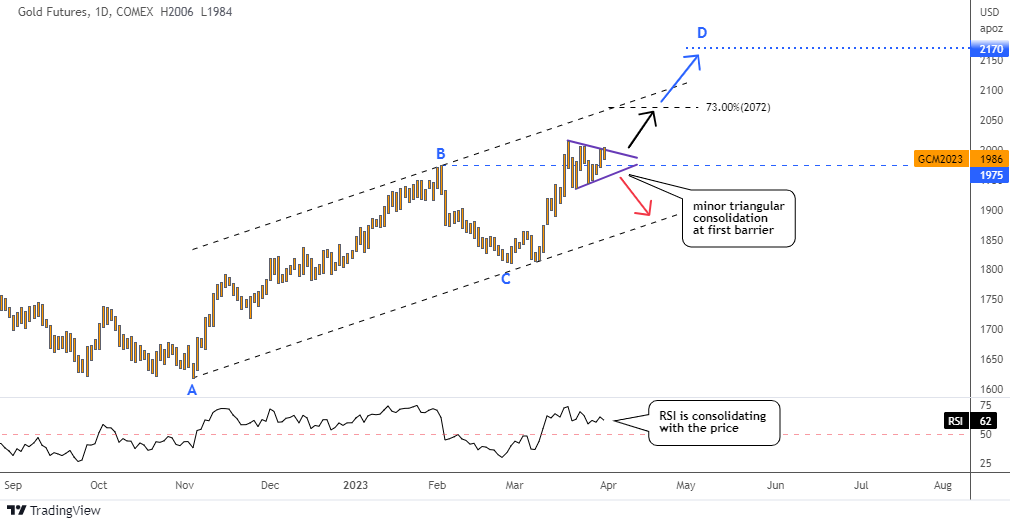
In the poll, most of you chose the green path, which suggested an extended period of consolidation for the yellow metal. However, it appears that the blue (straight bullish) and black (similar to the pattern observed in 2017) paths are more accurate, as the green path is no longer viable.

Gold Futures Daily

Source: TradingView

In just two weeks since the last update, the price of gold futures has increased by $160 or nearly 9%, reaching a high of $2,015 on March 20th. This surge in price caused the previous top at the blue B point of $1,975 to be broken, but the price has since been consolidating around this level.

The price of gold futures has formed a triangle pattern (purple) characterized by falling peaks amid rising valleys. The size of the pattern is relatively small, and last week, the price attempted to break out of the pattern to the upside but was unsuccessful.

As a result, the upside potential of the move may be limited due to the small amplitude of the pattern. Continue reading "Gold And Tesla: Bulls Check Barriers"

When Will The Balloon Pop Again?

Please enjoy this updated version of weekly commentary from the Reitmeister Total Return newsletter. Steve Reitmeister is the CEO of StockNews.com and Editor of the Reitmeister Total Return.

Click Here to learn more about Reitmeister Total Return


By far the most popular article I have written in years was from last week because it crystalized what so many of us are feeling. Here it is again:

The WORST Stock Market Ever!

Unfortunately, everything said then is just as true now. That being that the only trend is NO trend. And that is true even after a few solid days in the plus column.

Gladly, we can add a few key updates to help us plot our trading plan for the days ahead. That is what is in store in this week’s commentary below…

Market Commentary

Let’s start with a helpful analogy that will frame our discussion today. And that is to appreciate that the stock market is quite similar to a helium balloon.

Meaning that its natural state is to float higher unless it is being held down by a stronger, negative force that pushes it lower.

Please read that again so it sinks in.

Now if we pull back to the big picture, we can easily appreciate that state of floating higher is true because 85-90% of investment history is framed by bullish conditions where going up is more likely than going down. However, we find this picture to also to be the case during bear markets when negative events are removed.

Consider the start of the year…how the market climbed day by day in January. Perhaps it was because there was really nothing negative to hold stocks down. Continue reading "When Will The Balloon Pop Again?"

Opportunity To Get Ahead Of The Curve?

At the end of March, interest rates now sit at 6.32% average across the country for a 30-year fixed rate mortgage. While this is lower than a few weeks ago, they are still much higher than a year ago.

The cause is that the Federal Reserve has been raising rates aggressively over the last year to fight persistently high inflation. The Fed's goal of raising rates is to slow the economy and bring inflation back down to a normalized level or target goal of 2%.

Raising rates makes large capital expenditures for businesses or individual households more expensive, thus creating a situation where it is no longer affordable or makes good business sense to make those investments.

Fewer large investments or fewer new homes being built because the financing costs of making those purchases are too high will eventually slow the economy and thus bring inflation down.

While we all want inflation to come down quickly, it takes time for high-interest rates to flow through the system and change business leaders' and households' decision-making.

Furthermore, there is a rather big delay with the economic data that tells us how the economy is performing and whether or not large investments, home purchases, and overall spending is slowing.

This all means that when we realize business leaders-consumers have changed their minds about what investments and purchases are worth making, the economy is already slipping.

If we now look strictly at the household side of the equation, it seems clear that this group is heading toward tough times in the not-so-distant future, thus making the idea of a new home purchase much less likely.

First, we have high inflation. This is making everything across the board more expensive. Consumers' average cost of living is increasing, whether it be groceries, child care, transportation, or clothing. Continue reading "Opportunity To Get Ahead Of The Curve?"

Gold Developers At A Discount

It’s been an exciting year for the Gold Miners Index (GDX) with the index up 12% year-to-date and significantly outperforming the S&P-500 (SPY) for a second consecutive year.

This strong performance can be attributed to the recent strength in the gold price, with the metal launching 10% higher over the past month to hang out near psychological resistance at $2,000/oz.

The recent strength is a big deal for the average producer, which up until January suffered from considerable margin compression with a flat gold price since 2020 yet inflationary pressures across the board.

Unfortunately, for investors hanging out in the gold developer space, the returns have been dismal. Not only have the developers massively lagged the producers and many are scraping along the lows of their multi-year ranges, but they’re under-performing this year despite already lagging by 2000+ basis points last year as well.

This is obviously quite disappointing for investors and in some cases it may be leading to some irrational or forced selling as some investors are tired of not participating in the gold price move and choose to dump their shares.

In this week’s update, we’ll look at two names that continue to trade at massive discounts to fair value that offer a way to get leverage to gold without chasing names already up substantially year-to-date.

i-80 Gold (IAUX)

i-80 Gold (IAUX) is a $840 million market cap gold developer that has a resource base of ~15.0 million ounces of gold in the state of Nevada.

This is an enviable position to be in given that Nevada is one of the top-ranked jurisdictions globally for mining with an abundance of resources, access to a considerable workforce, and favorable permitting historically.

The company differentiates itself from its peer group for several reasons, with the main one being that it has the #1 growth profile sector-wide, with a plan to grow its production profile from ~30,000 ounces in FY2023 to ~250,000 ounces by H2 2026, with the potential to grow to 400,000 to 450,000 ounces long-term. Continue reading "Gold Developers At A Discount"

Finding A Good REIT For Today's Market

Editor’s Note: Our experts here at INO.com cover a lot of investing topics and great stocks every week. To help you make sense of it all, every Wednesday we’re going to pick one of those stocks and use Magnifi Personal to compare it with its peers or competitors. Here we go…


Real estate investment trusts, or REITs, have existed here in the U.S. since the 1960s. The mature American market means there are some interesting subsectors where investors can gain exposure.

One such asset class is infrastructure. American Tower (AMT), Crown Castle (CCI), and SBA Communications (SBAC) are the second-, fourth- and 11th-largest U.S. REITs. All three own communication towers across the country, which are leased out to mobile phone services providers, radio and TV broadcasters, government bodies, and other companies.

The other type of infrastructure popular in the REIT space is data centers. The third- and 10th-largest REITs, Equinix (EQIX) and Digital Realty (DLR), both own and lease data centers to technology companies requiring immense amounts of digital storage space.

However, the data center REITs have come under criticism. In 2022, well-known short seller Jim Chanos said he was raising money to bet against such companies, predicting that the tech giants currently renting the space would look to develop their own data centers going forward.

As Chanos put it, “…although the cloud is growing, the cloud is their enemy, not their business. Value is accruing to the cloud companies, not the bricks-and-mortar legacy data centers.”

Chanos also pointed to a wider issue in the REIT space: the risk that many are overvalued.

According to numbers compiled by FactSet, the average S&P 1500 REIT is priced at 2.39 times net asset value (NAV) and 40.2 times earnings. Also, the average S&P 1500 REIT’s net debt is 1.36 times its NAV.

However, the high multiples on REIT shares come from the fact that they have lots of exposure to high-growth sub-sectors, such as self-storage, healthcare, student accommodation, and the aforementioned infrastructure.

What we want to do this week is to compare a REIT in the sub-sector that Chanos doesn’t like — Digital Realty — and the largest of the communications tower REITs, American Tower.

The easiest way to do that is to ask Magnifi Personal to do it for us. It’s as simple as asking this investing AI to “Compare AMT to DLR.” Continue reading "Finding A Good REIT For Today's Market"