
Hello traders everywhere, Adam Hewison here, co-founder of MarketClub with your 1 p.m. market update for Tuesday the 7th of June.
Here's what's happening in the major markets ... Continue reading "1PM Recap"
Hello traders everywhere, Adam Hewison here, co-founder of MarketClub with your 1 p.m. market update for Tuesday the 7th of June.
Here's what's happening in the major markets ... Continue reading "1PM Recap"
 Trader Larry Levin, President of Trading Advantage LLC, has agreed to share one of his favorite trading tips as a special treat to our viewers. Determining the direction of the market can be tricky, and just plain confusing at times. Get Larry’s expert opinion on how to keep it simple. If you like this article, you won’t want to miss his secret one-time framing technique!
---------------------------------------------------------------------------------------------------------------------------------------------------------------------------------------
How to Pick Intraday Market Direction – the 80% Rule
Let me introduce you to one simple technique I've used to pick intraday market direction with 80% accuracy.
Would you like to know if a particular trade has an 80% probability of working? Would you like to know exactly where to enter that trade, and where to exit? Would you like to trade this technique with a 2 point stop loss or less? Continue reading "How to Pick Intraday Market Direction"
Hello traders everywhere, Adam Hewison here, co-founder of MarketClub with your 1 p.m. market update for Monday the 6th of June.
Here's what's happening in the major markets ... Continue reading "1PM Market Recap"

Yesterday you freshened up with the Williams %R oscillator. Today we have an indicator that you may or may not be familiar with as well.Like we have said before, if you have used other technical analysis indicators previously, you can use a combination of the studies and other techniques in conjunction with the "Trade Triangles" to further confirm trends.
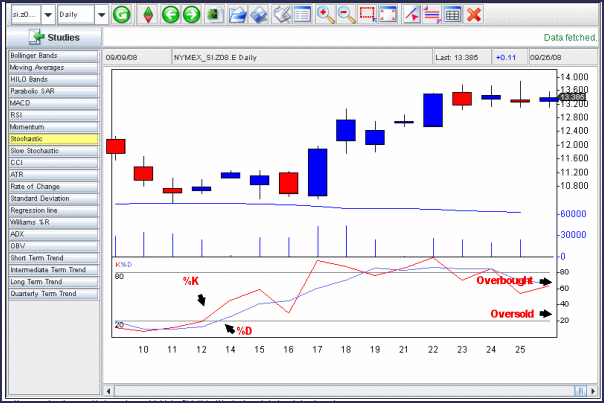
The stochastics indicator created by George Lane measures the relative position of the closing price within a given time interval. This indicator is based upon the premise that prices tend to close near the upper portion of a trading range during uptrends and near the lower portion of a trading range during downtrends. When prices close in the middle of a range, this suggests a sideways market. There are two components to this calculation, the %K value and the %D value. The %K is calculated as follows: %K= (C-Ln / Hn – Ln) x 100 where C = closing price of current period, Ln = lowest low during n time periods. Hn = highest high during n time periods and n = number of periods.
The %D value is the moving average of the %K value. The simple moving average calculation is: %D = 100 (Hn / Ln) also in the %K formula.
These formulas produce two lines that oscillate between a scale of 0 and 100. As with the other oscillators, a stochastic value below 30% suggest an oversold condition, while a value greater than 70% suggests an overbought condition.
Some simple trading rules apply in the use of the stochastics indicator. A sell rule would be to sell when the fast (%K) crosses over the slow (%D) and both are pointing down, but are still above the 70% level. A buy signal would be triggered when the fast crosses the slow, and both point up, but are below the 30% level.

Another type of signal occurs when the stochastics indicator diverges from a price move similar to momentum and RSI.
---
 You can learn more about the Stochastics and George Lane by visiting INO TV.
MarketClub is known for our "Trade Triangle" technology. However, if you have used other technical analysis indicators previously, you can use a combination of the studies and other techniques in conjunction with the "Trade Triangles" to further confirm trends.
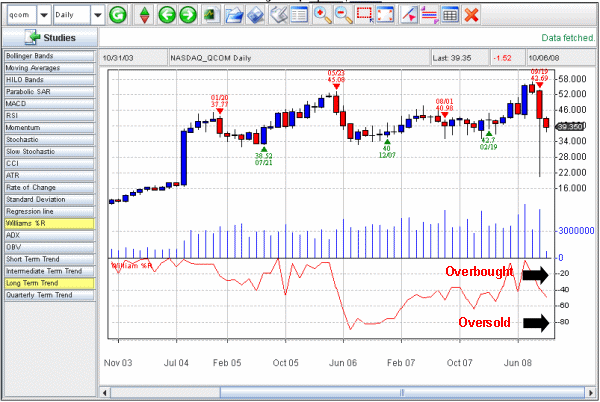
Williams' %R oscillator, attributed to Larry Williams, is a variation of the stochastics indicator previously discussed. Because the two oscillators are essentially the same, only minor modifications to the formula are required. The formula for calculating %R is: %R = Hn – C / Hn – Ln where Hn = highest high of the period, C = Close of the current period and Ln = lowest low of the period.
The %R oscillator differs from the %K formula in the stochastics indicator because the outcome of each formula is inverse to the other. In other words, %K compares the close with the lowest low, whereas %R compares the close with the highest high. Similar to other oscillators, %R is plotted with horizontal zones of 20% and 80%. When the indicator has a reading of -80% or below it signifies an oversold condition. Similarly, a reading of -20% or above signals an overbought condition.
---
You can learn more about the Williams %R and Larry Williams by visiting INO TV.
You are now leaving a Magnifi Communities’ website and are going to a website that is not operated by Magnifi Communities. This website is operated by Magnifi LLC, an SEC registered investment adviser affiliated with Magnifi Communities.
Magnifi Communities does not endorse this website, its sponsor, or any of the policies, activities, products, or services offered on the site. We are not responsible for the content or availability of linked site.
