3 Meme Stocks to Avoid

Meme stocks witness unusual rallies solely based on retail investors’ interest in them. Retail investors gather on social media platforms such as Reddit, Stocktwits, Twitter, and Facebook and bet on fundamentally weak stocks to trigger a short squeeze. As the skyrocketing rallies in these stocks have little to do with the fundamentals of the companies, they fail to sustain the high price levels they reach.

The meme stock mania, born during the peak of the COVID-19 pandemic, has recently returned after a pause for a few months, as evident from unusual rallies of certain fundamentally weak stocks. Since the surge in meme stocks is usually disconnected from the companies’ fundamentals, investors should shun them amid an uncertain market outlook.

The Consumer Price Index (CPI) for August rose 8.3% year-over-year. And the rampant inflation enhances the chances of the Federal Reserve maintaining its hawkish stance, pushing an already weakening economy into a recession. Thus, the stock market is expected to remain under pressure in the foreseeable future. This is a good enough reason to avoid the risk associated with meme stocks.

Hence, fundamentally weak meme stocks Robinhood Markets, Inc. (HOOD), AMC Entertainment Holdings, Inc. (AMC), and Bed Bath & Beyond Inc. (BBBY) are likely best avoided now.

Robinhood Markets, Inc. (HOOD)

HOOD operates a financial services platform in the United States. The company’s platform enables users to invest in stocks, exchange-traded funds (ETFs), gold, options, and cryptocurrencies. In addition, it provides learning and education solutions, including Snacks for business news stories, News Feeds that give access to free premium news from different sites, and first trade recommendations.

In August, HOOD announced its second round of layoffs this year, slashing 23% of its headcount by letting go of 800 employees, with marketing, operations, and product management functions of the firm being the most impacted. The company blamed the worsening of the economy, including inflation and the crypto market crash, which had reduced customer trading activity and assets under custody.

Financial services companies are also struggling with a shrinking active user base and increasing regulatory pressure. The monthly active users (MAU) declined 1.9% million sequentially to 14 million for June 2022, as consumers navigate an environment marked by high-interest rates and surging inflation.

For the fiscal 2022 second quarter ended June 30, 2022, HOOD’s revenues decreased 43.7% year-over-year to $318 million. Its operating expenses increased 21.8% from the year-ago value to $610 million. The company’s adjusted EBITDA was negative $80 million, compared to $90 million in the prior-year period.

In addition, the company’s net loss and loss per share attributable to common stockholders amounted to $295 million and $0.34, respectively.

The consensus revenue estimate of $353.60 million for the fiscal year 2022 (ending December 2022) represents a 24.7% decline from the prior-year period. The company’s loss per share is expected to come in at $1.14 for the current year. Furthermore, the company has missed the consensus revenue estimates in each of the trailing four quarters.

HOOD’s shares have slumped 21.4% over the past six months and 44.4% year-to-date to close the trading session at $10.26. Continue reading "3 Meme Stocks to Avoid"
Where do you think USDJPY will go?

The Japanese yen is the second largest component of the Dollar Index (DX). It occupies 13.6% of it.

The real interest rate differential is the main reason behind the current severe weakness of the yen. I have already visualized it for you in my earlier post in August.

The Bank of England (GBP, 3rd largest part of DX) and lately the European Central Bank (EUR, the largest component of DX) raised their interest rates significantly during the last meetings. The Bank of Japan (BOJ), the Japanese Central Bank has kept its negative rate of -0.1% since 2016. Moreover, it repeated that it would not hesitate to take extra easing measures if needed, falling out of a global wave of central banks tightening policy.

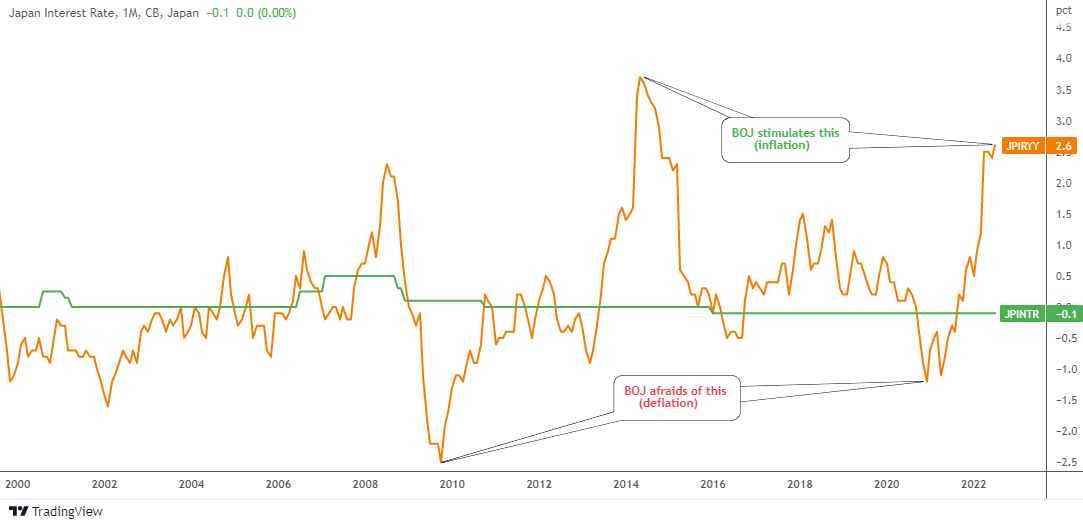
Why BOJ is so dovish? There are several reasons. One of them, the history of inflation as shown in the chart below.

JPN Interest Rate VS Inflation

Source: TradingView

Japan has had a chronic deflation since the 1990s after the asset bubble burst. We can see how short term spikes of inflation (orange line) into the positive territory were short-lived. The BOJ didn’t even touch the interest rate in spite of inflation that has soared to unseen levels of 3.7% in 2014. This time around, the inflation didn’t race to the same peak and as I wrote above, the BOJ thinks of an opposite – easing!

The BOJ governor Mr. Kuroda said in the summer “If we raise interest rates, the economy will move into a negative direction.” The Japanese Central Bank does not want to cause a recession as the economy is still fragile.

Maybe the next chart could clarify the logic of the BOJ. Continue reading "Where do you think USDJPY will go?"

AstraZeneca’s (AZN) Blockbuster Drug Pipeline

Finding winners in the pharmaceutical sector is not an easy process. But it is potentially quite lucrative.

For the pharmaceutical companies themselves, the current environment for success is reminiscent of the Greek myth surrounding Sisyphus, whom the gods condemned to repeatedly roll a boulder up a hill—only to have it roll down again once he got it to the top—for all eternity.

Today’s pharmaceutical firms must use vast amounts of capital in search of a blockbuster drug, which can generate $1 billion or more in annual sales. But then, even when such a medicine is found, the benefits provided are fleeting: from the moment a drug makes it to market, the clock begins ticking on its patent exclusivity. Once this expires and generic copycats reach the market—typically within a decade or so—revenues for the original inevitably fall, and often quite rapidly.

Then, like Sisyphus, the companies climb the hill of developing blockbuster drugs again, investing anew in the whole risky and costly process of drug development.

If you are an investor in the sector, you want to focus on the companies that have drugs in their pipelines with blockbuster potential, as well as the funds necessary to propel them through several trial stages.

Since 2010, the global pharmaceutical sector has invested the equivalent of around one quarter of its revenues in drug development each year. The U.S. industry alone spent some $83 billion on R&D in 2019—when adjusted for inflation, that’s about 10 times what it spent in the 1980s!

So, which segments of the pharmaceutical industry (and which drug companies) are poised to come up with the next blockbuster drugs?

Precision Therapies

Recent advances in science are ushering in a new era of highly effective personalized medicines. So-called precision therapies are based on greater understanding of how diseases work on a molecular level. This translates to doctors being able to identify what treatments fit which patients, and why.

Precision therapies are tailored to fit specific groups of people. This means they will likely be highly effective. But can cutting-edge personalized medicines reach blockbuster drug status? The naysayers say the market size is too small…but they seem to forget that innovative drugs can command very high price tags.

Consider recent data from the drug price tracking service division of GoodRX (GDRX). It shows that, after 15 years on the market, the average drug with accelerated approval by the FDA underwent 15.4 price increases. Drugs subject to conventional approval saw 12.7 price increases in the same span of time.

Keeping an eye on the list of development-stage therapies expedited through the FDA’s approval processes can provide insight into which companies have potential blockbusters in the pipeline. Continue reading "AstraZeneca’s (AZN) Blockbuster Drug Pipeline"

ARKK Fund's Wild Ride

After its first year of trading in 2015, the ARK Innovation ETF (ARKK) increased by 87.38% in 2017!

The fund produced a gain of 3.76% in 2015 and a small loss of 1.96% in 2016, all of a sudden, the boom in 2017! 2017 was followed up by another modest gain of just 3.58% in 2018. But in 2019, ARKK made 35.73%.

Then, despite 2020 being the year we will all remember the Covid-19 pandemic beginning in the United States and the stock markets crashing when the country shut down in an attempt to slow the spread of the deadly virus, ARKK showed its investors a return of 152.52%.

Unfortunately, in 2021, the fund did not perform as well, actually posting a loss of 23.35% for the year. And while we still have a few months left in 2022, year-to-date ARKK is down 49.17%.

Even though 2021 and 2022 have not been good to ARKK, the fund is still up an annualized 16% over the last five years. That is due to the incredible performance it experienced in 2019 and 2020.

Since its inception, some would say ARKK has been somewhat volatile. That is primarily due to the fund's lead investor, Cathie Woods, and how she takes what many would consider 'very long-shot bets.' Woods often invests in unproven technologies and companies trying to develop cutting-edge technology.

Cathie Woods believes the future of technology will, if it already hasn't, truly change the world. By looking at the performance of not just her flagship fund, ARKK, her other funds all focus on the same idea; finding innovative companies. But that comes with risk.

And Cathie Woods' ARK funds have a lot of risk in them. If the companies Woods invests in don't perform well, Woods funds take big hits. But, the other side of this coin is also at play. Continue reading "ARKK Fund's Wild Ride"

2 Restaurant Stocks In Undervalued Territory

It’s been a challenging year thus far for the restaurant industry, with dollars typically allocated to entertainment and a Friday night out wrestling to steal priority from rising gas bills, elevated energy costs, and higher mortgage rates.

Some restaurants have resorted to discounting to drive traffic, while others have relied on menu innovation and limited-time offers vs. promotional activities to protect their already softening margins.

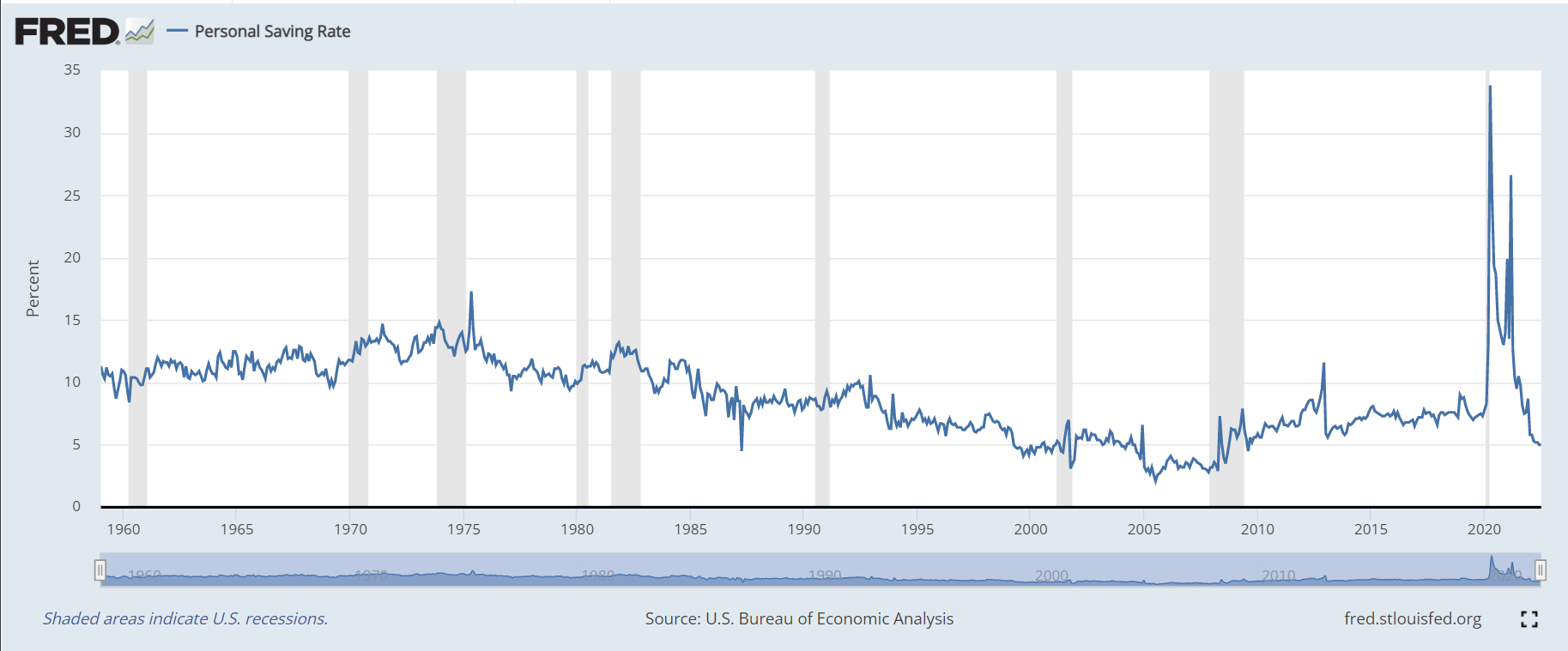
FRED Personal Saving Rate

(Source: Twitter, ND Wealth Management, Steve Deppe)

Those brands that are the most out of touch have continued to raise prices at a double-digit pace to ensure they maintain margins, with Chipotle (CMG) being one such offender. While this is likely to protect margins in the interim and allow the company to meet earnings estimates, it could backfire over the medium-term, with loyal customers feeling taken advantage of after being hit with consistent menu price increases in a recessionary environment.

Although this has made it difficult to invest in the sector, a few names are doing a great job navigating the current environment, and following recent share price weakness, they’ve slipped into undervalued territory.

One is a new breakfast chain that’s bucking the negative traffic trends in the casual dining space and enjoying industry-leading retention due to a key competitive advantage. The other is a pizza chain that’s enjoying strong unit growth, and while it’s having a tough year, annual EPS is forecasted to hit new all-time highs in FY2023 and FY2024.

Let’s take a look below: Continue reading "2 Restaurant Stocks In Undervalued Territory"