ETFs - How They Help Build Wealth

The idea of pooling investment assets has been around for centuries. Mutual Funds first appeared in the 1920s. But it wasn’t until the 1980s that mutual funds became widely popular with mainstream investors.

In recent years, ETFs have taken off as an alternative to mutual funds.

An exchange-traded fund (ETF) is a “basket” of stocks, bonds, or other financial instruments that gives convenient exposure to a diverse range of assets. ETFs are an incredibly versatile tool that can track anything from a particular index, sector, or region to an individual commodity, a specific investment strategy, currencies, interest rates, volatility, or even another fund.

You can do about anything with them — hold a diversified portfolio, hedge, focus on a particular sector, or even profit in a bear market.

The most significant practical difference between mutual funds and ETFs is that ETFs can be bought and sold like individual stocks — and mutual funds cannot. Mutual funds can only be exchanged after the market closes and their Net Asset Value (NAV) is calculated. Shares of ETFs can be traded throughout regular market hours, like shares of stock.

Both mutual funds and ETFs have expense fees that can range from low to high. Mutual funds can have front or backend loads or redemption fees in addition to management fees.

ETFs that trade like shares have commissions to buy and sell. But some ETFs are so popular that brokers offer commission-free trading in them.

So Many Choices

The sheer number and variety of ETFs can be a bit mind-boggling. Over the last 20 years, we’ve seen just a couple hundred ETF offerings grow to more than 8,000 worldwide, encompassing more than 10 trillion in assets.

A surprising number of ETFs have failed. They started with an interesting focus (well, “interesting” to somebody) but failed to attract enough interest to remain viable. For this very reason, I avoid narrow niche ETFs that trade with low volume.

I eliminate many ETFs on poor liquidity alone. I’m not interested if there’s not much volume in a product. I don’t want to suffer high slippage from wide bid/ask spreads. I want to get in and out quickly and at fair prices. Continue reading "ETFs - How They Help Build Wealth"
3 Stocks to Sell if You're Bearish on Crypto

The largest cryptocurrency, Bitcoin, topped the $20,000 barrier on Friday on optimistic market sentiments about a possible drop in inflation numbers. The second largest crypto, Ether, also rose on Friday.

However, additional interest rate hikes will likely constrict the economy, which is expected to create pressure on the relatively riskier crypto market. Experts believe cryptocurrencies will continue a downtrend amid the volatile economic backdrop.

Moreover, digital currencies might face heightened regulations in the future. Gary Gensler, the current SEC chair, stated that the Commodity Futures Trading Commission (CFTC) needs greater authority to oversee and regulate crypto non-security tokens and related intermediaries.

Moreover, with the much-anticipated Ether merge expected to occur soon, the crypto market might experience more volatility. Hence, the blockchain stocks Block, Inc. (SQ), Coinbase Global, Inc. (COIN), and Riot Blockchain, Inc. (RIOT) might be best avoided now.

Block, Inc. (SQ)

SQ engages in the creation of tools that enable sellers to accept card payments and provides reporting and analytics and next-day settlement. The company also provides hardware products.

On July 13, SQ subsidiary Afterpay and beauty retailer Sephora announced their partnership to enable customers to pay for U.S. beauty brands and products in four installments. However, the gains from this partnership might be stretched over a long period of time.

For the fiscal second quarter that ended June 30, SQ’s total net revenue decreased 5.9% year-over-year to $4.40 billion. Adjusted net income decreased 56.8% from the prior-year quarter to $110.74 million. Adjusted net income per share declined 63.3% from the same period the prior year to $0.18.

The consensus revenue estimate of $17.60 billion for the fiscal year 2022 indicates a 0.3% year-over-year decrease.

The stock has declined 70% over the past year and 54% year-to-date to close its last trading stock at $74.29. Continue reading "3 Stocks to Sell if You're Bearish on Crypto"

Gold/Silver Ratio Shows S&P 500 Is On The Edge

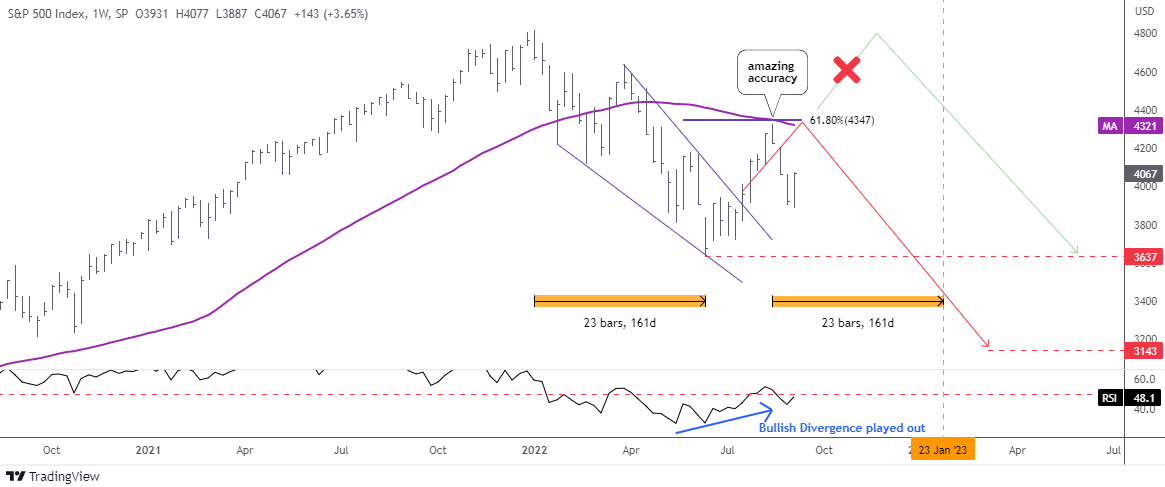
It’s time to update the S&P 500 index chart as it emerged inch-perfect since the last update in July.

SP500 Weekly Chart

Source: TradingView

To refresh your memory, I kept the main paths untouched and added new crucial highlights.

The idea of the upcoming breakout of the Falling Wedge pattern (blue converging trendlines) was posted right on time on the Blog as it played out instantly. Indeed, the Bullish Divergence of the RSI indicator with the price chart played out as planned supporting the breakup of the pattern’s resistance.

The majority of readers got it right choosing the red path as a primary scenario. The price action has been amazingly accurate in the 61.8% Fibonacci retracement area where the price failed to overcome the barrier and reversed to the downside from the minor top of $4,325 following the red zigzag.

I added the 52-week simple moving average (purple) to show you how strong the double resistance was at the $4,347-$4,349 level.

The next support is located in the valley in June at $3,637. Continue reading "Gold/Silver Ratio Shows S&P 500 Is On The Edge"

Natural Gas Opportunity For Savvy Investors

On August 31st, Russia's state-owned energy company, Gazprom, stopped the flow of natural gas in the Nord Stream 1 pipeline. The pipeline ran from Russia to Germany and was scheduled to be discontinued from August 31st until September 3rd. But September 3rd came and went, and the pipeline remained shut down.

At first, an oil leak was reported, causing the pipeline to remain shut down. But then, it was evident that the shutdown was in retaliation to the sanctions the West had implemented against Russia due to the war in Ukraine.

Many experts predict the economic pain in Europe will increase as the cold weather sets in across the continent. Some have gone as far as to say that the economic pain will be felt in both the coming winter and next winter, 2023-2024. Some are even saying that energy rationing will be required to ensure everyone has enough natural gas for heating.

However, many in Europe have been planning for this to occur for some time. Russia had reduced the pipeline operating volume to just 20% of what it could provide.

This was far less than what Europe comfortably needed to make it through winter. Thus, the European Union and other entities have been working on replacing the lost volume through other means. So while the pipeline shutdown is not ideal, it was predicted to happen at some point this winter.

Many are saying Russia is attempting to weaponize its gas supply to hurt the EU and other nations in an attempt to have Western countries drop or reduce sanctions against Russia.

At this time, there is no sign that either the EU or Russia will bend to the will of the other, and it is likely that we will continue to see elevated oil and gas prices in Europe. Thus, comes the opportunity for savvy investors.

I want to note that I am not condoning an attempt to profit from someone else's pain and suffering. I want to point out the high likelihood that natural gas prices will likely increase this winter as the EU finds ways to replace the gas they acquired through the Nord Stream 1 pipeline.

With that all said, let's look at a few of the options you have if you want to invest with the idea that gas prices will rise this winter. Continue reading "Natural Gas Opportunity For Savvy Investors"

After The Student Loan Bailout

Should President Biden's recent pay-for-votes forgiveness of student loans make you nervous if you own government-guaranteed securities?

Although it seems highly unlikely, the student loan giveaway could create a slippery slope that leads next to mortgage forgiveness for veterans or some other protected or politically favored class, or some other form of federal debt relief. 

In that event, what would happen to so-called government-guaranteed securities backed by VA mortgages if the president declared that some or all of those loans were forgiven? Why not FHA loans, that are made to many of the same people who have student loans, i.e., those who supposedly have trouble paying back their loans or getting them in the first place because they have marginal credit or can’t afford a large down payment.

It wasn’t very long ago that Fannie Mae and Freddie Mac, the twin secondary mortgage agencies, failed and were taken over by the government, leaving equity investors with shares worth next to nothing (both are currently trading at about 50 cents a share on the pink sheets).

Before they went bust during the global financial crisis, it was widely assumed that Fannie and Freddie were backed by the full faith and credit of the U.S. government, which turned out not to be the case (as that great legal scholar Felix Unger reminds us).

Assuredly, mortgages backed by the VA and FHA are different animals than those issued by Fannie and Freddie, but that doesn’t mean they’re invulnerable (they historically have high default rates). With interest rates on mortgages now north of 5% and a recession possibly looming, how long will it be before pressure grows on Biden to give the weakest homeowners a break?

Now it doesn't seem so far-fetched, does it? Today student loans, tomorrow home mortgages. How far do we want to take this? 

In the past we've heard some people say we should weaponize Treasury securities against our foreign adversaries, such as the Chinese, who own so much of our debt. Does this now become a little less of a fantasy and more of a possibility, as our relationship with Beijing continues to deteriorate and the president is in such a forgiving mood?

The actual dollar cost of Biden’s student loan giveaway has yet to be calculated, but it’s safe to say it’s a lot more than he and his defenders claim. Some analysts say the total cost will be about $1 trillion, which certainly seems reasonable. It could certainly add up to a lot more, if and when those saps who are still repaying their loans wake up and realize that they have indeed been duped and demand forgiveness, too, or simply stop paying. Continue reading "After The Student Loan Bailout"