Psychological Financial Fusion and The Dow Jones Transport Index

Today I asked the team from Psychology of the Call to open our eyes to an index that is often overlooked...or misunderstood as it relates to current or historic trends! I for one really didn't know too much about DJT and how it's been connected to our economic situation. Please enjoy the lesson and be sure and drop by Psychology Of The Call and tell them we sent you!

==================================================================

The Dow Jones Transportation (DJT) Index is a trusted leading economic indicator followed by wise men. The index was created by Mr. Charles Dow in 1884, a time when railroads were as important as today's internet superhighway, perhaps even more so. The index consisted of 11 stocks of which 9 were railroads, and all aboard have been derailed of late.

The deleveraging and divesting of every asset class in the cosmos has not been kind to the transport industry's equity holders, yet this sudden business shock may work to strengthen their business models as the world begins to dig itself out of this unprecedented trough.

Today's DJT is made up of 20 stocks of which only 4 are railroads: Burlington Northern (BNI), CSX Corp (CSX), Norfolk Southern (NSC), and Union Pacific (UNP). The other 16 stocks are airlines, trucking, and shipping.
http://en.wikipedia.org/wiki/Dow_Jones_Transportation_Average

Interestingly enough, today's talking heads insist on quoting the S&P 500 index as the best leading economic indicator, yet the DJT Index is 68 years its’ senior. That takes us back to just after President James A.. Garfield (R-20th) became the second U.S. President to be assassinated. The unfortunate event enabled Vice President Chester A. Arthur to take power.

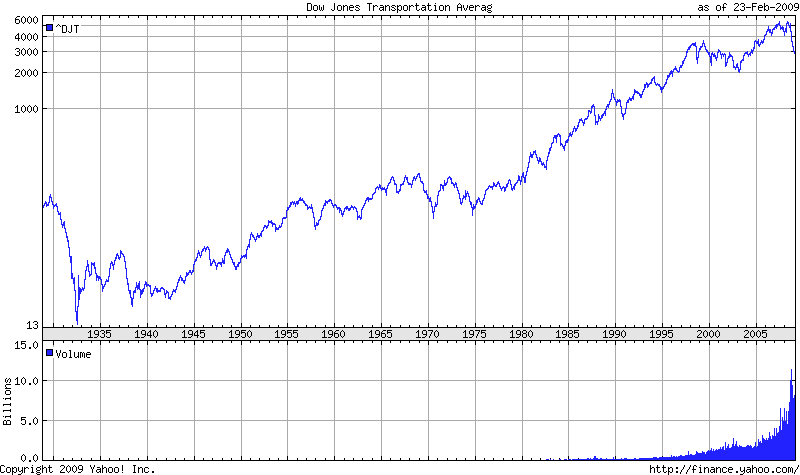
Here's a maximum time frame chart that doesn't even go back to its beginning in 1884:
Since corporate financial officers (CFO) are always striving to lower costs, many today would think their jobs have become easier since oil has fallen over $100/barrel, but that can't be further from the truth.
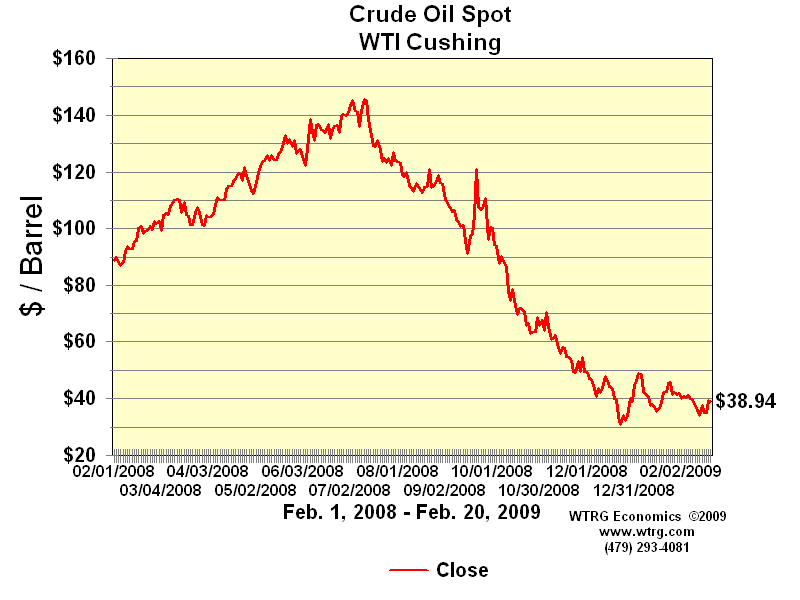
As CFOs experience this lower cost, the global economic slowdown is taking an even bigger toll on sales, share price, earnings per share, and margins. Profit margins at many of these companies are contracting due to desperate attempts to hedge what was a run-away oil market. Some airline CFOs stock piled crude supplies after it broke through $100/barrel, then $90/barrel, and so on. Thus the current price of sub $40/barrel has them miffed as global deleveraging is causing a domino effect of business contraction with the added burden of a higher crude cost supply glut in the short-term, yet not necessarily all are managed the same.

Even though the DJT's are a cyclical bunch, they usually signal an economic recovery before most other sectors since they must deliver raw materials from point A to point B. The raw materials are then utilized by manufacturers before eventually being sold at your Best Buy, WalMart, or Sears. The signals aren't looking too positive from a fundamental aspect of late since GDP and unemployment continue to suffer. The short-term technicals aren't giving us any bullish confirmations either. Notice  the DJT's dragging the S&P lower in this 3 month chart, foreshadowing a lower stock market ahead:

^GSPC = S&P 500
^DJT = Dow Jones Transportation Index
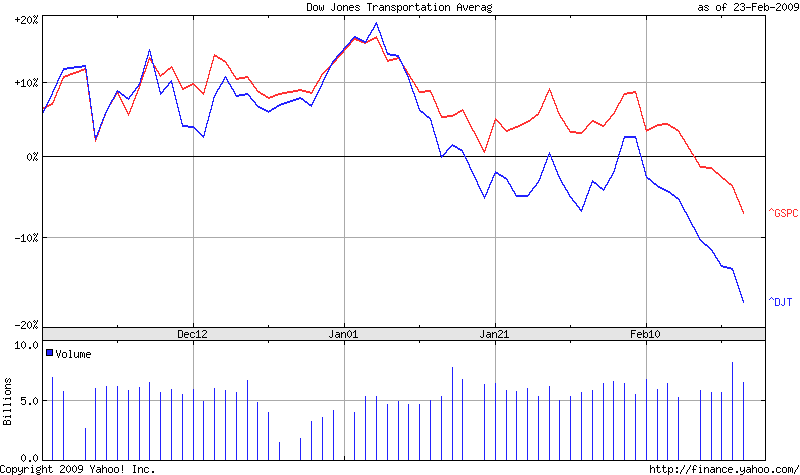
Since the DJT index is a corner stone of market history, forward-thinkers would be wise to follow it and use it in addition to the S&P when setting up pivot points for trades.

The financial sector is still a large weight inside the S&P index, and yet it hasn't dragged the S&P below the DJT in the last 3 months. The index is not signaling a sustained economic recovery anytime soon. The longer-term (5 year) chart reveals fairly solid footing in the 2,600 range, yet forward-thinkers respect the over-shoots that a climactic bottom prints.
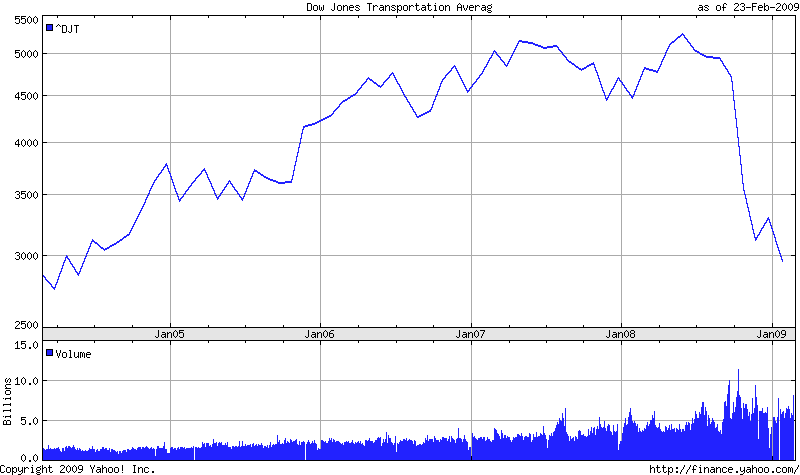
While you can invest in thousands of stocks that are not directly part of the DJT, just about every stock you choose will be at the mercy of some transport cost(s). So please give some respect to the Dow Jones Transportation index; it has stood the test of the most powerful judge, Father Time. If you share our optimism in an eventual economic recovery, monitor this index in the next few days, weeks and months; it may help you profit.
Psychology Of The Call

Parabolic Trading System

Last week I invited Mark McRae from SureFireTradingChallenge.com, to come and break down support and resistance..and did he ever! Check it out HERE if you missed it. After the post went live we received a ton of feedback with regard to the post AND Mark's project, SureFireTradingChallenge.com, and all the feedback was positive!

So I wanted to give you the chance to learn from Mark again. This time I asked him to go into the Parabolic SAR and the trading system that goes with it. Adam is a HUGE fan of the SAR, as you know, and I think this post will help you see why Adam and Mark both use it. Don't forget to swing by SureFireTradingChallenge.com and give Mark your feedback there.

======================================================================

This particular technique has been around a long time and is still widely used by many analysts because of its adaptability to most markets.

History

The parabolic time/price system was first introduced by J. Welles Wilder Jr. in his book 'New Concepts In Technical Trading Systems'. It is very often referred to as the SAR system meaning stop and reverse. This means when a stop is hit the system reverses so it is permanently in the market.

The actual point at which the system is reversed is calculated on a daily basis (or whatever time period you are looking at) and the stop moved to create a new reverse point. The SAR point never backs up.

In other words if you are long the market the SAR point will increase every day. The same is true for short positions. This is the time part of the system.

The other important part of the system is the speed at which the SAR point moves. If the market is moving fast the SAR point will move slowly at first and then increase as the market moves higher, this is the price part of the system. The rate at which the system increases is called the acceleration factor.

It is beyond this lesson to give the exact calculation of the acceleration factor and it is not really necessary to know the formula as most charting services now incorporate the system in their indicator range.

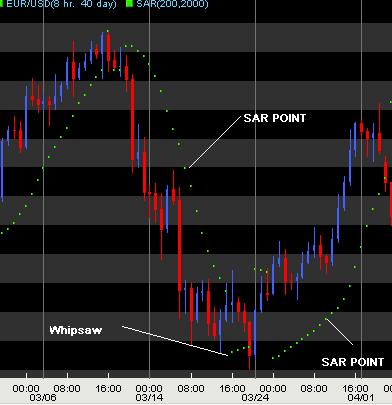
Example of what SAR looks like.

My Use Of SAR

So far so good. The system is simple to trade and is very visual so it's easy to know when you should be short or long. If the SAR point (dots) are above the market you should be short and if they are below the market you should be long.

Here's the problem! It doesn't perform very well in the markets I have tested it on nor do I know any traders who trade it as a stand-alone system. Maybe in the markets of the past it would have worked well but not so now. The problem is there is just too much whipsaw.

Now you may be asking if there is too much whipsaw why mention the system at all? Good question and here are two reasons I find a good use for the system.

* The system can be very effective if a filter of some sort is used. In the example below of the eur/jpy I have used a MACD as a filter. If we were long the market then only long signals would be taken and the short signals ignored as long as the filter (MACD in this case) remains long. If a short signal is triggered but the filter still remains long you could close the position and wait for the next long signal. The reverse is true for short positions. You could use any oscillator you feel comfortable with or even trend lines.

* Sometimes it can be very difficult to find a good place to put your stop. With the SAR system you will always know exactly where to place a stop and it will increase everyday to help lock in profits. It also gives the move enough room for market corrections without taking you out of the position. I like this particular method if I have a long-term position which; I only want to check on once a day. I can quickly check how the position is and then move my stop accordingly.

I am sure you can find many other uses for the SAR system and its well worth playing around with the parameters to see if it can be added to your trading arsenal.

Good Trading

Mark McRae

==================================================================

Be sure and visit SureFireTradingChallenge.com to learn more about Mark and the contest!

The BIG FIVE TRENDS

The BIG FIVE TRENDS

In my new, short five minute video, I analyze the major trends in what I call the big five. We'll be looking at the DOW (INDEX_DJI), the Dollar index (NYBOT_DX), crude oil (NYMEX_CL.J09.E), gold (FOREX_XAUUSDO), and the CRB index (NYBOT_CR).

I will show you step-by-step how to analyze each of these markets quickly to get the trend.

Once you discover this simple approach, you'll be amazed at just how accurate it is over time.

This is one of my most important videos and I want you to be able to see it without having to register or pay a fee to watch it. I honestly believe that my new video can make a world of difference to how you approach the markets in the future.

Every success and enjoy the video.

Adam Hewison
President, INO.com
Co-creator, MarketClub

Putting Theory into Practice (2 Classic Teaching Videos)

First we show you the theory ...


Now see the theory put into practice
.


When you learn how the markets really work you will automatically benefit from this pattern in the future.


Adam Hewison
President, INO.com

Asian stock markets mostly higher on Citi report

By JEREMIAH MARQUEZ
AP Business Writer

(AP:HONG KONG) Asian stocks were mostly higher Monday, with Hong Kong and South Korea's benchmarks up more than 2 percent, amid reports the U.S. government might take a larger stake in troubled banking giant Citigroup to ease the financial crisis.

Worries that major Western banks, crippled by growing losses from bad assets, might have to be nationalized sent markets sharply lower last week.

But investors seemed relieved to have some clarity about the fate of Citigroup after the Wall Street Journal, citing people familiar with the situation, said late Sunday that Citigroup Inc. is negotiating with authorities to increase the U.S. government's stake in the teetering lender to as much as 40 percent.

Executives would prefer to keep the government's stake closer to 25 percent, according to the Journal, which reported Citigroup made the proposal to regulators.

So far, President Barack Obama's financial rescue plans have met a lukewarm reception. But analysts say such a move could help restore confidence by finally bring a measure of stability to the hard hit financial sector, further boosting the chances for an economic recovery.

"People are taking it as a positive sign," said Francis Lun, general manager of Fulbright Securities Ltd. "It shows the government will not allow a major bank to fail again. They've learned their lesson with Lehman Brothers that the ramifications are so great, sometimes no amount of money can rebuild confidence."

Hong Kong's Hang Seng rose 291.26, or 2.3 percent, to 12,990.43 and South Korea's Kospi was up 25.39, or 2.4 percent, at 1091.22.

In mainland China, the Shanghai benchmark added 0.4 percent. Markets in Taiwan and the Philippines also edged higher.

In Japan, the Nikkei 225 stock average lost 29.12 points, 0.4 percent, to 7,387.26 as the yen strengthened against the dollar, thought recouped some its losses. Australian shares also fell.

U.S. futures were higher on the Citigroup report, suggesting Wall Street would recover at the open. Dow futures rose 67 points, or 0.9 percent, to 7,419 and S&P500 futures were up 7.8 points, or 1 percent, at 777.30.

Last Friday, continuing financial and economic worries sent the Dow Industrials down 100.28 points, or 1.3 percent, to 7,365.67 On Thursday, the Dow broke through its Nov. 20 low of 7,552.29, and closed at its lowest level since Oct. 9, 2002.

The Standard & Poor's 500 index on Friday fell 8.89, or 1.14 percent, to 770.05.

Oil prices were steady in Asian trade, with light, sweet crude for April delivery up 35 cents at $40.38 barrel. The contract edged down 15 cents to settle at $40.03 Friday.

In currencies, the dollar fell to 92.85 yen from 93.32 yen, while the euro strengthened to $1.2913 from $1.2825.