Gold Futures And Coins Out Of Sync

BY TRANG HO

INVESTOR’S BUSINESS DAILY

Posted 10/21/2008

Gold has been losing its luster as the dollar strengthens. The yellow metal fell almost 4% Tuesday as the dollar rallied to a 1 1/2-year high against the euro.

But gold still shines in some quarters. A mad rush for gold and silver coins that started in July has left dealers’ shelves across the country bare. Gold now trades with a two-tiered pricing structure.

The only coins for sale are on eBay, (EBAY) where sellers want an 18% to 35% premium. Silver coins at some dealers are fetching as much as 80% over spot prices.

Buyers also snatched up silver, platinum and palladium coins. Sales picked up 500% in July, and in September vaulted to 12 times average monthly sales as major banks collapsed, said a coin and bullion dealer who asked not to be named.

Fundamental View, A Bull Case

“With all the integrity and trust issues of the marketplace today, counterparty risks, etc., gold and silver’s ultimate status as money, as a safe-haven asset, is driving buyers into the real product,” said Peter Spina, president of GoldSeek.com.

“The safe haven for Americans is to live in the U.S. The safe haven for everyone else is get out of their currencies and buy gold,” said Tom Winmill, portfolio manager of Midas Fund, which specializes in precious metals and natural resources.

“We don’t know when (gold) will recover, but it will because global demand for commodities isn’t going away,” Winmill added.

Gold is also a “screaming buy opportunity” in his view because it’s trading at an unusually deep discount relative to the AMEX’s Gold BUGS Index or HUI. The HUI is an index of gold miners.

Technical View, A Bearish Case

A chart of gold prices provides a different view. It shows evidence that the precious metal lacks some of its safe-haven traits these days.

The spot price for gold peaked in March at $1,011 an ounce and has been trending downward ever since. It’s fallen 21% from its high and has made a series of higher lows and lower lows. The 10-week moving average crossed below the 40-week average in September and both lines point south — a bearish signal.

Long- and short-term trading signals flashed a sell signal on spot gold Thursday when it fell to $817.45 an ounce, according to Adam Hewison, president of INO.com, who trades based on his MarketClub software program. He expects the yellow metal to fall to $700 to $720 an ounce.

On the bright side, gold has held up better than other commodities since they peaked in July. Silver, as tracked by iShares Silver Trust, (SLV) has collapsed 51% from its high. Spot copper has plunged 48% from its peak of $4.06 per pound and now trades at $2.11.

Crude oil has skidded 49% from its peak of $145.66 a barrel, trading Tuesday at about $74. Gold has also held up better than the S&P 500, which trades 37% below its October 2007 high.

Hedge funds have played a role in the sell-off, Spina notes. Falling commodities prices have forced hedged funds to sell positions to meet margin calls and raise cash.

“As with nearly all markets, a massive deleveraging has been occurring, and the gold and silver markets have not been immune to this violent process,” Spina said. “There will be more victims of the fund collapse and more forced liquidations even if it requires them to sell their most desired assets like precious metals.”

A recession may spur deflation. Gold wouldn’t be a safe haven under such conditions, according to Dennis Slothower, president of Alpine Capital Management, with more than $100 million in assets under management.

“In a deflationary environment, investors want out of the market totally,” Slothower said.

He notes that in the recession of the early ’80s, gold peaked at $850 an ounce.

—-

Article posted on 10/21/08 by Investors Business Daily. See original posting here: http://www.investors.com/editorial/IBDArticles.asp?artsec=28&issue=20081021

A Life Changing Opportunity

I don't think anyone would consider themselves a wild investor...except The Wild Investor! With the market swings, government bailouts, and political stumping we need some good news. I asked The Wild Investor to come and give us some good news and how we can benefit from all the news. Enjoy!

==================================================================

When you think about the events that have taken place over the last year it almost feels like we are reading a book that is still being written. By the time we find a way to pull ourselves out (and we will) of this downward spiral of a market, the shelves will be littered with How I Survived the Credit Crisis Era books and paraphernalia.

You see the media has a way of exacerbating situations. While many of these outlets try to be as neutral as possible, often times they create more problems themselves than they report. We are constantly flooded with the notion that we are currently experiencing one of the worst economies since the Great Depression, soon nobody will have jobs, and all businesses will go bankrupt; however, all this couldn’t be further way from the truth. I would go as far as to say we are possibly experiencing one of the best opportunities anybody could ask for.

If you look back through history, then you will notice that many of the successful people in the world somehow found a way to be extremely profitable when nobody else could. If you delve down even further, you will notice these methods to get insanely rich were actually pretty easy and duplicatable. But if it was so easy, then how come more people didn’t profit? The answer is simple. Nobody wanted to take the risk.

Regardless of what experience you have had with the stock market, everybody can agree that there is always some sort of calculated risk. The misconception is that risk increases as the market goes down. The truth is that the risk is greater, while the market is rising.

How I have come to this conclusion is pretty simple. Lets say we are experiencing a bull run and stocks are on the rise. What happens if we decided to buy shares only to see the market suddenly turn for the worse? The higher a stock goes up; the more it can fall. Many people got trapped in this type of market just last year. We experienced huge gains, and when people finally got the courage to invest some money the market headed south.

Now lets say we are in a bear market and prices are obviously headed downwards. (like the market we are currently in). What happens if we buy some shares? There are two things that can take place. The first being the stock heads a little lower before eventually moving back up or we got lucky and correctly picked a bottom.

So you see there is less risk during a bear market. We know what the problems are, and there are really no surprises. As long as we do our due diligence and invest in solid opportunities, stocks or whatever you investment is more likely to move up, then had you bought on the rise.

The strong minded, who are able to set aside any third party news and take on that risk, will eventually be rewarded. Although the economy could still head lower, we are in a messed up time: expectations are low, but opportunities are higher.
While everybody is fleeing, the successful ones are heading towards the problem. We may be experiencing on of the worst economies, but we are also experiencing a life changing opportunity. Don’t take it for granted.

The Wild Investor - http://thewildinvestor.com
Speak Stocks - http://speakstocks.com

The video that proves it all.

Dear blog reader,

I just finished a new educational trading video on crude oil. This short video shows you all the Q3 trading signals that took place in this market. The results have been nothing short of spectacular. With gains of over $20,750 per contract, I think you'll understand why we are so excited about our "Trade Triangle" technology and this video.

During the Q3 period we had six trades; four winners and two losers. The biggest gain was $13,160 a contract, while the biggest loss was $3,770. Q3 was a great quarter that produced fabulous results. While our Q3 results were great, what is more impressive is our "Trade Triangle" approach has consistently produced positive gains for the past five quarters. With gains of $88,450.00 per contract over that last five quarters, you can see why we believe we have the perfect balanced approach to this market. That's what we are most proud of.

Every success,

Adam Hewison

President, INO.com
Co-creator, MarketClub

Our Q3 results matched the market volatility and then some.

In Q3 we hit unheard of levels of volatility in the markets.

I have been trading now for over three decades and I still love it. But, I have to admit that I have never witnessed markets that were so volatile, and in many cases so unpredictable. However, I know from experience that when you have a tool that eliminates emotion and calculates positions from actual market movement, it puts the odds in your favor that you'll come out on top.

So the question is, how did MarketClub's "Trade Triangle" Technology make out in Q3?

As you may know, we have been publishing our quarterly "Trade Triangle" results on corn, wheat, soybeans, crude oil, gold, and the Dollar Index. We've tracked these markets through their ups and downs and published the results on a regular basis. We have been doing this for 15 months and I'm happy, but not surprised to say that our "Trade Triangle" technology has been profitable in every quarter.

It just so happens that Q3 has turned out to be our best quarter ever. In this blog posting I have included three images. One that will show the results market by market for the past 5 quarters. The other chart shows the cumulative gains for the past 5 quarters, which is $$234,501.50. The last illustration is not a chart, but a spread sheet which displays the trading results in numeric format.

I've also made a short video that shows the results of trading crude oil (NYMEX_CL) with MarketClub. In this video, I'll show you all of the trades that we made to achieve those "Trade Triangle" results. In crude oil we made a total of six trades. Out of those six trades, we had four winning trades and two loosing trades. The current margin required to trade one contract of crude oil is around $10,000. If you would have followed all our "Trade Triangle" signals, the margin required would be around $50,000. I think you would agree that this approach has shown some pretty spectacular returns during the last 5 quarters. This new video will debut on Tuesday October 21st.

I also recommend that you to take a look at our previous 2007 Q3 and Q4 results as well as the results from this year's first two quarters. I think it proves my point that you can make money in any market when you have a game plan and you are disciplined.

If you have any questions about the "Trade Triangle" results, please give one of our customer service specialists a call at 1-800-538-7424. They can quickly set you up with a 30 day Risk-Free trial to MarketClub. This is where you can check on and replicate the same trading results shown above. You will also spot some new moves as our "Trade Triangle" technology is dynamic and instantly alerts you to price movements when they happen and not after the fact.

Every success,

Adam Hewison

President, INO.com
Co-creator, MarketClub

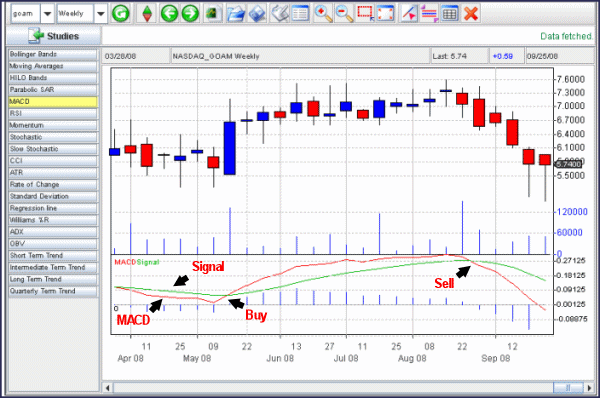
Traders Toolbox: Moving Average Convergence / Divergence (MACD)

MarketClub is known for our "Trade Triangle" technology. However, if you have used other technical analysis indicators previously, you can use a combination of the studies and other techniques in conjunction with the "Trade Triangles" to further confirm trends.

Developed by Gerald Appel, this indicator consists of two lines: a solid line called the MACD line and a solid line called the signal line. The MACD line consists of two exponential moving averages, while the signal line is composed of the MACD line smoothed by another exponential moving average.

To complete the standard calculation of the two lines, you must:

  1. Calculate a 12-period exponential moving average of closing prices
  2. Calculate a 26-period exponential moving average of closing prices
  3. Plot the difference between the two calculations above as a solid line. This is your MACD line.
  4. Calculate a nine-period exponential moving average of the MACD line and plot these results as a dashed line. This is your signal line.

MarketClub will do the above calculations for you. The MACD line is represented by a red solid line and the Signal line is represented by a green solid line. The default values for this study are set to the suggest values listed above.

The most useful signals generated from this system occur when the solid red (MACD) line crosses below the green solid line (Signal) and a sell signal occurs when it crosses above the signal line.

---

You can learn more about the MACD and Gerald Appel by visiting INO TV.