U.S. Crude Production Shows No Signs Of Bottleneck

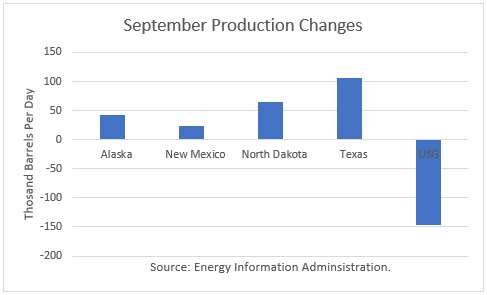
The Energy Information Administration reported that August crude oil production averaged 11.475 million barrels per day (mmbd), up 129,000 b/d from August. The gain was led by a 106,000 b/d increase in Texas, a 64,000 b/d rise in North Dakota and a gain of 24,000 b/d in Mexico. Seasonal factors affected the overall gain, as production fell by 147,000 b/d in the U.S. Gulf and rebounded by 43,000 b/d in Alaska.

permian basin

The EIA-914 Petroleum Supply Monthly (PSM) figure was 438,000 b/d higher than the weekly data reported by EIA in the Weekly Petroleum Supply Report (WPSR), averaged over the month, of 11.037 mmbd. Continue reading "U.S. Crude Production Shows No Signs Of Bottleneck"

A Post-Powell View Of USD, S&P 500 And Gold

The Fed blinked. This was not news to Macro Tourist Kevin Muir or readers of Biiwii.com, which is very pleased to publish his work.

Fed Finally Blinks

Amid a weakening global economy, gathering signs of weakening in the US economy and a dump in inflation expectations, Jerome Powell implied that the Fed may be going on hold for a while after a December rate hike.

This graph from SG Cross Asset Research/Equity Quant by way of Kevin Muir’s article attempts to show that the accumulated rate hike tightening and “shadow” tightening as a result of QE suspension has now met or exceeded the levels that preceded the last two economic recessions.

Jerome Powell

Add in very high profile haranguing by Donald Trump, the above-noted drop in inflation expectations and economic weakening (that began with our Semi sector signals nearly a year ago) and it sure is not surprising that the Fed may take its foot off the break for a while, and possibly a long while.

So what is expected of our two main themes, the cyclical and risk ‘on’ stock market and the counter-cyclical and risk ‘off’ gold and the miners, which leverage gold’s counter-cyclical utility? Let’s check in after this week’s events. Continue reading "A Post-Powell View Of USD, S&P 500 And Gold"

Hasbro Stock Struggling To Find Footing

The retail cohort reported a mixed bag during the most recent earnings season with Target (TGT), Khol’s (KSS), Gap (GPS), WalMart (WMT), Best Buy (BBY) and the Retail ETF (XRT) all experiencing downward pressure. This pressure has been exacerbated by the market wide sell-off in the broader indices. Hasbro (HAS) has struggled to find its footing moving into its historically biggest quarter. Hasbro is setting the post Toys R Us bankruptcy narrative and laying out a business roadmap for long-term profitable growth across its brands. The headwinds attributable to the bankruptcy of Toy R Us appear to be subsiding. This sentiment has been further bolstered by positive commentary from its CEO that the company will absolve itself of this Toy R Us related bankruptcy headwind come 2019. As Hasbro realigns and effectively manages the Toy R Us liquidation, this challenging backdrop is beginning to resolve itself to Hasbro's benefit. There are many current and future growth catalysts for Hasbro in movie franchises such as Marvel, Star Wars and other Disney (DIS) properties (Hasbro is the exclusive toy maker). Potential e-sports with Dungeons and Dragons and Magic: The Gathering, newly acquired Power Rangers franchise which will emulate Hasbro’s My Little Pony and Transformers’ Bumblebee within Hasbro Studios and its legacy games such as Monopoly and Nerf. Hasbro may benefit from a strong consumer, record low unemployment, a strong and growing dividend yield, clear skies post Toy R Us liquidation and putting forth initiatives within Hasbro Studios to further propel growth thus presenting a compelling long-term buy.

E-Commerce Channels Mitigating Toys R Us Bankruptcy

Analysts are predicting e-commerce toy orders to balloon to 40% of overall sales this year, up from 28% last year. Since Toys R Us has gone bankrupt, this puts a void of ~14% of last year’s U.S. toy sales that needs to be bridged, translating into $2.5 billion in revenue. This void will likely be filled by Target, Walmart and Amazon (AMZN) which recently, for the first time it will offer free shipping to everyone through the day before Christmas with no minimum purchase required. Per Jefferies analyst Stephanie Wissink, 70% of toy sales occur during the holiday season. Target and Walmart have announced expanded free-shipping programs of their own to drive online sales. Wissink sees Hasbro’s stock hitting $120 within a year and notes that the overall set-up for 2019 looks better than 2018. As other retail chains close the gap with the Toys R Us vacancy, Hasbro will likely return to form and growth across its brands. Hasbro has one more quarter to report earnings in which the Toys R Us issues will be impacting its numbers. 2019 will be free of this headwind, and all numbers will come full circle and be compared to post Toys R Us landscape. Continue reading "Hasbro Stock Struggling To Find Footing"

December OPEC Meeting Preview

When the OPEC-Non-OPEC Joint Ministerial Monitoring Committee (JMMC) convened in Abu Dhabi, United Arab Emirates in mid-November, it reported in a press release:

The Committee reviewed current oil supply and demand fundamentals and noted that 2019 prospects point to higher supply growth than global requirements, taking into account current uncertainties. “The Committee also noted that the dampening of global economic growth prospects, in addition to associated uncertainties, could have repercussions for global oil demand in 2019 – and could lead to widening the gap between supply and demand.”

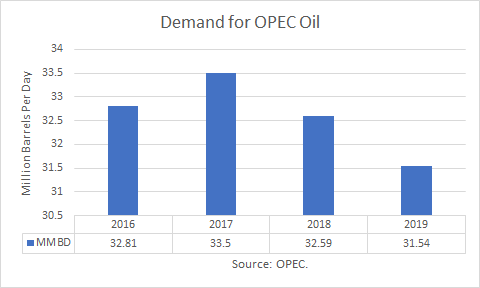
The figures they were reviewing were later released by OPEC in its November Monthly Oil Market Report. For 2019, they are projecting a decline in the demand for OPEC crude oil of about 1.04 million barrels per day to 31.54 mmbd. OPEC’s October production was estimated at 32.9 mmbd.

saudi energy minister khalid
Continue reading "December OPEC Meeting Preview"

Is The Housing Market About To Turn Positive?

One of the anomalies of the current economic rebound compared to past recoveries is the virtual absence of the housing market in the upturn. Not only has the housing industry – and its symbiotic partner, the mortgage market – failed to lead or even participate in the recovery, as it usually does, it’s been a laggard most of the way.

The main reason, of course, is the huge change in perception among young Americans about the attractiveness of home ownership. Most of them grew up during the housing boom of the early 2000s and the subsequent bust following the financial crisis – indeed, the housing bust was the root cause of the crisis – so homeownership for many of them has mostly negative connotations, as opposed to a symbol of the American Dream.

Then there’s the burden of student loan debt, which has made homeownership unaffordable for many, so it’s not hard to see why the U.S. homeownership rate has dropped to 64.3% most recently, down from the peak of 69.2% at the end of 2004.

Making matters even worse is the relative lack of homes for sale, which has created a huge supply-and-demand imbalance pushing prices in most areas of the country higher. The reason for the lack of supply is threefold: Older homeowners don’t want to give up the 3.5% mortgage they’ve refinanced into over the past several years. And many of them still can’t sell their homes at the price they want because the value is still below where it was 10 years ago. They’re also reluctant to sell their homes only to have to find a new home at an inflated price. Continue reading "Is The Housing Market About To Turn Positive?"