Sticky Contrarian Investors Wanted

The Gold Report: Rick Rule talks a lot about how much money can be made investing in things people hate, or at least don't like very much. Throughout the first quarter of this year, natural resources as a whole seemed to be in that category. How do you create a successful investing strategy out of a contrarian philosophy?

Paul Wong: First, it takes a lot of patience to be contrarian. You also need to have a lot of discipline. Probably more important than anything else, you need sticky investors. That's the hardest thing to get on the planet right now, an investor willing to stick it out.

Contrarian investors have to have the stomach to buy when the market is in the midst of a violent selloff, and they have to have the wherewithal to ride the volatility of the storm. That's the patience and the discipline part. Successful bottomfishing investors have to be able to discern the fine line between a company that could rally hard after a down leg and one that is on the verge of going bankrupt. You can throw luck into the requirements for being a contrarian investor as well, but at the end of the day it is a challenging way to approach building a portfolio so it is a good thing it sometimes pays off so dramatically.

"Pretium Resources Inc.'s Brucejack project is a spectacular deposit."

Mutual funds aren't traditionally built to be contrarian. I remember a joke I learned when I was a junior portfolio manager. I mentioned to someone that a stock could be a great investment in three or five years' time, and the fellow shot back to me, "Yes, my successor will look quite brilliant when that happens." That's the problem with long-term, contrarian-type investments. It may be a great idea, but you may not have a job by the time it pays off.

TGR: Does it take a lot more homework to be a contrarian investor than following an index or a blue chip stock?
Continue reading "Sticky Contrarian Investors Wanted"

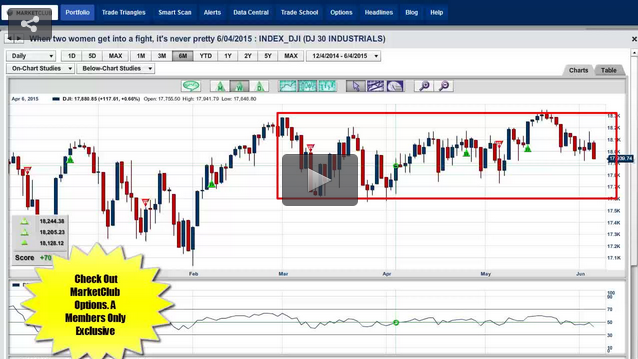
When Two Women Get Into A Fight, It's Never Pretty

This morning, Christine Lagarde, the boss of the International Monetary Fund, announced to the world that the Federal Reserve should hold off raising interest rates until 2016. I do not ever remember the head of the IMF ever saying anything like that before.

So the question begets, is she trying to save her own skin by doing a classic political move and pointing the finger at somebody else, in this case Janet Yellen, head of the Federal Reserve?

My advice on this, it's not going to be pretty and the IMF should take care of its own screw-ups (like Greece) before trying to fix the screw-ups in America.

With that said, let's take a look at what's really going on in the marketplace today. I'm going to look at the major indices with the Trade Triangle technology, which by the way is totally nonpartisan and unbiased, and just goes with the flow.

Here's what the Trade Triangle technology is saying right now. Continue reading "When Two Women Get Into A Fight, It's Never Pretty"

Candlestick Patterns – Harami

If you follow our blog, then you are definitely familiar with trader Larry Levin, President of Trading Advantage LLC. We have gotten such a great response from some of his past posts that he has agreed to share one more of his favorite trading tips as a special treat to our viewers. Determining the direction of the market can be tricky and just plain confusing at times, but Larry’s expert opinion keeps it simple.

If you like this article, Larry’s also agreed to give you free access to his award winning book.

I've already covered some of the better known patterns like Doji and Engulfing – now it's time to add Harami to your candlestick chart pattern arsenal. Let's take a look at what this technical signal looks like, and what opportunities might be presenting themselves when you see it.

Harami patterns can be bearish or bullish

Harami, like engulfing patterns, are a two candlestick formation. They are actually often confused with engulfing patterns because they both involve candles where one real body is bigger than the other. The difference is that in harami, the preceding (or first) candle in the pattern is the longer one of the pair; it encompasses the whole body of the second candlestick. Continue reading "Candlestick Patterns – Harami"

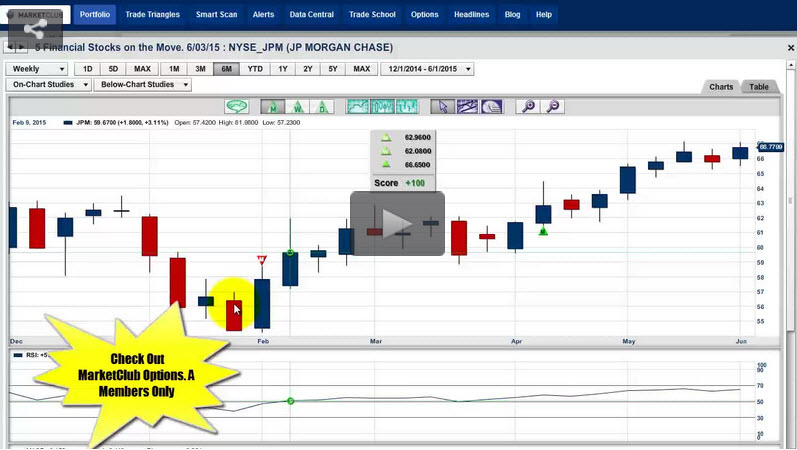
The Banks Are Back!

Today, I'm going to be looking at the financial sector to see which of the banking stocks look the strongest.

Here is a list of the five stocks I will be analyzing: Continue reading "The Banks Are Back!"

The Easy Money Has Already Been Made

George Yacik - INO.com Contributor - Fed & Interest Rates


As a financial journalist, I talk to lots of financial planners and investment advisors on a regular basis. One common thread in their comments is how hard it is to make money – or, more accurately, not lose money – by investing in the financial markets.

"Almost nobody ever makes money consistently over time in the stock market – I mean almost no one," says one adviser who's been in the business for more than 30 years. If people make money one year, or even three or four years in a row, they wind up losing it when the correction comes, and then they're back to square one – if they're not actually in the red.

Indeed, the goal for many advisors is simply to "preserve capital," as they say in the business, which simply means not to lose money. "You win by not losing big," this advisor says. "Make it and keep it," says another, who's been managing clients' money for more than 50 years.

Why such modest goals? Continue reading "The Easy Money Has Already Been Made"