Weekly Futures Recap With Mike Seery

We've asked Michael Seery of SEERYFUTURES.COM to give our INO readers a weekly recap of the Futures market. He has been Senior Analyst for close to 15 years and has extensive knowledge of all of the commodity and option markets.

Michael frequently appears on multiple business networks including Bloomberg news, Fox Business, CNBC Worldwide, CNN Business, and Bloomberg TV. He is also a guest on First Business, which is a national and internationally syndicated business show.

Crude Oil Futures

Crude oil futures in the June contract are trading below their 20 and 100 day moving average as I have been sitting on the sidelines for the last several months in this market but if have a long futures position I would continue place your stop loss above the 10 day low which stands at 56.00 however in my opinion I think prices have topped out. Strong demand and a very weak U.S dollar have pushed crude oil prices up from a contract low around $46 a barrel to around $63 in Wednesdays trade which has been a remarkable rally in my opinion but I think this market is overextended so I’m still going to remain sitting on the sidelines waiting for better chart structure to develop as this market will remain volatile for the rest of 2015 in my opinion giving you many trading opportunities. Continue reading "Weekly Futures Recap With Mike Seery"
How To Trade Like A Hedge Fund

Today, I would like to show you how to create your own private hedge fund for your own account. It's not that difficult and it can make a huge difference to your bottom-line. Let me explain what I mean by that.

What Is A Hedge?

A hedge is an investment position intended to offset potential losses/gains that may be incurred by a companion investment. In simple language, a hedge is used to reduce any substantial losses/gains suffered by an individual or an organization.

A hedge can be constructed from many types of financial instruments, including stocks, exchange-traded funds, insurance, forward contracts, swaps, options, many types of over-the-counter and derivative products, and futures contracts.

Public futures markets were established in the 19th century to allow transparent, standardized, and efficient hedging of agricultural commodity prices; they have since expanded to include futures contracts for hedging the values of energy, precious metals, foreign currency, and interest rate fluctuations.[1]
Source: Wikipedia.org.

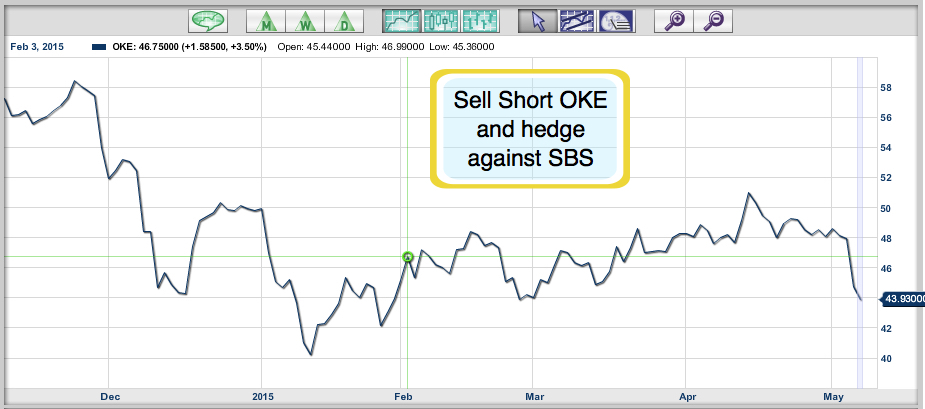
For our purposes today I'm going to be looking at hedging stocks. I'm going to give you specific examples of what you can do today. One stock you're going to buy and go long, the other stock you're going sell and go short.

In order to make this work, you need to have the same amount of invested capital in each stock. The two stocks I'm looking at today are traded on the New York Stock Exchange (NYSE). The first stock is ONEOK Inc. (NYSE:OKE), the second stock is Basic Sanitation Co. (NYSE:SBS).

For discussion's sake, let's say you have $10,000 to invest. Divide the money up into two buckets of $5,000 each. You would then look at what price each stock was trading at. OKE is currently trading around $43 a share and SBS is trading around $6 a share. Then divide the value of 1 OKE share (presently at $43) into $5,000. This gives you 116.27 shares that you can buy or short with your $5,000. To make things easier, I would round this down to either 110 or 115 shares.

NYSE:OKE

ONEOK, Inc. engages in the gathering, processing, storage, and transportation of natural gas in the United States. It operates in Natural Gas Gathering and Processing, Natural Gas Liquids, and Natural Gas Pipelines segments. Continue reading "How To Trade Like A Hedge Fund"

Yellen's Gaffe

George Yacik - INO.com Contributor - Fed & Interest Rates


Is Janet Yellen suddenly signaling an imminent rise in U.S. interest rates?

At a conference in Washington Wednesday sponsored by the Institute for New Economic Thinking, in an answer to a question from co-panelist Christine Lagarde, Yellen said:

"I would highlight that equity-market valuations at this point generally are quite high. Now, they're not so high when you compare the returns on equities to the returns on safe assets like bonds, which are also very low, but there are potential dangers there."

The Federal Reserve chair also had something to say about interest rates. "We could see a sharp jump in long-term rates" after the Fed starts to normalize – i.e., raise – interest rates, she said.

Her words had the desired effect, if indeed that was her desire. Stock prices dropped around the globe, as did bond prices, driving yields sharply higher. The yield on the 10-year German government bund jumped as high as 0.78%, its highest level in more than five months and up from just 0.08% only three weeks ago. The yield on the 10-year U.S. Treasury note rose above 2.20%, its highest level in two months and up more than 35 basis points in the past month. Continue reading "Yellen's Gaffe"

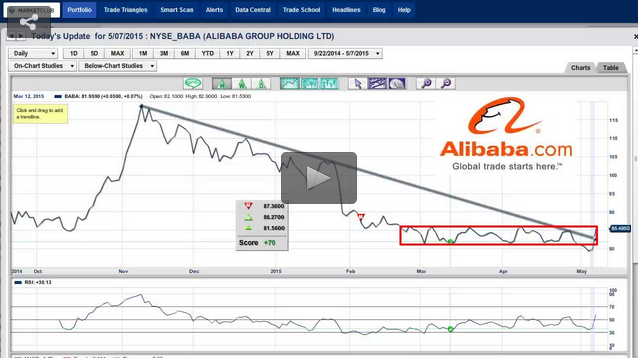
Did This Multi-Billion Dollar Company Just Make A Major Reversal To The Upside?

Today, I'm going to be looking at a very well-known stock that has all the tell-tale signs of having put in a major low this week. This company also just announced a new CEO, as well as a significant earnings beat.

In addition to this stock, I will also be looking at all three of the major indices. All three indices flashed warning signals yesterday to move to the sidelines.

The broad trading range that is the gold market right now continues. Today, gold experienced a sizable decline and is rapidly approaching the lower levels of its trading range.

Crude oil has taken a bit of a pause, but remains on its upside trajectory. I'm still thinking that an upside target zone of somewhere around $68-$70 a barrel is in the cards.

The dominant dollar has been losing ground against the Euro for the past four weeks. While we may see another dollar bounce, the dollar continues to look less powerful than it did just four weeks ago. I still think that the euro can go somewhat higher (1.1500) from where it is right now.

Every success with MarketClub,
Adam Hewison
President, INO.com
Co-Creator, MarketClub

Candlesticks - Using the Doji

If you follow our blog, then you are definitely familiar with trader Larry Levin, President of Trading Advantage LLC. We have gotten such a great response from some of his past posts that he has agreed to share one more of his favorite trading tips as a special treat to our viewers. Determining the direction of the market can be tricky and just plain confusing at times, but Larry’s expert opinion keeps it simple.

If you like this article, Larry’s also agreed to give you free access to his award winning book.

On a candlestick chart, there is a pattern that technicians refer to as a doji. A doji has top and bottom shadows like a regular candlestick, but has practically no real body. This happens when the opening and closing price are the same, or so close that they just leave a sliver of a real body. A doji looks like a plus sign or cross.

Finding a Doji can tell a technical analyst key things about a market trend

Doji are considered a good sign of indecision in a market. Finding a doji with short and nearly identical shadow points suggests a neutral trading session. The market opened, had a small trading range, and then closed at the opening price. Neither bulls nor bears got the upper hand. Longer shadows show potentially greater indecision. They are neutral on their own, but paired with a trend, a doji can hint at a coming change.

Market participants looking for a reversal like to see Doji

Doji are like little battle scars of conflict. The trade had action but in the end no one won the day and the market closed pretty much where it started. If the market was on a bullish trend, this could be a signal that the bears were coming in. The opposite could be deduced if the market was in a bearish trend.

A technician's reversal argument is simple. If the dominant trend were still in control, there wouldn't have been a wrestling match for control. And there would have been a clear winner. Instead, the real body showed that the day was almost a wash. Continue reading "Candlesticks - Using the Doji"