Don't Get Ruined by These 10 Popular Investment Myths (Part VI)

Interest rates, oil prices, earnings, GDP, wars, peace, terrorism, inflation, monetary policy, etc. -- NONE have a reliable effect on the stock market

By Elliott Wave International

You may remember that after the 2008-2009 crash, many called into question traditional economic models. Why  did they fail?

And more importantly, will they warn us of a new approaching doomsday, should there be one?

This series gives you a well-researched answer. Here is Part VI; come back soon for Part VII.

Myth #6: "Wars are bullish/bearish for stocks."

By Robert Prechter (excerpted from the monthly Elliott Wave Theorist; published since 1979)

... If the stock market is not reflecting macroeconomic realities, what else could it possibly be doing? Well, how about political news? Maybe political events trump macroeconomic events.

It is common for economists to offer a forecast for the stock market yet add a caveat to the effect that "If a war shock or terrorist attack occurs, then I would have to modify my outlook."

For such statements to have any validity, there must be a relationship between war, peace and terrorist attacks on the one hand and the stock market on the other. Surely, since economists say these things, we can assume that they must have access to a study showing that such events affect the stock market, right? Continue reading "Don't Get Ruined by These 10 Popular Investment Myths (Part VI)"
Weekly Futures Recap With Mike Seery

We've asked Michael Seery of SEERYFUTURES.COM to give our INO readers a weekly recap of the Futures market. He has been Senior Analyst for close to 15 years and has extensive knowledge of all of the commodity and option markets.

Michael frequently appears on multiple business networks including Bloomberg news, Fox Business, CNBC Worldwide, CNN Business, and Bloomberg TV. He is also a guest on First Business, which is a national and internationally syndicated business show.

Gold Futures

Gold futures in the December contract are trading far below their 20 and 100 day moving average plummeting for the 2nd consecutive trading session down another $30 at 1,168 an ounce hitting a 4 1/2 year low as the Japanese government stated that they are going to engage into more quantitative easing sending the Japanese Yen sharply lower against the U.S dollar therefore pressuring the precious metals today. Gold futures settled around 1,231 last Friday finishing down around $60 dollars as the trend is clearly to the downside, however the chart structure is very poor at the current time so I’m sitting on the sidelines in this market, however I am certainly not recommending any type of bullish position in the gold market as prices go lower in my opinion with a possible retest of $1,100 here in the near future. All of the interest is back into the S&P 500 once again as the stock market hit an all-time high as money is flowing out of the precious metals and many of the commodity markets and putting it back to work in the stock market and I don’t think that trend will end any time soon as the months of November and December are historically bullish for the S&P 500 and bearish for the gold market so continue to play this to the downside and take advantage of any rally making sure that you place the proper stop loss. As I had written in previous blogs I was always concerned of the fact that gold prices were not rallying with all the problems with Isis and numerous other catastrophes throughout the world & that made me nervous as prices now look very weak as there is no reason to own gold at the current moment.
TREND: LOWER
CHART STRUCTURE: AWFUL
Continue reading "Weekly Futures Recap With Mike Seery"

Japan Shocks The Market With A Halloween Treat

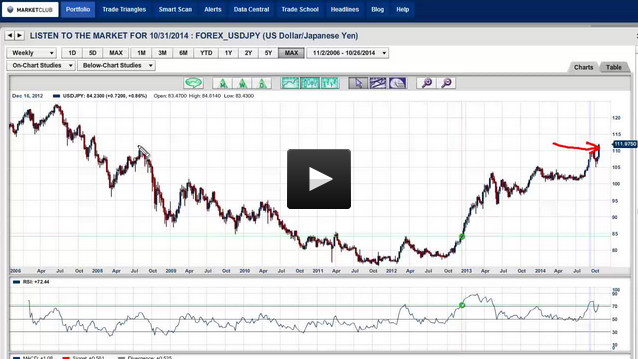
Overnight actions by the Bank of Japan jump-started the equity markets to seven-year highs in that country, plunging the Japanese yen to its lowest levels since 2008.

The Bank of Japan's big market-moving announcement was that they will triple purchases of exchange-traded funds and real-estate investment trusts. This was clearly a big surprise to all the markets and it sent a big message to the currency markets. This will affect all the other Asian countries as they too will be forced to compete against a cheaper Japanese Yen. Can you say that the currency wars are just starting?

The move by The Bank of Japan (BOJ) was all that was needed to send gold and crude oil prices crashing to the downside.

In today's video, I'll be looking at the U.S. Dollar VS the Japanese Yen (FOREX:USDJPY), gold (FOREX:XAUUSDO) prices, which gave a major sell signal today and crude oil (NYMEX:CL.Z14.E) prices, as they continue their downward spiral.

I'll also be following up on some of the stock picks that I talked about earlier this week:
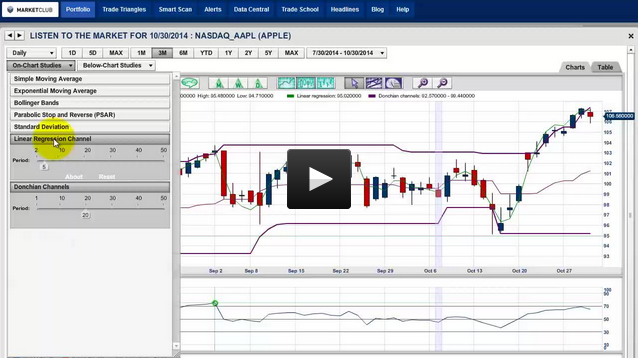
Apple Inc. (NASDAQ:AAPL)
Alibaba Group Holding Limited (NYSE:BABA)
Facebook Inc. (NASDSAQ:FB)
Allergan Inc. (NYSE:AGN)

I'll also be looking for some stocks to trade over the weekend with "The 52-Week New Highs on Friday" trading rules.

As always, I welcome your comments and feedback. Please feel free to leave a comment or question below this post.

And don't forget follow us on Facebook and Twitter.

Have a great weekend everyone,
Adam Hewison
President, INO.com
Co-Creator, MarketClub

They Do Ring A Bell At The Top Of The Market

Hello traders and MarketClub members everywhere! Just this morning I was thinking of an essay I had read many, many years ago. The intriguing feature to me was the headline which read, "They Do Ring A Bell At The Top Of The Market."

Well, I have to say it was an intriguing headline which got me to read the article, perhaps like you're reading this post now. The essence of the article was when interest rates go up, they usually signal a top in the market. As we all know, we have had unusually low interest rates for a prolonged length of time with one QE after another. All of which has boosted the stock market, but I believe the jury is still out on the economy.

With the end of quantitative easing, it's only going to be a matter of time before the Fed begins to raise interest rates. So the question is, how is that going to affect the markets? On one side of the coin, you can argue that it is only going to be good for people that have fixed incomes and rely on bonds and interest-bearing instruments. On the other side of the coin, will investors be willing to risk hanging in the market if they can get a return elsewhere with little or no risk? Continue reading "They Do Ring A Bell At The Top Of The Market"

World Cup Questions Answered

We've had a lot of questions about the World Cup portfolio (WCP) and its amazing performance so far this year. Through the first 3 quarters of 2014, it's had a very positive 99% return on invested capital.

One of the many questions we have had is, "Can I substitute ETFs for the markets in the WCP?" The short answer is yes you can, but there is one important caveat.

You're not going to get the same returns as the World Cup portfolio. The main reason for this is the leverage involved in the futures markets. In the futures market, you're only putting up a small percentage of the value of the contract. For example in gold, the current margin is $4,400 to control 100 ounces, which is the size of one gold futures contract. Your margin requirements are less than 4% of the total value of one contract. If gold is trading at $1,250, 100 ounces or one contract is worth $125,000.

You don't have that same kind of leverage in an ETF.

Here are the equivalent ETFs to replicate the World Cup portfolio. Please remember this is not a recommended portfolio, as there is no way to short corn, wheat, or soybeans. Continue reading "World Cup Questions Answered"