Gold Contrary Indicators

The gold sector is peopled by a high concentration of contrary indicators because it is a relatively (to the vast world of equities and bonds) small market that offers refuge from some of the damaging aspects of the spectrum of investment products that are supported by the manipulation of interest rates and printed (and digitally created) money supplies. Thus, gold has moral high ground if an asset can be thought to have morality.

More accurately, the people bullish on and promoting gold take high moral ground and that is where the emotional power comes from in this market. This power feeds upon the desires of regular people to not suffer the consequences of the 'evil' actions of those running a system that many do not agree with. Readers of this site know of course that I certainly don't agree with the setting and manipulation of interest rates by decree of man (and woman) in service to engineering desired outcomes in financial markets. Continue reading "Gold Contrary Indicators"

5 Ways To Tell If You Own A 'Dividend Disaster'

Imagine living in a world with stocks creating dividend yields of 20%, 30% or even over 40% on an annual basis. For income investors, that sounds like a dream come true -- but the truth is, these yields exist right now.

I recently searched for the highest-yielding stocks on the U.S. stock markets. I found 10 actively traded stocks that yield between 20% and close to 50% annually. My first reaction is that there must be something wrong with the data -- but these stocks actually exist. Here are three examples:

It may seem like all an investor needs to do is invest in one or more of these names and their portfolio will grow like wildfire. However, nothing is further from the truth.

Sure, several of the top 10 names will continue to pay ultra-high dividends for a while, but the dangers inherent in them are simply too high for prudent, risk-averse portfolios. Remember, a high dividend does not always indicate a successful company. Often, a high dividend yield is indicative of a plunging stock price or a failing company's last-ditch effort to attract interest. 

What's the best way to avoid a high-yielding "dividend disaster"? Here are five questions to ask before risking a penny on a high-yielder. Continue reading "5 Ways To Tell If You Own A 'Dividend Disaster'"

Robert Cohen's Three Drivers for the Gold Price in 2014

The Gold Report: Low interest rates, a cornerstone of recent modern Western economic policy, have proven positive for gold over the last several years. What do you see as the three primary price drivers for gold this year?

Rob Cohen: The primary price driver is global liquidity. That is fed by balance-sheet expansion in many Western countries and foreign exchange reserves, typically the result of trade deficits built up in countries such as China.

Number two is real interest rates. The Federal Reserve could tighten rates, but we don't know where inflation will be. Negative real rates are very good for gold. Mildly positive real rates are not harmful for gold. Positive real rates above 2% can stall the gold price.

"It's really hard to come up with a higher quality investment than Tahoe Resources Inc.'s Escobal."

Number three is geopolitical crisis. Strife can get priced in and out of the gold price. Continue reading "Robert Cohen's Three Drivers for the Gold Price in 2014"

Chart of The Week - Soybeans

Each Week Longleaftrading.com will be providing us a chart of the week as analyzed by a member of their team. We hope that you enjoy and learn from this new feature.

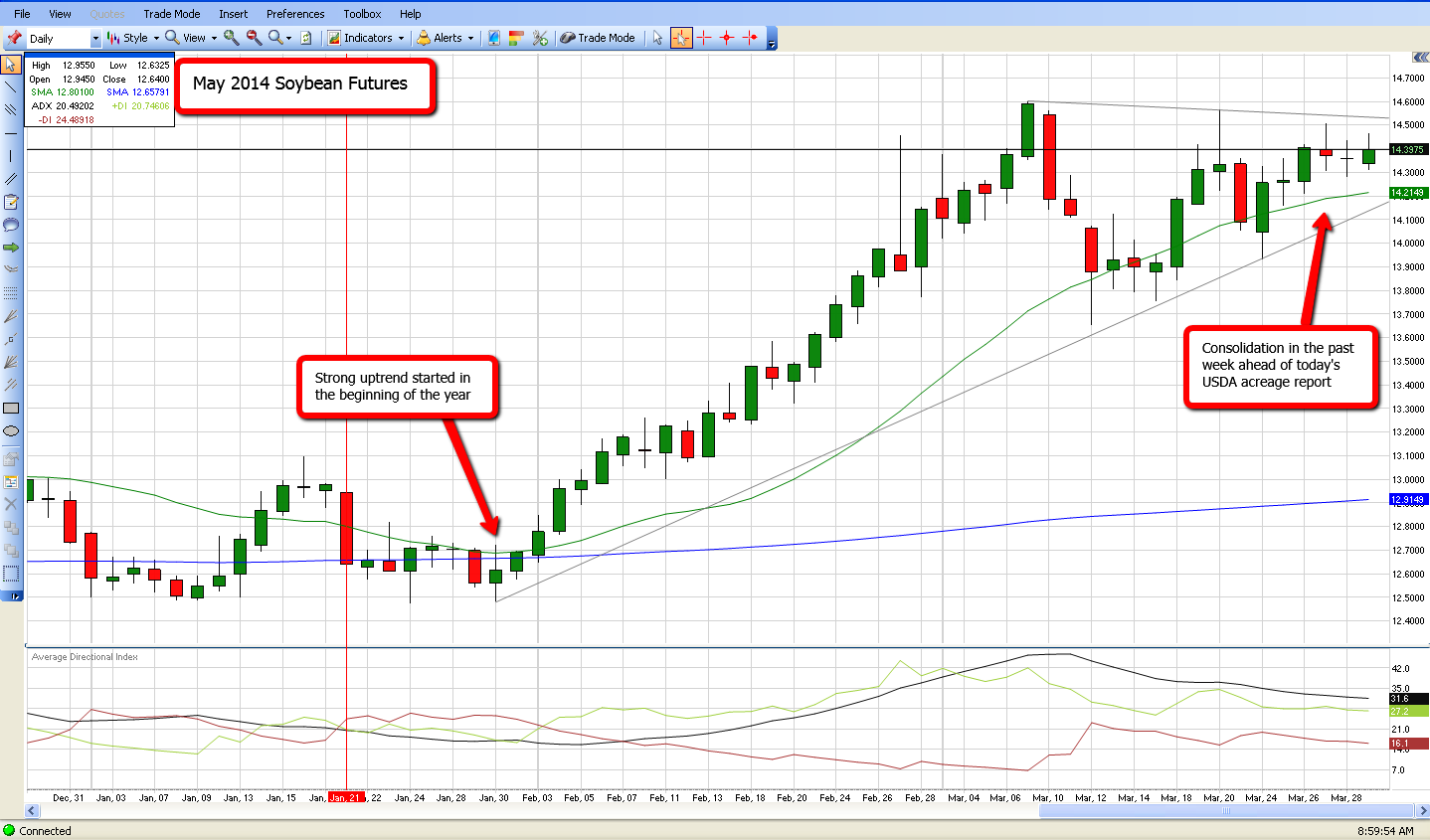
This week's focus shifts to the grain markets and looming USDA reports that will be released during today's trading session. The general sense is that Soybean planted acreage could be higher than expectations. The Department of Agriculture is expected to report a significant shift in planted acreage to Soybeans from Corn because of favorable pricing. In the past week, this sentiment seemed to be continually priced into the market. Any indication of less than expected acreage could add fire to an already bullish market and cause May Soybeans to make a move toward $15.

As we turn to the May Soybean chart, we are able to clearly identify a very strong up-trend in the market since the start of the new year. After posting the high print of $14.60 on March 7, the market has consolidated as traders positioned themselves for today’s March 31st USDA report. With so much sentiment geared towards a large expected acreage in Soybeans, an underwhelming number is very possible. In this case, I would look to take a buying position in the Soybean market and look for $15/bushel in the near future. Continue reading "Chart of The Week - Soybeans"

3 Stocks I Love Long-Term

Hello traders everywhere! Adam Hewison here, President of INO.com and co-creator of MarketClub, with your video update for Monday, the 31st of March.
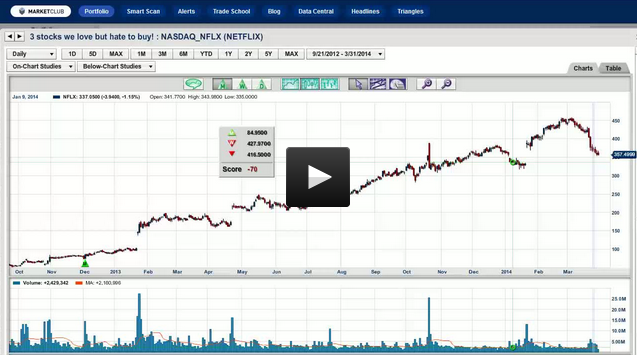
In today's short video, I will be covering three markets that I really like longer-term, but don't want to buy right now.

Tesla Motors, Inc. (NASDAQ:TSLA) - the maker of electric cars.
Netflix, Inc. (NASDAQ:NFLX) - the leader in streaming online video.
Amazon (NASDAQ:AMZN) - the number one online retailer.

Learn why I like these stocks, but don't want to own them right now when you watch the video.

Every success with MarketClub,
Adam Hewison
President, INO.com
Co-Creator, MarketClub

Bloomberg BNN CNBC FOX

Adam appears frequently on the following financial news channels as a guest expert. Click on any cable logo to watch Adam's latest appearance.