Spreads sometimes are touted as a no- or low-risk trading option, ideally suited to smaller or more risk-averse traders. Although some do have limited risk in certain circumstances, spreads are by no means risk free, and in fact they contain some unique risks, especially for traders who don't have a clear understanding of the limitations and possibilities of these transactions.
In options markets, the term spreads covers everything from simple time spreads to complex butterflies, boxes and conversions. Although futures spreads are, at least on the surface, more straightforward than many of their options counterparts, understand the basic price relationship between different futures contracts as well as the function off spread trading is integral to a well-informed market perspective.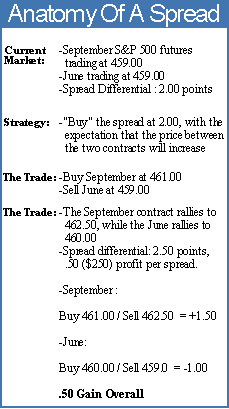
In the most basic sense, a spread refers to the price difference between two or more trading instruments, whether they are two contact months of the same commodity, two different commodities or the cash and futures price of a particular commodity. (The cash/futures spread is commonly called basis.)
When putting on a spread, a trader establishes a long position in one month or contract while simultaneously establishing a short position in another month or contract. For example, a trader might buy September bonds and sell June bonds, or buy October cattle and sell October hogs. In putting on a spread, the trader seeks to profit from an increase or decrease in the price difference between the two contracts (legs) of the spread, rather than outright price movement of the commodities involved.
Spread orders commonly are placed and executed at the price difference (differential) rather than at the
individual prices of each leg. An exception may occur when a trader deliberately buys or sells one leg of the spread outright, and then waits to complete the other half of the spread, usually to secure a better spread differential. This process, called legging, can be very risky.
When buying the spread, the trader expects the spread differential to increase; when selling, he expects it to decrease.
Reduction - Spreads can reduce risk and offer expanded trading opportunities for two main reasons. First, because a spread contains both a long and short position in the same or related contracts, losses on one leg of the spread are countered by gains on the other. This will limit profit as well, but for many traders, this is an acceptable compromise. Second, by virtue of this reduce risk, some spreads also will have the added advantage of lower margins, often significantly lower than the margin an an outright positions. This offers
the options of putting on a greater number of spread positions, but will, of course, increase exposure.
Two questions naturally arise about spreads: Why do price differences occur, and how do traders profit on spreads if losses are offset by gains in different legs?
 Spreads occur between different months of the same contract for a variety of reasons. For many agricultural contract, the cost of storing and insuring the physical commodity from month to month (referred to as carrying cost) is incorporated into the price of the back months in relation to the nearby month or the cash price, and will account for at least a minimum price difference between two contracts.
Changes in the supply and demand picture from month to month, as well as basic uncertainty about the future, will contribute to a fluctuating spread. Seasonal differences, such as the change from an old crop year to a new one, also influence the spread. For financial contracts, changing interest rates, the relationship between short-term and long-term interest rates, and currency rates also will affect the value of contracts form moth to month and account for a widening or shrinking of the spread. The same commodities on different exchanges can differ for locally specific economic reasons, like the varying transportation and carrying costs in the different markets.
Intense market volatility and confusion, such as often occurs during rollover periods (when the front month of a commodity is nearing expiration and many positions are reestablished in the next nearby month), also will create spread opportunities. Traders commonly will put on spreads to roll positions into the next month, A long June S&P could be rolled over by selling the June - September spread, that is, selling the June contract and buying the September. In every market, speculators and hedgers will have a fundamental knowledge of the factors affecting the spread, and will sense when prices are out of line.
To Read The Remainder Of This Post Please Click Below...
 all traders.
 Isn't it hard to sit back and let someone else manage your money? If you are going take a loss wouldn't you rather it be your fault opposed to your broker?


 PDF Workbook
 Stan Ehrlich graduated from Southern Illinois University in 1971 and joined Conti Commodities Services in the fall of that year. After trading for a few years, Stan invented the Ehrlich Cycle Finder, a physical, accordion-like device used to find cycle activity in any chart. The oldest mechanical technical analysis tool in the futures industry, the Ehrlich Cycle Finder can be used on all kinds of markets worldwide. Often quoted in publications such as Bond Week, Successful Farming Magazine, Crane Chicago Business Weekly, Futures magazine, and Stocks and Commodities magazine, Stan has also made numerous appearances on television and radio. Several technical analysis texts mention or detail the Ehrlich Cycle Finder. Stan has taught at dozens of investment seminars around the world, including several real-time trading seminars. In the past, Stan has worked with such well-known investment personalities as Jake Bernstein, Robert Prechter, and Robert Saperstein. Stan currently faxes a timely technical analysis market letter to his clients every few days.