3 Ways to Identify Support and Resistance - 5 Chart Examples

By: Elliott Wave International

Today's lesson considers three ways to identify price support and resistance in the markets you trade.

  1. Previous highs and lows
  2. Trendline support
  3. Fibonacci Ratios

These examples are adapted from Jeffrey Kennedy's Trader's Classroom service.

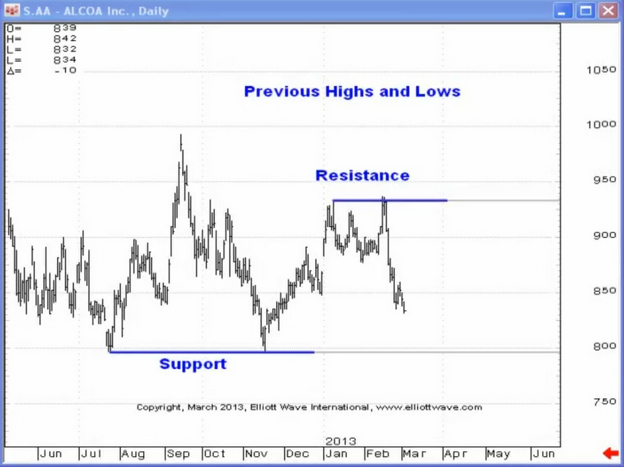
1) Uptrends terminate at resistance while downtrends terminate at support. Previous highs and lows often act as resistance and support.

In ALCOA Inc (AA), the September 2012 selloff found support near the previous July 2012 low.

The February 2013 peak occurred following a test of resistance at the January peak at $9.33. Continue reading "3 Ways to Identify Support and Resistance - 5 Chart Examples"

How to Make Money in the Chaos of Oil and Gas

The Energy Report: Stephane, do you think the oil price has hit bottom and is now recovering?

Stephane Foucaud: When the Brent oil price was close to $50/barrel ($50/bbl), I think it was the bottom. It has recovered quite a bit. There is a risk that it might dip again, but I don't think we will reach the low $50s for quite some time. The reason I think there is a risk that the oil price could dip is that there has been an overreaction to the North American rig fleet reports, and particularly to what appears to be a large number of rigs being taken out of the market. Those rigs are, however, associated with lower-producing areas. Therefore, I think it's more sentiment than reality in terms of impact on the supply. The recovery has been too steep.

TER: What prices are you forecasting for 2015 and 2016?

Continue reading "How to Make Money in the Chaos of Oil and Gas"

Market insight: U.S. Dollar at 11-Year High Against Euro

By Elliott Wave International

On March 4, we spoke with Jim Martens, our Chief Currency Strategist. His Currency Pro Service is participating in our Pro Services Open House, a free week-long event that starts next Tuesday at elliottwave.com.

Elliott Wave International: Jim, it's a good time to talk about currencies, because the euro has just touched an 11-year low against the dollar. Did you ever think you'd live to see this day?

Jim Martens: Did I ever think I'd live to see this moment... Well, back in mid-2011, when EURUSD was trading near $1.50, we started talking about the upcoming retest of $1.1876, the 2010 low. We were convinced that the rally from that level was a correction -- so EURUSD would ultimately fall back to it. It took a while to get there because what followed was a wide-ranging sideways consolidation in EURUSD -- a triangle, in Elliott wave terms, an overlapping pattern labeled ABCDE that you see on this chart:

That triangle ended in May 2014 with EURUSD almost hitting $1.40. From that point we had been expecting a move below $1.1876 -- and we had lower targets, as well. Most of them have been hit, and the interesting thing is that now, all of a sudden, the idea of the dollar/euro parity is becoming popular. Someone at Goldman recently talked about parity by the end of 2017.

Elliott Wave International: Do you think we'll see parity? Continue reading "Market insight: U.S. Dollar at 11-Year High Against Euro"

Forex Traders: The Only Question You Should Be Asking

By Elliott Wave International

I can't help it. Whenever I read the mainstream financial news, I feel like I'm eavesdropping on a job interview at Microsoft.

In case you don't remember -- Microsoft was made famous, in part, for asking prospective employees one single question: Why is a manhole cover round?

They wanted to assess how a person approaches a question that has many answers. And, many answers are what they got, from the most practical (i.e. "Because a manhole is round") to the most philosophical (i.e. "The circle is the most aesthetically pleasing shape for the human eye.")

I'll now take you back to the world of mainstream finance where those in charge are regularly asked to answer this basic question: Why did market "X" move this way today? And, many answers are what they give.

Take, for a real-world example the March 9-10 upsurge to a 7-and-1/2 year high in the Dollar/Yen currency exchange pair. As for why the USDJPY rallied, the experts offered up these (and many more) explanations: Continue reading "Forex Traders: The Only Question You Should Be Asking"

Weekly Futures Recap With Mike Seery

We've asked Michael Seery of SEERYFUTURES.COM to give our INO readers a weekly recap of the Futures market. He has been Senior Analyst for close to 15 years and has extensive knowledge of all of the commodity and option markets.

Michael frequently appears on multiple business networks including Bloomberg news, Fox Business, CNBC Worldwide, CNN Business, and Bloomberg TV. He is also a guest on First Business, which is a national and internationally syndicated business show.

Gold Futures

Gold futures in the April contract settled in New York last Friday at $1,164 an ounce while currently trading at 1,156 down about 8 dollars for the trading week in a relatively nonvolatile trading session still trading below its 20 and 100 day moving average telling you that the trend is to the downside as I have been recommending a short position as of last Friday and if you took that trade place your stop loss above the 10 day high which currently stands at 1,214 risking around $2,400 per mini contract, however the chart structure will start to improve dramatically next week lowering the stop loss. The problem with gold at current time is the fact that the U.S dollar is sharply higher this week once again continuing to put pressure on the commodity markets as I don't see that trend stopping anytime soon as the next level of support is 1,130 – 1,140 & if that level is broken you would have to think that gold prices will trade below 1,100 and if you look at platinum prices they are hitting another contract low so I think gold will catch up to platinum to the downside. Continue reading "Weekly Futures Recap With Mike Seery"