 Our friend Scott Andrews, a West Point graduate and former CEO of a public company, is now Founder and President of MasterTheGap.com. Today he is going to share an interesting perspective in this article on using historical probabilities. For a limited time to Traders Blog readers, Scott is offering a complimentary historical research study on opening gaps in the S&P 500. If you enjoy this article, you may wish to download his complimentary SPY Gap Study HERE.
--------------------------------------------------------------------------------------------------------------------------------------------------------------
Maybe you shouldn’t try to kiss all the pretty girls?
In the timeless words of Sir Winston Churchill, “Those who fail to learn from history are doomed to repeat it."
Though Churchill was not speaking of the markets, the concept is certainly applicable. In fact, the easiest way to make money trading the markets, is to avoid those setups that have been unprofitable historically.
Many folks obsess over trying to trade every winning setup. I do not. I am a gap fader. When the historical probabilities are favorable, I will short ‘up’ gaps and buy ‘down’ gaps. Since more than 70% of all opening gaps have filled the same day historically in the U.S. indices, I do not need to catch every winner to be successful.
In fact, I’ve had my best success focusing on simply trying to avoid the majority of the losing setups. Let’s a take look a look at a real market example. Continue reading "Avoid Losing Setups" →

 If you follow headline news, then we don’t have to tell you about the kind of hit that the recent job report had on the major markets this week. OUCH. Just today the DJI fell 105 points, the S&P 500 lost 10 points, and the Nasdaq fell 21 points. The DOW alone shed over 400 points since Wednesday!
 Loading ...
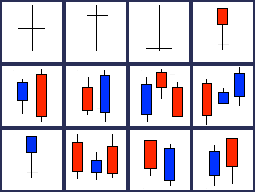 broad brush. Candlesticks draw on the same open-high-low-close data as do bars. Here the length of the bar, or “candle,” is determined by the high and low, but the area between the open and close is considered the most important.This area, the “body” of the candle, is filled with blue (or white for most charting programs) for closes higher than open, and is filled with red (or black from most charting programs) for down days. The wicks above and below constitute the “shadow” of the candle, or high or low.