Why Warren Buffett Just Made a Huge Mistake

Editor’s Note: Our experts here at INO.com cover a lot of investing topics and great stocks every week. To help you make sense of it all, every Wednesday we’re going to pick one of those stocks and use Magnifi Personal to compare it with its peers or competitors. Here we go…


Sometime in the third quarter of last year, legendary investor Warren Buffett’s Berkshire Hathaway Inc. (BRK-A) took a $4 billion stake in Taiwan Semiconductor Manufacturing Co. Ltd. (TSM), the Taiwanese contract chipmaker.

With TSM being the world’s largest and most valuable semiconductor fabricator with chips in most high-tech equipment the world over, and with Warren Buffett’s reputation for making extremely savvy investments, lots of people took notice.

But just a few months later, Buffett seems to have said “never mind” and sold more than 85% of his stake.

We have no insight into Buffett’s thinking, but it does seem odd for a buy-and-hold value investor to sell a great company that is so cheap. TSM is a well-run business with wide competitive moats and big profits. Yet, the stock is at a discount to its peers, at 17 times forward earnings.

By comparison, its rival Intel Corp. (INTC) — thanks to its crashing profits — has a price-to-earnings ratio (p/e) in excess of 60 times. And the company just slashed its dividend.

So, we thought it would be interesting to compare TSM to INTC using the Magnifi Personal compare function. Comparing two or more stocks has never been easier than with Magnifi Personal. All you had to do was type “Compare TSM and INTC” and Magnifi Personal showed us this:
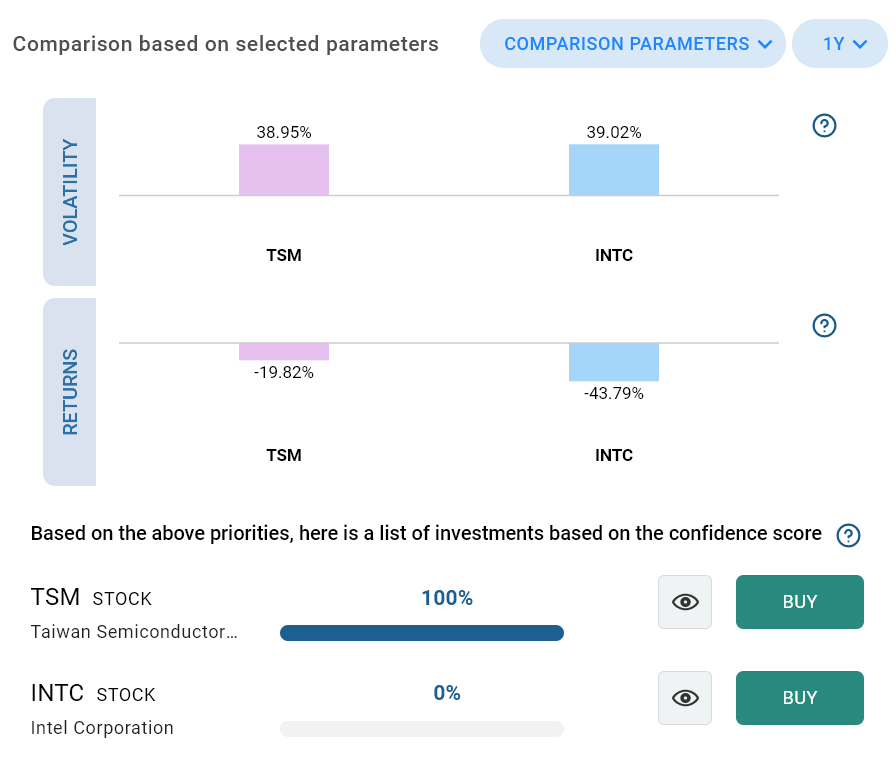
Compare TSM and INTC

This is an example of a response using Magnifi Personal. This image is not a recommendation or individual advice. Please see bottom disclaimer for additional information, including INO.com’s relationship with Magnifi. Continue reading "Why Warren Buffett Just Made a Huge Mistake"
3 Stocks You Can't Go Wrong With

The stock market started the year on a positive note after a year filled with macroeconomic and geopolitical challenges.

The rally was driven by the Federal Reserve’s smallest rate increase since the beginning of the monetary policy tightening in March 2022 and Fed Chair Jerome Powell’s acknowledgment that inflation was showing encouraging signs.

However, investor sentiment has taken a hit lately as minutes from the central bank’s monetary policy meeting indicated that the rate hikes will not end anytime soon. The Fed officials believe interest rates need to increase and stay elevated until inflation reaches 2%.

The officials’ resolve was backed by the 0.6% sequential and 5.4% year-over-year rise in the Personal Consumption Expenditure (PCE) and the hotter-than-expected jobs report. The market expects the Fed to raise the fund rate beyond 5% this year.

However, JPMorgan CEO Jamie Dimon believes a soft landing is “still possible.” Goldman Sachs believes the chances of the American economy slipping into a recession are now just 25%, down from its previous estimate of 35%. Moreover, President Joe Biden recently said he believes the U.S. economy will not fall into a recession this year or next.

Given this backdrop, it could be wise to make the most of the strong uptrend in fundamentally strong stocks, The Hershey Company (HSY), Acuity Brands, Inc. (AYI), and Flowers Foods, Inc. (FLO).

The Hershey Company (HSY)

HSY engages in the manufacture and sale of confectionery products and pantry items. The company operates through three segments: North America Confectionery, North America Salty Snacks, and International.

It offers chocolate and non-chocolate confectionery products; gum and mint refreshment products, including mints, chewing gums, and bubble gums; pantry items, baking ingredients, toppings, beverages, and sundae syrups; and snack items. Continue reading "3 Stocks You Can't Go Wrong With"

Alert In Two Major Cryptocurrencies

It is time to update the crypto charts as I spotted a strong alert in two major coins for you.

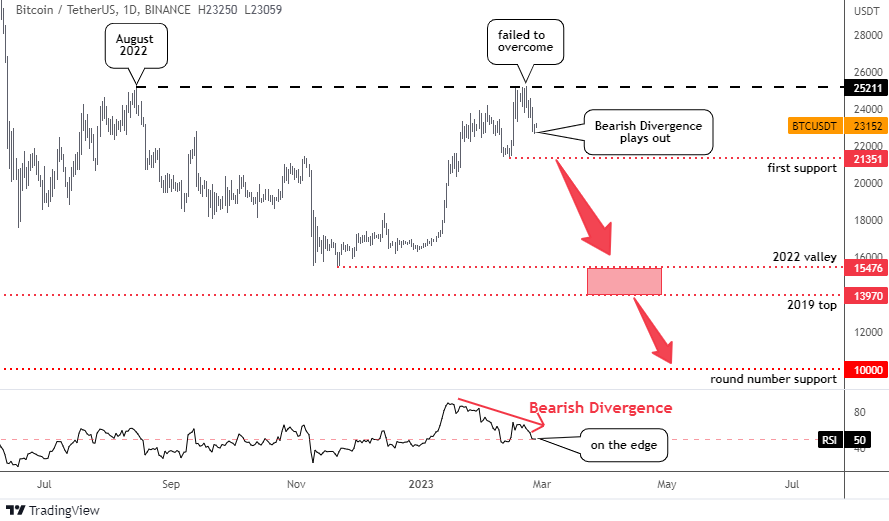
It is ironic that the signal comes from the same indicator that accurately predicted the rally of Bitcoin last November when the price was around $16k.

Bitcoin Daily

Source: TradingView

Indeed, the main coin has rallied for whopping 52% after the signal topping slightly above $25k. The previous peak of August 2022 at this level unexpectedly acted as a strong barrier that the price couldn’t overcome.

In my recent update last month I warned that “the bullish impulse should not fade until it touches the moving average around $27k to convince the trading community”.

Unfortunately for bulls, the rally has faded below the target. However, the majority of readers did not see this rally as a sign of a global market reversal.

This time, the same RSI indicator doesn’t confirm the most recent peak on the price chart as it shows a lower top. This is called a Bearish Divergence. Continue reading "Alert In Two Major Cryptocurrencies"

Growth At A Reasonable Price

It’s been a much better year thus far for the major market averages, and several tech names have soared more than 30% off their lows just seven weeks into the year after coming into 2023 at deeply oversold levels.

Although this has been a nice move for those quick enough to establish positions, there are far less attractive setups out there currently, and one must be rigid with their stock selection.

In this update, we’ll look at one semi recession resistant growth story and another company that continues to gobble up market share that are both worth keeping at the top of one’s watchlist if we see a deeper market correction.

Visteon Corporation (VC)

Visteon Corporation (VC) is a $4.6 billion company in the Auto-Truck and Original Equipment industry group and is a global automotive electronics supplier that was spun out from Ford Motor Company (F) in April 2000.

Visteon Corporation differentiates itself from its auto parts peers given that it is the only pure-play supplier of automotive cockpit electronics, the fastest-growth segment within the industry.

For those unfamiliar, the segment is forecasted to grow from $36 billion to $60 billion in 2027, and this incredible growth showed up in Visteon’s most recent Q4 results, with revenue up 35% to $1.06 billion, well above the low double-digit sales growth reported by peers in the same period.

On a full-year basis, Visteon had an incredible year, launching 45 new products (13 in Q4 alone), nailing down $6.0 billion in new contracts, and ending the year with a strong balance sheet, evidenced by $174 million in net cash.

This certainly showed up in its financial results, with record revenue of $3.76 billion (40% growth year-over-year) and 153% annual EPS growth ($5.33 vs. $2.11), a new record for the company.

However, while this is incredible growth relative to FY2020 levels ($2.77) the forward outlook is just as impressive, with annual EPS expected to increase to $9.98 in FY2024, pointing to nearly 90% growth over the next two years. Continue reading "Growth At A Reasonable Price"

Thinking About Social Security?

If you believe the scaremongers in the financial press and elsewhere, the clock is rapidly ticking down to the time — early June, according to the Wall Street Journal — when the U.S. Treasury will default on its obligations unless Congress passes legislation to increase the debt ceiling.

If Congress doesn’t act in time, the government will default on all of its obligations, we’re told, including payments due Social Security recipients, veterans, and beneficiaries of other government programs, not to mention the millions of investors both foreign and domestic who own the $31.5 trillion (and counting) of outstanding government debt.

If you’re like me, you’re probably tired of reading another story about what a monumental disaster this could be, but don’t worry, I’m not going to bore you with one.

I’m just using the debt ceiling drama as a segue into one of my financial pet peeves, and that is the advice we’re constantly given about when is the best time to start claiming Social Security benefits — assuming there are any in the event Congress fails to act and the government defaults.

If you believe the scare talk and you’re over 62 and therefore eligible for Social Security, you’re probably thinking you should apply now before the government runs out of money.

But according to the experts, you’re supposed to wait until you reach your “full” retirement age, which for most people is between 66 and 67, depending on what year you were born. (“Full” means you can earn as much as you want from a job and still collect your full Social Security benefit; if you start collecting before that, any money you earn from a job reduces your benefit dollar for dollar, although you’ll eventually get it reimbursed over time. But we won’t get into that right now.) If you can wait even longer, until you’re 70, you’ll reach your “maximum” benefit.

By waiting until you reach your full or maximum retirement age, these experts say, you can earn a much larger monthly Social Security check, or about 8% a year, for as long as you live. Which is pretty substantial, and it’s true.

However, these same experts almost invariably fail to tell you that by waiting until you’re 67 or older, you’re forgoing Social Security payments you could have been collecting in the interim, which can also add up to a nice amount of money.

But what if you don’t live that long and never collect? Continue reading "Thinking About Social Security?"