Reasons to be Optimistic

As expected, the Federal Reserve raised the target for its benchmark federal funds interest rate by 50 basis points at its mid-December meeting, to a range between 4.25% and 4.5%.

That was down from the 75 basis-point hikes at its four previous meetings, yet the market’s immediate reaction to the move was an immediate selloff.

Was that a classic “buy on the rumor, sell on the news” reaction — i.e., the Fed delivered exactly what Chair Powell had earlier indicated it would do?

Or was there some element of disappointment that the Fed, despite the more modest rate increase, included in its updated economic projections that most officials expect to raise rates by another 100 basis points, to about 5.1%, next year?

But was that really a surprise, given earlier comments from Powell and other Fed officials?

On a positive note, according to the Fed’s revised economic projections, it now expects inflation to fall to 3.1% next year before declining in 2024 to 2.5% and 2.1% in 2025, putting it at its long-term target.

In November, the year-on-year increase in the consumer price index fell to 7.1% from 7.7% a month earlier, down sharply from June’s 9.1% peak. So it looks like the Fed is optimistic about where inflation is headed, whether its rate-rising regimen deserves the credit or not.

It's also now calling for U.S. GDP to grow by 0.5% next year, unchanged from this year’s pace, before climbing to 1.6% in 2024.

By way of comparison, the economy rebounded at an annual rate of 2.9% in the third quarter following two straight quarters of negative growth.

The Fed projects the unemployment rate to jump to about 4.5% over the next three years, up from 3.7% currently, due to its rate increases. Continue reading "Reasons to be Optimistic"

2 Stocks to Play the Rebound in the Restaurant Sector

It’s been a solid quarter thus far for the AdvisorShares Restaurant ETF (EATZ) and the restaurant index as a whole, with the ETF and the index up 9% and 17%, respectively, thus far in Q4, a significant outperformance vs. the S&P-500 (SPY).

This outperformance can be attributed to the fact that many restaurant stocks were priced very attractively heading into Q4 after a violent 18-month bear market and because gas prices have been trending lower and inflation looks to have peaked, which both benefit restaurant brands.

The reason? Restaurant food traffic is sensitive to gas prices which impact discretionary budgets, and food costs and labor costs have been rising for two years, pinching the margins of many restaurant brands.

Unfortunately, while some names like Restaurant Brands Intl (QSR) are sitting at 52-week highs, others have remained under pressure, and Jack In The Box (JACK) and Dine Brands (DIN) are two examples of names that haven’t participated much in the recent rally. Given that both are well-run and trading at attractive valuations, I believe both make solid buy-the-dip candidates.

Jack In The Box (JACK)

Jack In The Box is a small-cap stock in the restaurant sector, with two brands, including Jack In The Box and Del Taco, after completing the $585MM acquisition earlier this year.

Unfortunately, the stock has lost over $300MM in market cap since the deal closed in March, with this attributed to weaker restaurant-level margins at both brands of 16.2% and 15.9%, respectively (Jack In The Box/Del Taco). At Jack In The Box, this represented a 390 basis point decline year-over-year, impacted by higher food, labor, electricity, and paper costs.

In the company’s most recent quarter (fiscal Q4), it reported revenue of $402.8MM, up 45% year-over-year, but this was largely due to the new contribution from Del Taco that made the results look much better.

Meanwhile, on a same-store sales basis, same-store sales were up just 4% at Jack In The Box and 5.2% at Del Taco in fiscal Q4, suggesting meaningful traffic declines when factoring in double-digit pricing.

This is not the end of the world, and the rest of the industry is also seeing traffic declines, but it is a little disappointing, given that the quick-service and fast-casual brands have been outperforming casual dining.

Hence, I expected a little stronger results from Jack In The Box. Continue reading "2 Stocks to Play the Rebound in the Restaurant Sector"

BBW is Well-Positioned Following Q3 Revenue Beat

Build-A-Bear Workshop, Inc. (BBW) operates as a multi-channel retailer of plush animals and related products.

The company operates through three segments: Direct-to-Consumer, Commercial, and International Franchising. It runs around 346 locations managed by corporate and 72 franchised stores in Asia, Australia, the Middle East, Africa, and South America.

On November 30, the company announced record fiscal third quarter results. Its total revenue increased 9.9% year-over-year to $104.48 million, beating the consensus estimate by 1.8% and registering the seventh consecutive quarter of revenue growth.

Sharon Price John, BBW President and Chief Executive Officer, attributed this solid performance to momentum and consistency in business with solid brand interest from consumers. She expressed her confidence that the company is on track to deliver the most profitable year in its 25-year history.

Mirroring the above sentiment, the stock has gained 45.3% over the past month to close the last trading session at $25.17 despite the broader market remaining volatile on concern over the Fed’s potential rate hikes to bring inflation down to its 2% target.

Can the Fed achieve its 2% inflation target by 2023?

View Results

Loading ... Loading ...

BBW is trading above its 50-day and 200-day moving averages of $17.33 and $17.28, respectively, indicating an uptrend.

Here is what may help the stock maintain its performance in the near term.

Solid Track Record

Over the past three years, BBW’s revenue has exhibited a 10.5% CAGR, while its EBITDA has grown at a stellar 99.4% CAGR. The company has increased its EPS at a 55% CAGR during the same period. Continue reading "BBW is Well-Positioned Following Q3 Revenue Beat"

1 Tech Stock That's Safe And 1 That's Not

Recent data suggests that the U.S. economy has been more resilient than expected, despite the Fed’s efforts to cool it down through monetary tightening. However, the market widely expects the central bank to implement a lower rate hike in its meeting this month.

However, many economists believe that the terminal interest rates will beat the earlier estimates. This might tighten fund availability for growing businesses while softening consumer demand in the year ahead.

Hence it would be safe to bet on stocks with an encouraging outlook while avoiding the weak ones.

Given the uncertain economic outlook, do you expect a Santa Claus Rally this year?

View Results

Loading ... Loading ...

Given its strong trends, it could be wise to buy NVIDIA Corporation (NVDA) to capitalize on increased consumer spending on electronics during holidays. On the other hand, CrowdStrike Holdings, Inc. (CRWD) might be best avoided now, given its downtrend.

NVIDIA Corporation (NVDA)

NVDA is a global provider of graphics, computation, and networking solutions. The company operates through two segments: Graphics and Compute & Networking.

NVDA’s revenue has exhibited a 41.8% CAGR over the past three years. During the same time horizon, the company’s EBITDA and net income have also grown at 51.6% and 35.2% CAGRs, respectively.

For the fiscal third quarter, ended October 30, 2022, NVDA’s non-GAAP operating income increased 15.9% sequentially to $1.54 billion, while its non-GAAP net income came in at $1.46 billion, up 12.7% quarter-over-quarter. This resulted in a sequential increase of 13.7% in non-GAAP EPS to $0.59 during the same period.

Analysts expect NVDA’s revenue and EPS for the fiscal fourth quarter to increase 1.5% and 37.9% sequentially to $6.02 billion and $0.80, respectively. The company has surpassed consensus EPS estimates in two of the trailing four quarters. Continue reading "1 Tech Stock That's Safe And 1 That's Not"

USDJPY: Reversal or Setback?

Back in September, I shared with you my take on the USDJPY currency pair based on 360° view. A combination of fundamental factors and technical factors has supported the continued strength of the U.S. dollar relative to the Japanese yen.

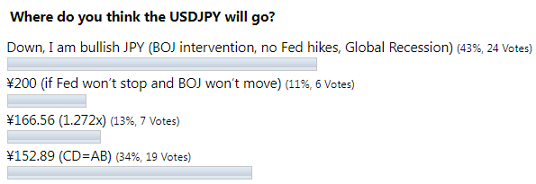
However, the majority of readers predicted the opposite, as you can see in the screenshot below.

Poll Results

As the second largest vote played out the best, the USDJPY has soared more than six percent to reach a peak of ¥151.94. The previous time this level appeared on this chart was in the summer of distant 1990, two decades ago. That move was close to hit the CD=AB target at ¥152.89, however it has lost the momentum.

The pair has lost more than it gained in that call and there is a question, is that all or are we just in a large correction?

I prepared for you another bunch of visualizations below to answer that question.

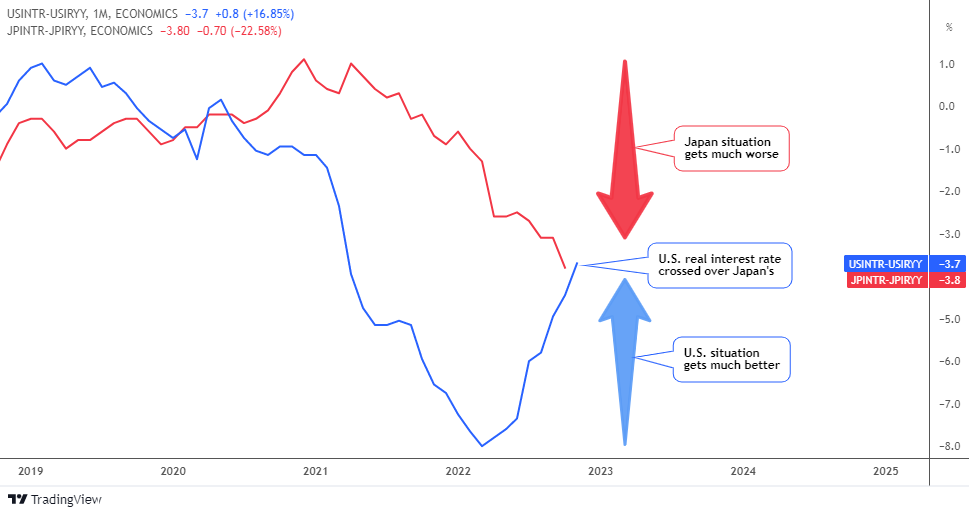
Let’s start with the fundamentals first in the interest rate comparison below.

US vs JP Real Interest Rate

Source: TradingView

Continue reading "USDJPY: Reversal or Setback?"