Is it just me, or should we all apply for a bailout?

Is it just me, or should we all apply for a bailout?

Every time I read, listen, or watch the news, the US government is bailing out someone and giving away more and more money.

When does it stop?

The U.S. Government is convinced it can spend its way out of this mess. This is same mess we spent our way into, so how could we possibly get out of it by spending even more money?  I can't see the logic in that.

Here we are again, giving more and more money to Citi (NYSE_C) and Bank of America (NYSE_BAC). Didn't BAC just buy Merril Lynch and Countrywide ... and now they need even more money just to keep going.

Here's my take: rather than spend all this money (and we're talking trillions of dollars at this point), why not give all the small-businesses in America a serious tax break. Small businesses produce 80% of all the jobs in this country. Small businesses do a far better job and have a vested interest in getting it right. I am not so sure the Government has the same vested interest. Does anyone know for sure what happened to the first 350 billion dollars of the TARP money?

So, if we cut taxes for small business they will have more capital to invest, increase employment numbers and can become competitive again. I would also do away with capital gains. If we cut corporate taxes for small businesses and eliminate the capital gains tax, we could certainly slow down and turn this freight train back to more confident times.

What's also amazing to me is that we have the same players in charge, just in different uniforms. With all this talk about change and the need for experienced people, it may be possible that this is not the answer. Just look at what experienced people have gotten us into in the first place. We need some new ideas from people who have common sense and know that two and two is four.

I would really like to get your views on what you think could be a solution for the US economy. If you want to leave a comment, you're more than welcome to do so. We ask only one thing, that comments are not obscene or threatening to anyone.

Many people have drawn a parallel between the current economy and to the crash of 1929. I have been doing some research and I found that the crash of '29 lasted a little over 34 months. When the stock market reached its high on September 3, 1929, it basically went straight down with some minor rallies, but eventually put in its ultimate low on July 8, of 1932. That was 34 months later. If you think of the recent high in the stock market being on September 9, 2007, and you look at a bear market period of 30 to 34 months then you are looking at an absolute bottom in the stock market some time in 2010 and not 2009.

Trust, confidence, hope for the future: these are all the elements that are needed to drive the stock markets of the world higher. I believe that President-elect, Obama's job is an impossible task. Expectations for this President are way beyond belief. He may (or may not) fall short on promised solutions for all the economic and other challenges we face in the future. Only time will tell.

I think that the stock market is going to remain in a decidedly negative tone and expect that short-term rallies will be met with selling pressure. All of the old ways of valuing stocks through earnings, dividends, sales and so forth can be thrown out of the window for the next year and a half. What we're trading now is simply fear, frustration, and the destruction of value.

Let me know your comments.

Adam Hewison
President, INO.com
Co-creator, MarketClub

94% Winners & Triple Digit Returns (Q4 Results-New Video)

A year and a half ago we decided to track the results of our "Trade Triangle" technology in six different markets. The markets we decided to trade were corn (CBOT_C), wheat (CBOT_W), soybeans (CBOT_ZS), crude oil (NYMEX_CL), gold (XAUUSDO) and finally the dollar index (NYBOT_DX). We picked these markets at random, not because we could see into the future, but because these markets historically have had prolonged and therefore profitable moves in the past. Most big markets have one or two moves every year. Our "Trade Triangle" technology allows you to catch these moves and stay on top of the market.

I have truly been surprised and amazed that we have had such big profits, especially in the last two quarters. When I helped co-create MarketClub, I knew we had something great... but even these results would astound anyone.

In Q3 of '08 we had a phenomenal return and one that I did not think we would see again. However, in Q4 of '08, not only did we exceed the Q3 results but we did it in different markets which is quite remarkable. This underscores our fundamental belief that investors/traders should be diversified into several different markets.

In Q4 of '08, the results we had in corn were significantly less them in Q3. Non-the less, they were positive. Our Q4 results in the wheat market were almost double that of our previous quarter's profits. Soybeans on the other hand proved to be very positive, but not as positive as Q3 which was our best quarter ever for that commodity. The star of the show, or I should say the quarter, was crude oil. Crude oil produced an astounding gain of $40,040 per contract in the quarter. This return was practically double our Q3 results and by far our best returns of any market in this quarter. You may want to watch our Q3 movie and see what we were saying about crude oil at that time.

Gold proved to be just that, golden, as the yellow metal produced another stellar return in the quarter. Lastly, the dollar index showed it's best returns in 6 quarters.

Q4 of '08 turned out to be a record quarter producing $78,142 in gains before commissions. This was our best quarter ever and quite frankly it was more than we had expected.

The return on capital for the last six quarters was 624%. The number of winning quarters (for all six markets) was 34 out of 36, that's a 94.44% winning streak. Losing quarters for the six commodities totaled to just 5.5%. (Special note: We are trading six markets and six quarters gives us a universe of 36 individual quarterly results to judge our results by.)

Watch new video here:

In the 6 quarters we have traded the six commodities listed above, we have never seen a losing quarter dollar wise or quarter wise (no pun intended).

Certainly there is no guarantee what Q1 of '09 will bring. Certainly the markets we are in have a tendency to move, therefore they should present opportunities to make good profits in the future.

Take a look at this short video that I have prepared to show you the results. I will go through some of the actual signals that we dynamically generated with  our "Trade Triangle" technology. The "Trade Triangles" are just one tool of our MarketClub service.

You may also want to look at our earlier Q3 video and check out our past signals. We use the same formula and same approach each quarter for the markets we are tracking.

Enjoy the videos. If you have any questions about our results, please give us a call at 1-800-538-7424. As many of you know, brokers love us because we are not brokers, we simply provide educational material to help traders improve their trading.

Every success in trading in 2009,

Adam Hewison
President, INO.com
Co-creator, MarketClub

Can You Trust a Teaser?

I've asked Travis Johnson of www.StockGumshoe.com to be today's guest blogger. Travis has built up quite a following as being a detective of sorts, of email and newsletter teaser ads. Today Travis is going to share with us an interesting story that shows just how much stocks can be effected by hype. Enjoy!

===================================================================

Most of us are quite familiar with investment newsletters and trading services. I focus on the newsletters that advertise heavily to retail investors, and the most successful type of ad is apparently the “teaser” letter, a well-argued case for a particular stock or investment ... that withholds the actual name and ticker until you throw your subscription dollars into the hat.

Thankfully, with a little research and some critical thinking we find that many of these “teasers” can be solved, letting us reveal the names of the stocks, get people started on their research, and make patient decisions about newsletter subscriptions (and investments) without relying on impulsive “tell me the name of that stock” urges.

The implicit promise is that these “teaser” stocks represent the best ideas of these often well-known newsletter editors, whether it’s the Gardner brothers at the Motley Fool, Louis Navellier, Paul Tracy, or any of dozens of others whose names you would probably recognize.

One stock in particular represents the promise, and peril, of these kinds of teasers -- and the ad is still circulating today, so let’s use it as a quick case study.

Have you heard of the “forever battery?”

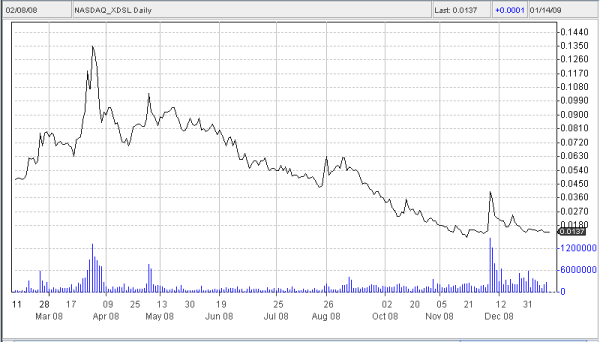
The company that “makes” this battery was first teased by the folks at the Untapped Wealth newsletter in a heavy ad campaign early in 2008 -- it turned out to be, once we followed the clues, a small firm named mPhase Technologies that used to develop DSL technologies, but was now throwing itself into the nano-battery development business. I like to talk about this one because it has been actively promoted at several distinct times in the past year, and because it’s a microcap stock that is easily influenced by what could be even a small number of new investors. And because, of course, the company has few fundamental drivers like earnings, or sales, that would help to explain movements in the stock.

The first newsletter ads teasing this “forever battery” went out in early March of 2008, and they must have struck a chord with investors because the volume of email picked up dramatically by the beginning of April, with Untapped Wealth promising that the company was on the verge of a public demonstration of their technology (they actually did demonstrate the technology, as promised -- at a steakhouse in Manhattan, of all places).

Then the promotion was sent out sporadically for the following few weeks, including a number of times in early May that caught my readers’ attention. I continued to see occasional copies of similar ads for much of the summer, but nothing that was in such heavy rotation that my email box filled up as it had in the Spring.

XDSL

Can you guess where on the chart those emails hit? Hint: Just look at every point where volume increased and the shares rose, those were almost all timed exactly following periods when many of my readers received this email ad.

More ads came out in September that claimed a “catalyst” for the shares was around the corner, which helped to slow the stock’s decline for a few weeks. Then in early December a couple of industry awards and an announcement that the company had entered a “critical partnership” with Porsche Design to develop their “Always Ready” emergency flashlight provided a big boost in volume that helped drive the shares up significantly (though they remained well under the price they traded a year ago, before the newsletter hype began in earnest). This was the first time all year, in my opinion, that the shares had moved without heavy advertising by Untapped Wealth, but just as with those ad-fueled spikes, the move was quickly reversed.

This week? Yet more campaigns rolled out, using much the same ad copy and argument as they had made a year ago, with the shares about 90% off their highs of the year.

Back in March of last year, the promise was that these shares were expected to go up by 3,600% in the next twelve months, with the shares then trading at six or seven cents a share and spiking briefly to nearly 15 cents ... now the shares are trading for about one and a half cents each, and in the current ads these same folks are expecting, you guessed it, 3,600% gains in the next twelve months.

The point here is not to single out Untapped Wealth or mPhase, but to point to the impact that even an apparently legitimate newsletter teaser campaign can have on a stock, and to provide one example from among hundreds of an ad that is sent out repeatedly (sometimes over the course of many years), with very little change to the copy, not because a stock idea is working but because the ad is working to bring in new investors.

Similar patterns have held true for many stocks that have been actively teased by investment newsletters, especially when a newsletter with a big advertising budget or large email list hits on a stock with a relatively small market cap -- a good ad drives new subscribers, and those subscribers are primarily motivated by this one stock idea, so they’re likely to buy the stock immediately.

Some of my readers have tried on occasion to trade off of these touts, but of course it’s never quite that easy -- as you can see from the XDSL chart, you would have had to be very nimble for this one, and even for stocks with market capitalization's of $500 million or more the resultant action can be wildly unpredictable.

Louis Navellier, for example, ran two very aggressive ad campaigns for his newsletters last Summer that promised dramatic near-term moves in a chosen stock -- in one case, the ad apparently worked well and it was repeated several times, which helped drive the shares of Gran Tierra Energy (GTE) higher for a few weeks. In the second case, with an extremely similar ad for Fuel Systems Solutions (FSYS), the ad went out only once, on a Sunday, and the bounce from that ad was very brief -- not because the fundamental prospects for the company were necessarily different, but, one assumes, because the ad didn’t work well enough at bringing in subscribers, so they didn’t mail it a second, third or 15th time.

As for that “Forever Battery” from mPhase?  It may well be that the company’s technology ends up working someday, or becomes a real product.  Perhaps even a profitable one, in the distant future.  The stock?  A great story, well told by a master copywriter, that sold a lot of newsletter subscriptions ... so far, that’s about it.

Cheers,

Travis

===================================================================

For more on Travis and to take a look at more of his handy-work be sure to check out www.stockgumshoe.com/about.

Steve Jobs leaves Apple for health reasons (Video Prediction)

Look what we said about Apple stock on 11/08.

In a letter to Apple employees, Jobs wrote:

Team,

I am sure all of you saw my letter last week sharing something very personal with the Apple community. Unfortunately, the curiosity over my personal health continues to be a distraction not only for me and my family, but everyone else at Apple as well. In addition, during the past week I have learned that my health-related issues are more complex than I originally thought.

In order to take myself out of the limelight and focus on my health, and to allow everyone at Apple to focus on delivering extraordinary products, I have decided to take a medical leave of absence until the end of June.

I have asked Tim Cook to be responsible for Apple's day to day operations, and I know he and the rest of the executive management team will do a great job. As CEO, I plan to remain involved in major strategic decisions while I am out. Our board of directors fully supports this plan.

I look forward to seeing all of you this summer.

Steve

______________________________________________________________________

Steve, here's to your speedy recovery.

All the best from all of us at MarketClub,

Adam Hewison

President, INO.com & Co-creator, MarketClub