From our media partner: The Associated Press.
CEOs, famous investors hit hard by market plunge
By RACHEL BECK
AP Business Writer
(AP:NEW YORK) Here's something that might provide a bit of solace amid the plunging values in your retirement accounts: Warren Buffett is losing lots of money, too. So are Kirk Kerkorian, Carl Icahn and Sumner Redstone.
They are still plenty rich, but their losses _ some on paper and others actually realized _ illustrate how few have been spared in today's punishing market when even big-name investors, corporate executives and hedge-fund titans are all watching their wealth evaporate.
The portfolio damage for some of these high-flyers has soared to billions of dollars in recent months. And they can't just blame the market's downdraft _ some did themselves in with badly timed stock purchases or margin calls on shares bought with loans.
"It's always hard to beat the market no matter who you are," said Robert Hansen, senior associate dean at Dartmouth's Tuck School of Business. "But when the ocean waters get that rough, it is hard for any boat to avoid getting swamped."
It has been a painful year for anyone exposed to the stock market. The Standard & Poor's 500 stock index, considered a barometer for the broad market, has lost about 36 percent since January, with every single sector _ including once thriving energy and utilities _ seeing declines of about 20 percent or more.
Such losses in the last year have wiped out an estimated $2 trillion in equity value from 401(k) and individual retirement accounts, nearly half the holdings in those plans, according to new findings by the Center for Retirement Research at Boston College. Similar losses are seen in the portfolios of private and public pension plans, which have lost $1.9 trillion, the researchers found.
As stocks have plunged, so have the value of chief executives' equity stakes in their own companies. The average year-to-date decline is 49 percent for the corporate stock holdings of CEOs at 175 large U.S. companies, according to new research by compensation consulting firm Steven Hall & Partners.
Topping that list is Buffett, who has seen the value of equity in his company, Berkshire Hathaway, fall by about $13.6 billion, or 22 percent, so far this year, to leave his holdings valued at $48.1 billion. Oracle founder and CEO Larry Ellison has seen his equity stake fall by $6.2 billion, or about 24 percent, to $20.1 billion, according to the research that ran from the start of the year through the close of trading Oct. 29.
Rounding out the top five in that study were Microsoft's Steve Ballmer, whose company equity fell by $5.1 billion to $9.4 billion; Amazon.com's Jeff Bezos, whose equity fell by $3.6 billion to $5.7 billion; and News Corp.'s Rupert Murdoch, with a $4 billion contraction to $3 billion.
News Corp. and Microsoft declined comment, while representatives from Berkshire Hathaway, Oracle and Amazon.com didn't respond to requests for comment.
Those results included the value of the CEOs' stock, exercisable and non-exercisable stock options and shares that haven't yet vested. They are drawn from each company's most recent proxy statement, which means they might not include subsequent stock purchases or sales.
"Everyone wants to see executives have skin in the game, and this shows they certainly do," said Steven Hall, a founder and managing director of the compensation consulting firm. "But in the end, we have to remember they still have billions to fall back on."
But there have been recent instances where executives' large equity positions have blown up _ not only damaging a particular CEO's portfolio but the company's shareholders, too.
A growing number of executives at companies including Boston Scientific, XTO Energy Corp. and Williams Sonoma Inc. have been forced to sell stakes in their companies to cover stock loans to banks and brokers. The company stock was used as collateral for those loans. The falling prices triggered what is known as a "margin call."
"A decrease in insider ownership is bad for corporate governance," said Ben Silverman, director of research at the research firm InsiderScore.com. "Then executives' interests are less aligned with their shareholders."
Investors in Chesapeake Energy Corp. were recently faced with the surprising news that company CEO Aubrey McClendon was forced to sell almost 95 percent of his holdings _ representing more than a 5 percent stake in the natural gas giant _ to meet a margin call. His firesale of more than 31 million shares, valued at nearly $570 million, put downward pressure on Chesapeake's stock in the days surrounding the mid-October transaction.
McClendon has called this a personal matter and said he would rebuild the ownership position, according to Chesapeake spokesman Tom Price.
Redstone, the famed 85-year-old chairman and controlling shareholder of CBS Corp. and Viacom Inc., was forced to sell $233 million worth of nonvoting shares in those companies. That was done to satisfy National Amusements' loan covenants, which had been violated when the value of its CBS and Viacom shares fell below required levels in the loan agreements.
National Amusements is Redstone's family holding company, and the stock sales represented 20 percent of the holding company's CBS shares and 10 percent of its Viacom shares. A spokesman for National Amusements declined to comment.
Certainly some of the biggest investors aren't happy with recent market events.
Earlier this year, billionaire Kerkorian's investment firm Tracinda Corp. paid about $1 billion, at an average share price of near $7.10, for about 141 million shares in Ford Motor Corp. That represented a 6.49 percent stake in Ford.
Those shares have tumbled as the automaker's financial condition weakened considerably amid slumping sales and tighter credit conditions. That drove Tracinda to disclose twice in recent weeks that it was selling some of its Ford stock _ one batch of 7.3 million shares sold at an average price of $2.43 each, and the other for 26.4 million shares at an average sale price of $2.01 each. That means for about a quarter of his total Ford holdings, he got $71 million.
Tracinda spokeswoman Winnie Lerner declined to comment.
Activist investor Icahn faces an equally ugly situation with his investment in Yahoo Inc. earlier this year, when he bought about 69 million shares for a nearly 5 percent ownership stake. As of June 30, those shares were valued at about $20.60 each, according to a regulatory filing.
Over the summer, he fought hard to get Yahoo's board to agree to a takeover by Microsoft Corp., a deal that never went through. As a concession, Icahn got a seat on the Yahoo board for himself and two allies.
But his Yahoo holdings are off sharply, with the company's shares trading around $13 each. That means he's down more than $500 million since late June. Icahn didn't respond to a request for comment.
As Tuck's Hansen notes, the current market conditions are serving up a reality check _ not just for individual investors but for the biggest names around.
"Fishing isn't called catching, and investing isn't just called making money," Hansen said. "We have to remember that things can go down by a lot."
Copyright 2008 The Associated Press.

 I was looking through our alerts recently and this stock just jumped out at me. I want to share my thoughts about what I expect will happen to this market in this short video. We've discussed this pattern before on several other videos and all have worked out very successfully.
 Adam Hewison
 Spreads sometimes are touted as a no- or low-risk trading option, ideally suited to smaller or more risk-averse traders. Although some do have limited risk in certain circumstances, spreads are by no means risk free, and in fact they contain some unique risks, especially for traders who don't have a clear understanding of the limitations and possibilities of these transactions.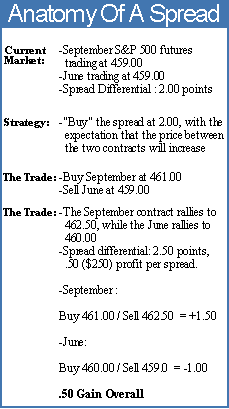
 Spreads occur between different months of the same contract for a variety of reasons. For many agricultural contract, the cost of storing and insuring the physical commodity from month to month (referred to as carrying cost) is incorporated into the price of the back months in relation to the nearby month or the cash price, and will account for at least a minimum price difference between two contracts.
 all traders.