Bear Market Rally Or Something Else?

The stock market ended the week higher for its best week in over a year. But the question is, is this just a bear market rally, or have we seen the bottom and its blue skies ahead?

The DOW rose 274.17 points or +0.80% to close at 34,754.93, its fifth day of gains to close out the week. The S&P 500 gained +1.17% to reach 4,463.12, and the NASDAQ added 2.05% to end the day at 13,893.84. Both indexes surged for a fourth consecutive day.

On a weekly level, the S&P 500 notched a +6.16% gain, the DOW posted a weekly gain of +5.50%, and the NASDAQ outperformed with a monster gain of +8.18%. These gains helped the indexes post their best week since November of 2020. Continue reading "Bear Market Rally Or Something Else?"

Bond Market Breakdown with Jeff Gundlach

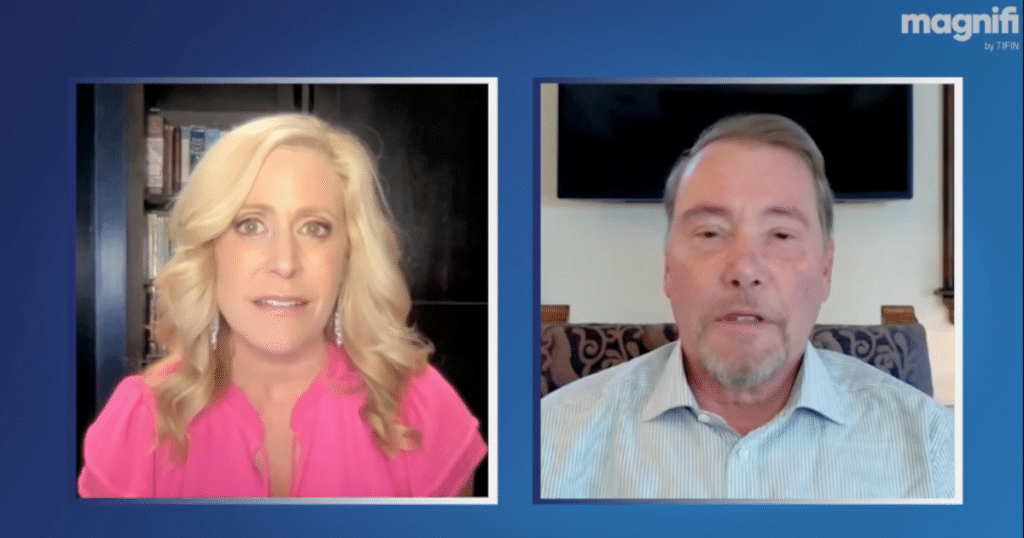
DoubleLine CEO Jeffrey Gundlach, and Capital Wealth Planning CIO Kevin Simpson, join host Melissa Francis, former CNBC, MSNBC, Fox Business, and FOX News anchor, to break down standout trends in the bond markets. Featuring special guest Gary Kaminsky, former vice chairman at Morgan Stanley and former capital markets editor at CNBC.

Watch the full interview and see more bond market breakdowns on Magnifi by TIFIN.

Melissa Francis
Welcome, everyone. Today we're here to talk about Magnifi by TIFIN, a marketplace where you can harness real-time proprietary data to help individual investors and financial advisors find, compare and buy investment products like stocks and ETFs and mutual funds and model portfolios to grow and preserve your wealth.

I'm Melissa Francis. I know a little bit about this subject matter. I am former CNBC, MSNBC, Fox Business and Fox News anchor. And joining us today is investor, legend and founder of DoubleLine Jeffrey Gundlach. Welcome. Thank you so much for joining us. I know on a day when we are watching markets tank, everyone wants to talk to you and get your perspective. I'm lucky enough to have you here and I'm just going to let you go. What's your take on what's happening today?

Jeffrey Gundlach
Well, I think we need to start admitting that we're running into a stagflation situation. The Fed is in a really difficult position because these price spikes are really going to need the Fed to be aggressive if they're serious at all about fighting inflation. And we're starting at such a low rate level relative to an inflation rate that's already seven and a half percent. We have about a 1.7% 10-year treasury. We have Jimmy Carter type of negative interest rates. They're even more negative than Jimmy Carter.
Continue reading "Bond Market Breakdown with Jeff Gundlach"

Big Banks' Meltdown Overblown

Higher Expenses and Geopolitics

Capping off 2021, the cohort of big banks had the perfect set-up with secular trends via a confluence of a rising interest rate environment, post-pandemic economic rebound, financially strong balance sheets to support expanded buybacks and dividends, a robust housing market, and the easy passage of annual stress tests. However, as earnings season kicked off in January 2022, investors saw a step-up in expenses, specifically wage inflation. Bank of America (BAC), JPMorgan Chase (JPM), Morgan Stanley (MS), Wells Forgo (WFC), and Goldman Sachs (GS) all reported very strong quarters; however, investors couldn't look past the increasing expenses and these stocks sold-off as a result.

To exacerbate the sell-off across the financials, the geopolitical backdrop with the Russian/Ukraine conflict paved the way for a second leg down. This one-two punch resulted in BAC, JPM, and GS selling off 18.3%, 22.3%, and 22.6%, respectively, from their 52-week highs through the first week of March. However, as Jerome Powell sets the stage for an economic "soft landing" with the clear commitment of raising interest rates by 25-basis points and the geopolitical headwinds inevitably abating, the big banking cohort looks appealing at these levels.

Big Banks

Immaterial Geopolitical Exposure

The big banking cohort has minimal to no direct exposure to Russia; thus, the second leg down in this space is not tied directly to the geopolitical conflict. This is especially important as the geopolitical tensions rage on and possibly snap up these stocks as a function of overall market sentiment. Overall, the big banks generate an inconsequential amount of revenue from Russia, per Bank of America's analysis of regulatory 10-K filings. Continue reading "Big Banks' Meltdown Overblown"

Cryptocurrency Strategies for 2022

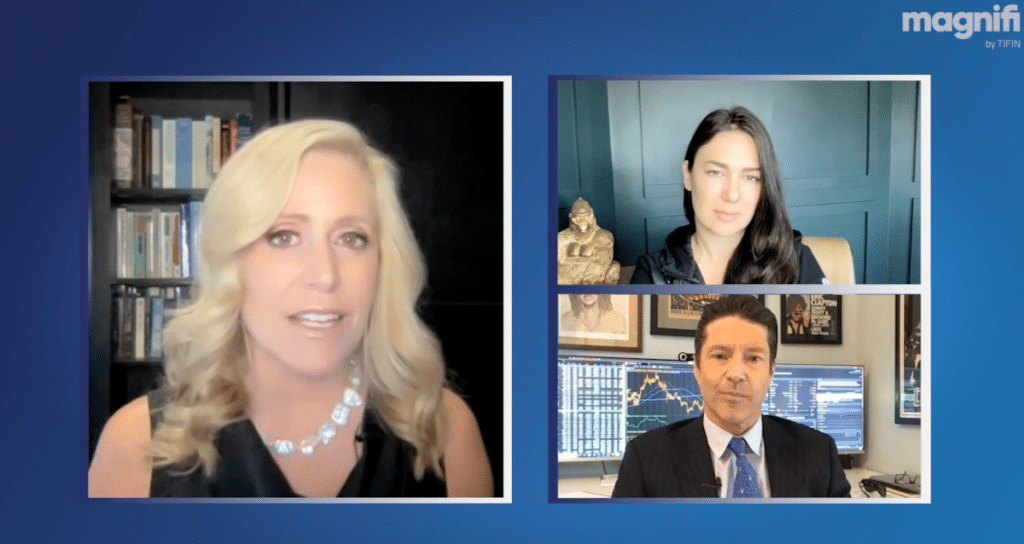
SkyBridge Capital Founder Anthony Scaramucci, CoinShares CSO Meltem Demirors, and Seymour Asset Management CIO Tim Seymour join host Melissa Francis, former CNBC, MSNBC, Fox Business, and FOX News anchor, to delve into the nuances of the digital currency market.
Watch the full interview and see more on crypto, inflation, and interest rates from Wall Street titans on Magnifi by TIFIN.

Melissa Francis
Welcome back to Magnifi by TIFIN. Today, we are talking crypto and the best way to incorporate it into a portfolio. Tim Seymour is CIO of Seymour Asset Management, and Meltem Demirors as chief strategy officer at CoinShares. Welcome to both of you.

Melissa Francis
You guys have both been pioneers in crypto. But before we get to that even, I want to get your reaction to what you heard Anthony Scaramucci say. Well, let's start with crypto. I mean, he says he thinks it's going to get to 100,000 in the next two years. What do you think about that?

Tim Seymour
Meltem, do you want to jump in? I'll jump in. Yeah, I think we've seen a ton of volatility in crypto and Bitcoin markets in in the last, probably five years. So the question of calling where 100,000 is the mark, I think the more important dynamic is that prices are moving higher and that the drawdowns of 20% to 40% seem to be somewhat garden variety. I think we're going to get into this conversation, the fundamentals for owning Bitcoin.

Something I also heard Anthony talking about is the regulatory environment around Bitcoin is something that's actually a friend to the pricing, and despite the decentralized nation and some of the ethos and the existential reasons for wanting to own Bitcoin, and I get it. Defi to the moon, but Bitcoin's going higher.
Continue reading "Cryptocurrency Strategies for 2022"

Interest Rates Are Going To Go Higher

Even while the Russian-Ukraine conflict continues to rage on, the fact of the matter is the US, and honestly, the majority of the world is dealing with higher-than-expected inflation. And the most direct way to bring that inflation back down to sustainable levels is for the Federal Reserve and other central banks around the world to take action and increase interest rates.

Prior to the Russian-Ukraine situation occurring, it was widely expected that the Federal Reserve would raise the benchmark interest rate by 0.5% in March. However, now that the war in Ukraine is occurring, many believe the Fed will only increase rates to 0.25% in March and reassess the situation at the following meeting.

However, even while most market participants expect a rate hike of just 0.25%, some Fed officials still believe that a 1.00% rate hike is justified in March. While there is talk of the 1% hike, very few believe it will occur in March, especially since the Russia-Ukraine situation.

Furthermore, market participants also need to consider when and how quickly the Federal Reserve decides to start winding down its balance sheet. Some believe when the Fed begins that process, it could have more of an effect on interest rates than when the Fed actually raises rates since the Fed was a huge buyer of bonds. Since the bond market and bond interest rates are essentially determined by supply and demand, if demand is weak due to limited buyers, the interest rates will increase until buyers step in. With the Fed no longer buying and potentially selling bonds, supply will be high, which will require much more attractive yields in order to entice investors to step in and buy bonds.

So as an investor, how can you profit from this information? Continue reading "Interest Rates Are Going To Go Higher"