Stocks Fall After Tariffs and Fed Cut

Hello traders everywhere. All three major indexes will end the week in negative territory after suffering a one-two punch from the Fed and President Trump. The move lower started on Wednesday when the Fed announced that they were cutting the key interest rate a quarter-point in effort to keep economy on track. That news caused all three major indexed to finish -1% lower on the day with the S&P 500 triggering a new red weekly Trade Triangle at the end of trading that day indicating a move to a sidelines position.

Thursday morning saw a bit of optimism with stocks climbing higher in early trading only to be chopped down when President Trump tweeted "Trade talks are continuing, and during the talks the U.S. will start, on September 1st, putting a small additional Tariff of 10% on the remaining 300 Billion Dollars of goods and products coming from China into our Country. This does not include the 250 Billion Dollars already Tariffed at 25%". That news sent the DOW lower losing -1% or 280pts on the day triggering a new red weekly Trade Triangle as it joined the S&P 500 on the sidelines.

The stock market continues to move lower as we end the trading week lower culminating with the NASDAQ joining the S&P 500 and DOW triggering new red weekly Trade Triangle after losing -1.39% as we head into afternoon trading. As we stand stocks are on pace to have their worst week of the year with the S&P 500 and DOW losing over -3% and the NASDAQ losing over -4%.
Key Levels To Watch Next Week:

Continue reading "Stocks Fall After Tariffs and Fed Cut"

ETFs That Let You Play The HOT IPO Market

In 2019 the Initial Public Offering market has been on fire. We have seen huge pops in share prices from some of the big-name companies like Uber, Levi Strauss, Lyft, Pinterest, Zoom Video, CrowdStrike, Chewy, and of course Beyond Meat. And actually, Beyond Meat was the “biggest popping U.S. IPO since 2000”.

The vast number of fast-growing companies that have hit the market in 2019 and the promise that investors see from these stocks has caused some investors to take on more risk than they should when they rush in after the large pops and buy up shares of the already somewhat inflated stock.

This leads to the biggest challenge of investing in newly public companies, which is first determining which ones are the next Pet.coms and which ones could go on to become the next Amazon.com. The risk is extremely high with recently IPO’d stocks, and especially ones that have seen some of the increases we witnessed in the first half of the year because in most cases profits are still none existent. But a few different Exchange Traded Funds are available which will give you exposure to these hot new IPOs, but minimize your overall risk.

Instead of cherry-picking which recent IPO’d stock or stocks you think can become a monster winner from here, you can buy all of them and feel good knowing you will have some skin in the game. So, let's take a look at which ETFs you may want to research further. Continue reading "ETFs That Let You Play The HOT IPO Market"

Fed Set To Rattle Global Markets

Today is the day for the US Fed to announce their rate decision and we believe the 25 basis point rate cut is the only option they have at the moment that will attempt to settle foreign market fears and allow for a suitable “unwinding” of the credit/debt “setup” we highlighted in Part I of this research post.

We believe out August 19 expectation of a global market PEAK and the beginning of a price reversion move is related to multiple aspects of the timing of this Fed move and the current global economic outlook. The unwinding of this debt/credit bubble will likely take many more years to unravel. Yet, right now the US Fed is trapped in a scenario they never expected to find themselves in. Either continue to run policy that supports the US economy (where rates would likely stay between 1.75 to 2.75) over the next 5+ years or yield to the global market and attempt to address a proper exit capability for this debt/credit “setup”.

We believe global investors are expecting a massive collapse in the US stock market as a reaction to this move by the Fed and because of the expectation that another bubble has set up in the US. But we believe the actual bubble is set up in the foreign markets and not so much in the US. Yes, the US markets have extended to near all-time highs and the US consumer is running somewhat lean. It would be natural for the US economy to revert to lower price levels and for the US economy to rotate as “price exploration” attempts to find true market support. Yet, our fear is that the foreign markets are much more fragile than anyone understands at the moment and that a reversion in the US markets will prompt a potential collapse in certain foreign markets.

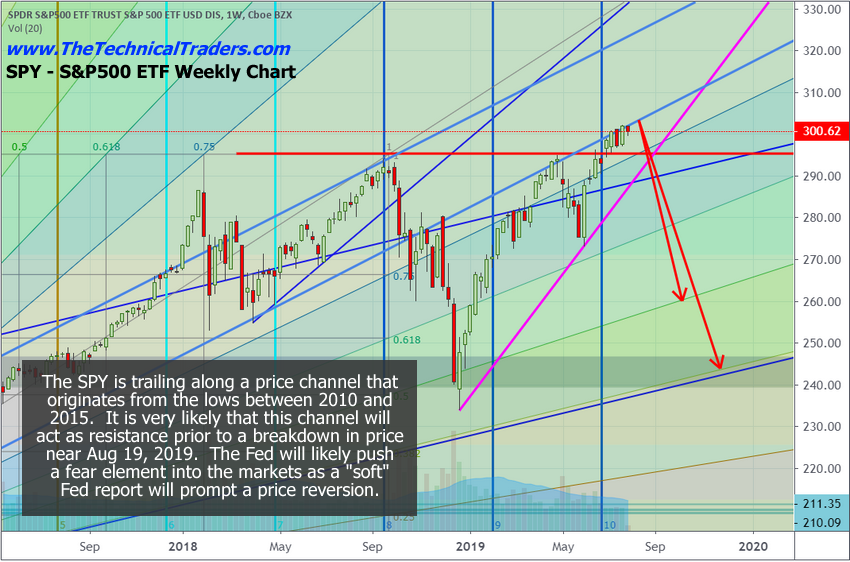
Weekly SPY Chart

This Weekly SPY chart highlights what we expect to transpire over the next 6 to 8+ months. We believe the August 19 peak date that we predicted months ago will likely start a process that will be tied to the US election cycle event (2020) and the US Fed in combination with global market events. We believe a reversion price process is about to unfold that could be prompted into action over the next 2+ weeks by the US Fed, trade issues and global central banks.

fed

If the US Fed drops the FFR by 25pb, the fragility of the foreign market debt/credit issues is not really abated or resolved. It just allows for a bit of breathing room that may allow these foreign debtors enough room to wiggle out of some of their problems. The US Fed would have to decrease rates by at least 75 basis point before any real relief will materialize for these foreign debtors. Continue reading "Fed Set To Rattle Global Markets"

Pre-Fed Precious Metals Update

We review these metals as the media schleps all over itself trying to tell people why the Fed will cut 1/4, will cut 1/2, should not cut at all and/or why the president of these United States of America is on Twitter haranguing the Fed to be as disreputable as Mario Draghi and China’s central planners because they know how to play the game. It’s all a game after all, isn’t it Trump? You old currency warrior, you.

Copper daily is nesting on the SMA 50 but locked below resistance and the SMA 200. Still in bounce mode but very unspectacular.

copper

Copper weekly still looks pretty gross. It’s above critical support but locked below a ton of resistance. The 2016-2019 pattern also looks like a freak. I refuse to like industrial metals (or cyclical commodities in general) until I get some technical reason to like them. Continue reading "Pre-Fed Precious Metals Update"

ETFs Paying 8% Plus Dividend Yields

There are currently more than a handful Exchange Traded Funds that are paying more than an 8% dividend yield. And yes, you are reading that correctly, more than an 8% dividend yield. There are at least four ETF’s currently paying dividend yields above 8%, while a few others are paying yields even higher.

Furthermore, these ETF’s are investing what is surprisingly a wide range of different investments, meaning even if you’re not a fan of REITS or MLP’s, there is still may be an ETF, that’s paying a healthy yield, out there waiting for you. So, let’s take a look at a few of the different options.

First, we have what most would expect out of a high dividend-yielding ETF, an MLP ETF. The VanEck Vectors High Income MLP ETF (YMLP) is currently yielding 8.18% and has an expense ratio of just 0.82%. The fund has 18 holdings, all of which are MLP’s structured as C-corporations. Also, the weighted average market cap is only $1.36 billion, and the funds top nine holdings all fall in line at 7% to just over 8% fund weighting. Year to date the fund is up 18%, but only 2% over the last month and 3.85% over the previous year.

Another typical high dividend-paying investment is a REIT or Real-Estate-Investment-Trust. And you can imagine when one ETF owns 27 different REIT’s, the dividend gets a little juiced. One such ETF is the VanEck Vectors Mortgage REIT Income ETF (MORT) which has a yield of 7.4% but has an expense ratio of just 0.41%. MORT has 27 holdings with a weighted average market cap of $5.13 billion and has a year-to-date performance of 10.93% while being up just 1.55% over the last month and 11.61% over the last 12 months. MORT invests in mortgage REIT’s which are REIT’s that own mortgages or mortgage back securities. The risk with these investments is that we see outsized mortgage loan default rates, such as what we saw during the last recession. Continue reading "ETFs Paying 8% Plus Dividend Yields"