White And The Whiter: Who Let Palladium Out?

Aibek Burabayev - INO.com Contributor - Metals


Dear INO.com Readers,

New month, new everything!
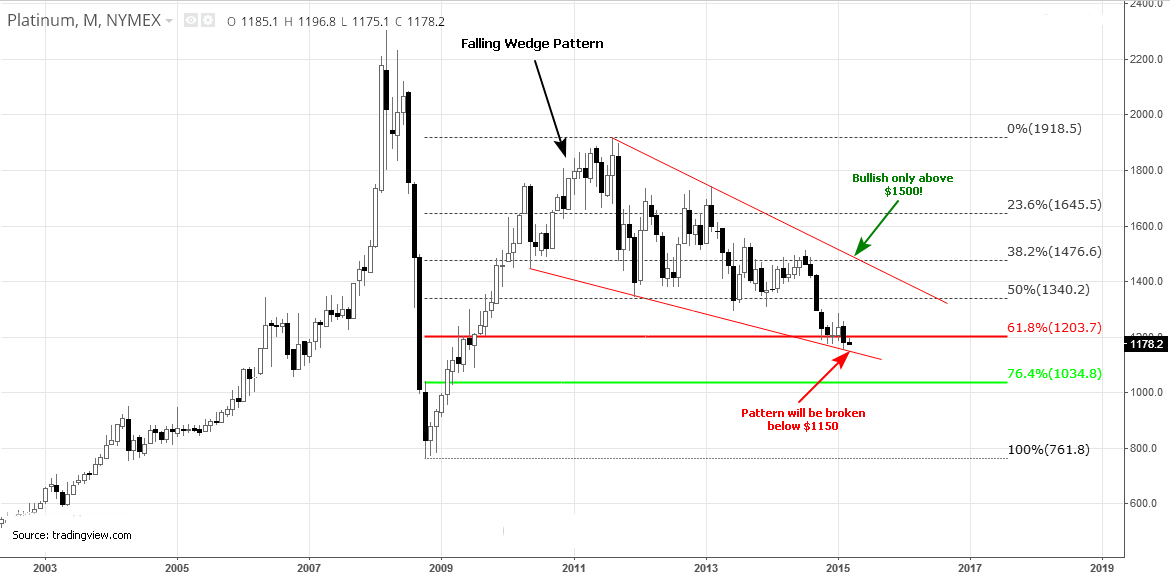
Monthly Platinum chart

As seen on the above monthly chart, Platinum spent a pretty quiet season inside of a narrow $100 range, sitting on the 61.8% Fibonacci level around $1200, trading with a discount to Gold. February closed lower at $1185, with the monthly low at $1155 and touched the falling wedge pattern's support. Price couldn't accumulate enough momentum to fulfill the pattern so far. The pattern is bullish and to bring the bullish track the white metal would need to overcome the wedge's resistance at $1500 and two Fibonacci levels at $1203 and $1340 on the way to it, difficult but still a possible task.

I don't rule out that with such an unconvincing performance, the bears would try at another chance to break below the wedge's support at $1150. That will negate the model and the price could quickly reach the last Fibonacci support at the $1034 level. I don't want to be too cruel and imagine what would be next after that. Continue reading "White And The Whiter: Who Let Palladium Out?"

How to Position Your Portfolio for the Coming Gold Upturn

The Gold Report: The metal mining sector is undergoing many of the same types of issues as the energy sector. What is your candid assessment of the near future for gold, silver and the base metals?

Etienne Moshevich: My outlook for the sector is very similar to that of the overall energy marketthe world needs gold and the commodity isn't going away. It may go out of favor for a couple of years, which we're experiencing now, but it seems as though the market is slowly starting to creep back up and this is the time investors need to be positioning themselves in high-quality management teams and projects before the market gets away from them.

Although many things could change, macro signs are pointing to a turn in the gold market. Even though the U.S. dollar is still the strongest and most reliable currency in the world, more and more countries seem to be shifting away from the dollar, which would definitely strengthen demand for gold. Also, if the U.S. economy falls into another recession and the Federal Reserve decides to apply another one of its quantitative easing techniques, then this will be very bullish for gold.

"Source Exploration Corp.'s past success indicates the great potential for the upcoming drill program."

One last major factor that we should consider is the possible demand from foreign central banks. We need to keep in mind that the Swiss are voting on a gold referendum that would require the Swiss National Bank to hold 20% gold reserves. Even if this doesn't go through, I'm sure there would be more pressure on it to increase gold reserves over time. I'm bullish on silver, as well, over the long term because of its industrial and technological applications.

TGR: Let's tour the field. Starting with gold, which companies do you spot as viable? Continue reading "How to Position Your Portfolio for the Coming Gold Upturn"

Solid Trading Tips For 2015

This is the beginning of a new year and perhaps the best time when investment experts predict their views on the trading performance of stocks and shares. They will also analyze the upcoming trading trends and strategies for your benefit. The media has been flooded with investment queries running at the back of your mind.

An investor must follow a few solid trading tips to succeed:

• Count on the future surprises – Don’t depend on the future predictions; it’s not possible for you to see through the curtain that separates today’s happenings with that of tomorrow.

• Good and bad times lie ahead – You’ll need to determine future strategies keeping with your investment and planning goals. In order to accommodate all natural outcomes, you’ll need to formulate flexible strategies. Continue reading "Solid Trading Tips For 2015"

Here's What Stock Market Bulls Might Be Overlooking

By:Elliott Wave International

On Friday (Feb. 27), the 4th quarter U.S. GDP was revised downward to 2.2% from the original 2.6%.

"U.S. stock markets shrugged off the revision," wrote Fox Business. And why wouldn't they -- after all, the conventional wisdom says that as long as the economy is growing, so is the stock market.

Except, it's not exactly true.

See, if that notion were true, then you'd have to assume that the U.S. economy was in a bad shape in 2007, when the stock market began its biggest decline since the Great Depression. But the facts show the opposite.

When the Dow topped in October 2007, key economic measures were indeed strong: Continue reading "Here's What Stock Market Bulls Might Be Overlooking"

Are We In A Boom Or A Bust?

George Yacik - INO.com Contributor - Fed & Interest Rates


This is the world we live in today: Stocks are priced as if the global economy is booming, while the bond market is priced as if we’re in a worldwide depression.

Nowhere is this truer than in Europe, where stocks are at or near record highs while yields on sovereign bonds are at record lows, below zero in many cases.

Of course, we’re neither in a boom or a bust. While we’re closer to the former in the U.S., we’re a lot closer to the latter in Europe. The bond market in Europe is telling us that the euro zone economy’s in the tank, which is much closer to reality, while the stock market there is now trading at a seven-year high. Continue reading "Are We In A Boom Or A Bust?"