Is Google losing its mojo?

Hello traders everywhere! Adam Hewison here, President of INO.com and Co-creator of MarketClub, with your mid-day market update for Wednesday, the 16th of October.

Tomorrow, Google (NASDAQ:GOOG) announces its long awaited earnings and I thought I'd take a look at this stock today before tomorrow's big announcement.

There are some interesting developments in Google (NASDAQ:GOOG) that have largely gone unreported. I will be using our Trade Triangle technology to point out these discrepancies to our viewers.

Of course, the Democrats and Republicans clawing at each other as they try to beat the deadline on the 17th is the big unknown for the market. My best guess is that there will be a deal that no one likes and the politicians will agree to "kick the can down the road" until next year.

Please feel free to leave a comment and share your thoughts on the markets or if you dare, Washington politicians.

Have a great trading day,
Adam Hewison
President, INO.com
Co-Creator, MarketClub

Bloomberg BNN CNBC FOX

Adam appears frequently on the following financial news channels as a guest expert. Click on any cable logo to watch Adam's latest appearance.

Colorado Floods Highlight Opportunity in Oil and Gas Services

The Energy Report: Jason, how did the recent flash flooding in Colorado impact the Wattenberg oil field?

Jason Wangler: It was a very nasty flood and all the companies on the ground are working hard to assess the damage. There have been reports of tank leakages and other problems. But the wells were turned off during the flood, so drilling operations were not affected much. The questions that remain are how much work is necessary to fix the roads? And when can the drillers safely turn the wells back on?

TER: Given the ever-present possibility of natural disaster, what type of emergency preparations do oil and gas drillers typically take? Continue reading "Colorado Floods Highlight Opportunity in Oil and Gas Services"

How to successfully swing trade using MarketClub

Swing trading has been popular for years amongst professional traders. It is a type of trading that tries to catch the various up moves and down moves in a market over the course of a few days to a few weeks. Unlike a longer term trend trader, a swing trader typically uses technical analysis to identify markets with short term momentum.

Swing trading can be a good trading style for beginner traders, as it offers a middle ground between day trading and long term trend trading. However, it can still offer the potential for significant profits for more advanced traders.

One of the key elements to successful swing trading is determining the direction of the major trend. This can be done easily using MarketClub's Monthly Trade Triangle. A green Triangle represents an uptrend and a red Triangle represents a downtrend. Using the chart for SunPower (NASDAQ:SPWR), you can see the green Monthly Trade Triangle was established on December 10, 2012, and has stayed in place for all of 2013.

Since the major trend is up for SunPower (NASDAQ:SPWR), it might be a good candidate to successfully swing trade. How far a market pulls back from a high and subsequently breaks over the previous high, can be used to determine how far that price swing will go. For example, if the price was 10 and the market pulled back to 5, the difference between 10 and 5, is 5. If the market subsequently moved over the previous high of 10, then you would add 5 to 10 and have a target zone of 15.
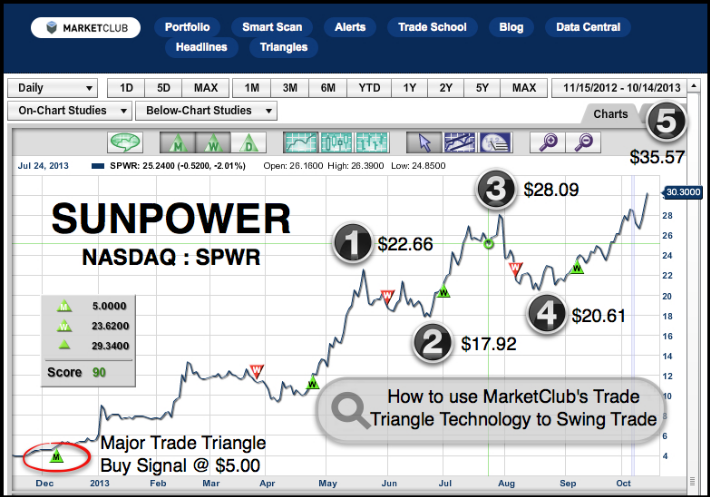
On the chart, you will see the numbers (1) through (5). Next to the number you will see a price point, which represents the highest stock price closing for that particular swing.

At (1), the price point was $22.66. The market then fell to (2) which represents a drop in price of $4.71.

Now, you simply add the price drop of $4.71 to the high price at (1) $22.66, which gives you a new swing point objective of $27.37.

At (3), the price point was $28.09. The market then dropped back to (4) $20.61, which represented a pullback of $7.48.

Now, the market has already moved through (3) $28.09, which is where we add on the pullback amount of (4) $7.48 to (3) $28.09. This produces our next target zone of $35.57.

We will see in the future if that level is achieved.

I hope you are able to apply this suggested method to other markets as well.

As always, I appreciate hearing back from you with your thoughts and ideas on different markets. Until then, I wish you every success in the marketplace.

All the best,
Adam Hewison
President, INO.com
Co-Creator, MarketClub

The Peerless Way to Precious Metal Profits

The Gold Report: In a July research report, you wrote that the ongoing decline from the all-time high in the gold price may represent a correction of the last large up leg, which some say began in 2009 or mid-2008. Or it may represent a correction of the entire 1999 - 2011 advance in the gold price. Which is it? And has that correction run its course?

Tom Szabo: We are in a correction of the 20082011 rally and it is ongoing. Big picture, the gold price needs to drop below $1,155/ounce ($1,155/oz) and then subsequently below $1,067/oz before this would represent a correction of the entire gold cycle that goes back to 1999. We haven't seen such a decline at this point so we can't conclude that it's a larger correction.

TGR: We've seen modest upward momentum in the gold price since the lows of April. Is there enough momentum to invest in gold equities? Continue reading "The Peerless Way to Precious Metal Profits"

Trading Using Monetary Policy Analysis

Monetary policy, which is also known as interest rate policy, describes the actions or in-actions of a country’s central banks.  Interest rate policy generally focuses on maximizing price stability and growth.  The central bank of a country is considered the institution that controls a countries currency, money supply, and interest rates. Central banks also usually oversee the commercial banking system of their respective countries.

Each central bank has guidelines that are mandated by their legislature.  For example, in the US, the central bank has a dual mandate which is to maximize price stability and employment.  Other central banks, such as the European Central bank, have only one mandate which is price stability.

Central banks often spur growth and employment by reducing interest rates, making it easing for banks to lend money at reduced rates.  Lower interest rates also increase liquidity, and make purchasing riskier assets a more attractive alternative than holding low interest baring government notes. Continue reading "Trading Using Monetary Policy Analysis"