Copper Trade: Stopped Out

A month ago I got the short entry trigger in the copper futures. The idea started to emerge this February, and I was watching copper closely from that time and posted updates for you. And you witnessed how I moved entry triggers higher and higher until the price has finally pushed below the last one. And this was the true benefit of avoiding simple guessing to wait for the signal.

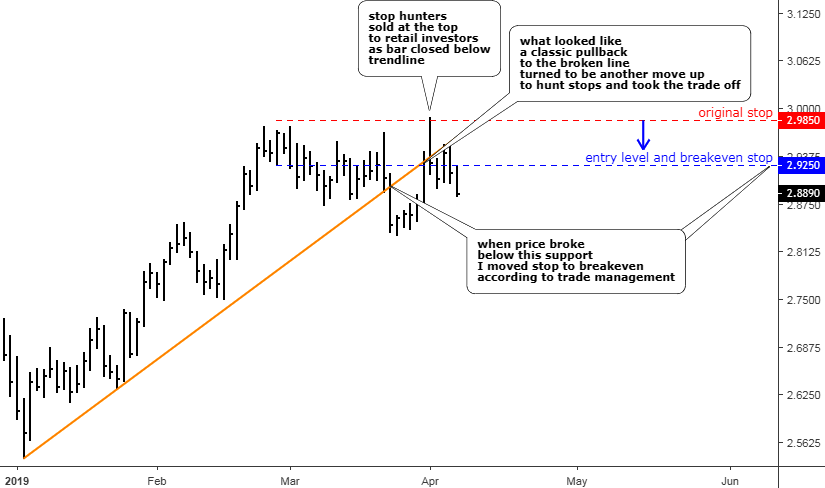
In the chart below I would like to show you how that trade was managed and what the outcome was.

Copper Futures Daily Chart: Walked Away Without A Scratch
price of copper
Chart courtesy of tradingview.com

The price of copper showed great volatility around the entry level (blue line) moving within a 10 cent range between $2.87 and $2.97. This happens due to a clash of opposite market forces at the extreme levels. Finally, the bears took the ball and pushed the price not only below the range but also below the crucial orange trendline support. Copper has hit the one month low at the $2.8345 on the 25th of March. At that stage, the short position had a profit of 3%, and I moved the stop to breakeven to enjoy the safe ride. This is a part of trade management as we should try to avoid risks as much as we can because we cannot control the market; we can only control ourselves and manage our risk. Continue reading "Copper Trade: Stopped Out"
Waiting For The Next Big Move

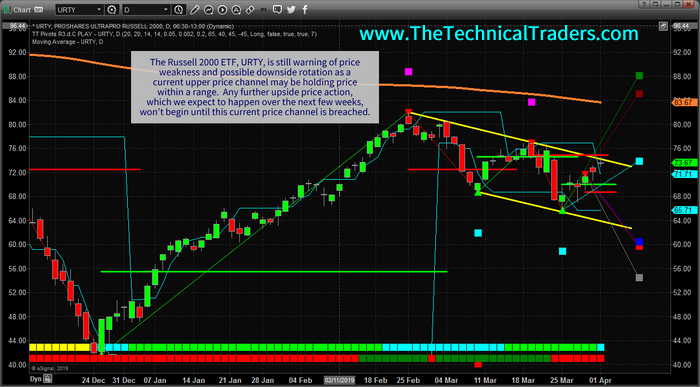
While we have recently suggested the US stock market is poised for further upside price activity with a moderately strong upside price “bias”, our researchers continue to believe the US stock market will not break out to the upside until the Russell 2000 breaks the current price channel, Bull Flag, formation. Even though the US stock markets open with a gap higher this week, skilled traders must pay attention to how the Mid-Caps and the Russell 2000 are moving throughout this move.

As we continue to advise our clients that the upside pricing cycle in the US stock market is being underestimated, see this research post: we also believe that increased volatility and price rotation will continue to drive larger rotations in price before the final breakout upside move takes place. We want to continue to warn traders that we still don’t have any confirmed upside breakout with price continuing to stay within this price channel in the Russell 2000. Eventually, when and if the price does breakout to the upside, we will have a very clear indication that continued higher prices and a larger upside move is happening. Until then, we need to stay cautious about the types and levels of rotation that continue within the markets.

The Next Big Move

Recently, volatility has started to increase as can be seen in this VIX chart. If the Russell 2000 is not able to break this trend channel with this current upside price move, then we fully expect continued price rotation in the US stock markets and another increase in the VIX as this rotation takes place. The NQ recently rotated downward by nearly 4% while historical volatility continues to narrow. When volatility diminishes in extended price trends, we’ve learned to expect aggressive price rotation can become more of a concern. We expect the VIX to spike above 16~18 on moderate volatility as we get closer to the cycle inflection date near June/July 2019. Continue reading "Waiting For The Next Big Move"

Gold Update: Reversal Pattern Emerges

Last time I updated the gold chart at the beginning of the year I focused on the long-term consolidation, which has started at the end of 2015 and has a tricky structure as all corrective stages do. I shared with you the three most feasible options of structure development.

The first one implies the straight move up beyond the former top of $1375 (blue labels), it took only 22% of your likes. The second option, which you liked the most (48%), offers triangular consolidation (green labels). The third alternative (red labels) gained 30% of your support, and it could bring gold back down to retest $1122 area before it goes up.

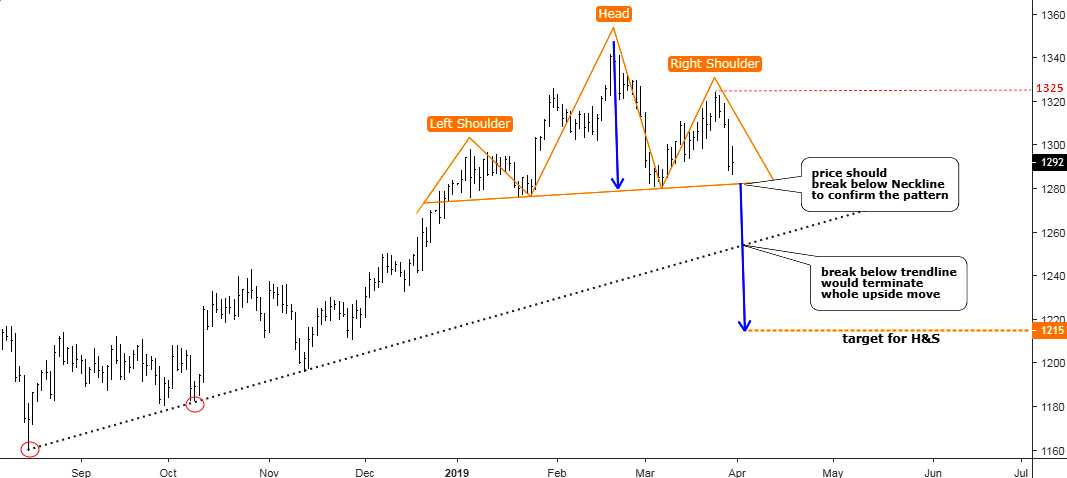
I am proud to have such smart readers of my posts as most of the time you accurately predict the market behavior as last time you did it with a Santa Claus rally of precious metals. These days I spotted one notorious pattern, which could terminate the first option, which collected the least support from your voting, that amazes me again and again.

Gold Daily Chart: Possible Head And Shoulders Pattern

LLLL
Chart courtesy of tradingview.com
Continue reading "Gold Update: Reversal Pattern Emerges"

Treasury Inversion And Political Fed Cycles

With so much news hitting the wires regarding the Treasury Inversion level and the "potential pending recession", we wanted to shed a little insight into this phenomenon and what we believe the most likely outcome to be going forward. Our researchers, at Technical Traders Ltd., believe the Treasure inversion is a reactionary process to overly tight US Fed monetary policies, consumer demand factors and outside cycle forces. There is very little correlation to inverted Treasury levels and causation factors other than the US Fed and global central banks. We believe consumers and consumer sentiment also play a role in setting up the conditions that prompt yield inversion. The one aspect we believe everyone fails to consider is the uncertainty that is associated with major US election cycles.

The US Fed is obviously a driving force with regards to yields and consumer expectations. In the past, the US Fed has rotated FFR levels up and down by enormous amounts (in some cases 200 to 500%+ over very short spans of time. Consumers, you know those people, the ones that are the actual driving force of the local and state level economies, have been the the ones having to deal with wildly rotating FFR levels and the consequences of their debt rotating from 4~7% average interest rates to 8~25%+ average interest rates over the span of just a few years.

Take a look at this chart that highlights the current and previous US Federal Reserve FFR rate changes. It is quite easy to see that consumers and business, on the receiving end of these changes, often swing from one extreme to another as the US fed makes these dramatic moves. And, yes, that last 2400% number is correct. The FFR went from 0.06% to 2.4% over the past 3+ years – do the math yourself if you don't believe us. Continue reading "Treasury Inversion And Political Fed Cycles"

U.S. Equities Price Anomaly Setup Continues

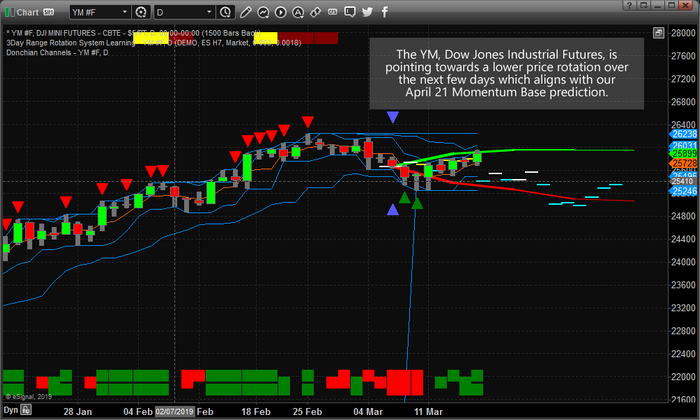
This research post highlights what we believe to be a unique price anomaly setup in many of the US major markets this week. Our research suggests that April 21, or near this date, will be an important price inflection point base level for the US stock markets. We believe a unique price base will begin to form near this date and a bigger price move in May/June 2019 will unfold.

Our Advanced Dynamic Learning (ADL) price modeling system is suggesting the rotation in the US stock market may stay somewhat muted before this move on April 21 begins. The ADL predictive modeling system is one of our proprietary price modeling utilities that our research uses to identify key levels of future support and resistance as well as to watch for "price anomalies" that setup. Price anomalies are where the current price level of any symbol is greatly diverted from the ADL predictive price level. When this happens, the price will usually "revert" back to near the ADL levels at some point in the immediate future – sometimes setting up a great trading opportunity.

This Daily YM chart shows a current price anomaly in the YM of about 1000 points. This is a pretty big range for skilled traders that are capable of identifying the right trade. The ADL system is suggesting that YM will rotate lower between now and the end of April by at least 800~1000 pts.

adl price modeling system
Continue reading "U.S. Equities Price Anomaly Setup Continues"