GE's Recent Dividend Cut Highlights The Problem With Dividend Investing

General Electric (GE) has been paying a dividend to shareholders for 119 consecutive years. But if you look at the history of GE’s dividend, it regularly has been cut. Most recently, just at the end of October, the company lowered its $0.12 per share quarterly dividend down to $0.01 per share quarterly dividend. It should also be noted that its dividend was only at $0.12 per share after the company cut it from $0.24 per share per quarter in November of 2017.

GE’s move to slash its dividend down to the mere bone is just another reminder of the massive downside risks associated with investing in dividend-paying stocks. You see because when GE cut its dividend from $0.24 per share per quarter down to $0.12 per share per quarter, the stock dropped more than 7% from where it was the previous day. The same decline occurred this past October when the dividend was cut from $0.12 down to $0.01; the stock fell 8.7%. Furthermore, since the day prior to the announcement of the first dividend cut, GE stock is down an astonishing 63%.

But just because GE cut its dividend and its stock price has fallen off a cliff doesn’t necessarily mean all dividend-paying stocks are extremely risky. Or more so, that there is no way to lessen the risk associated with dividend-paying stocks. Continue reading "GE's Recent Dividend Cut Highlights The Problem With Dividend Investing"
Visa: The Valuation Conundrum In A Frothy Market - Part Two

I wrote a piece back in July “Visa: The Valuation Conundrum In A Frothy Market” putting forth my belief that Visa Inc. (NYSE:V) did not possess the growth characteristics to justify its valuation and its appreciation was largely a function of its Visa Europe acquisition and the overall bull market. This bull market was rewarding stocks with sky-high valuations particularly in the technology sector which has recently fallen out of favor. The recent market wide sell-off in equities during the fourth quarter has erased all gains for the broader S&P 500 index and many individual stocks. Despite this market wide sell-off, Visa has delivered great returns in 2018, appreciating 23% and currently sits at $137 per share against a 52-week high of $151. Visa faces emerging threats in the digital payments space, blockchain technology and maturing markets in the traditional payments space leading to slower growth prospects. I’ve been reluctant to get behind the stock of Visa considering its valuation, slowing growth and trends away from the traditional credit card space among the younger demographics that embrace PayPal (PYPL) and PayPal’s Venmo for payment options and exchanging payments between multiple parties. There’s also Zelle that is now powering transfers to and from bank accounts, adding to the digital evolution in the payments space. Amazon (AMZN) may be disrupting the credit card transaction space with its potential launch of Amazon financial services and Amazon Pay. I feel that shareholders have become overly enthusiastic about Visa’s growth prospects. The stock has appreciated over 20% this year, boasts a P/E of over 30 and a PEG of over 1.7 in the midst of a frothy market that has only recently sold off. This scenario doesn’t provide a great benefit-reward profile at these levels in my opinion unless the market wide pull back brings Visa more in-line with its growth profile.

Visa Fiscal Q4 Earnings and Valuation Paradox

Visa reported its fiscal Q4 earnings that beat on EPS by $0.01 (EPS of $1.21) and missed on revenue estimates by $10 million (revenue of $5.43 billion) which grew by 11.7% year-over-year. Visa also provided guidance for its fiscal 2019, “annual net revenue growth: Low double-digits on a nominal basis, with approximately one percentage point of negative foreign currency impact.”

I feel Visa’s stock price is still misaligned with its overall revenue growth prospects with an unjustified P/E and PEG ratio that remains higher than the majority of large-cap growth stocks that have a greater growth profile. Visa’s management has forecasted continued revenue growth in the low double digits with EPS growth in the mid-teens, artificially high due to share buybacks. This forward-looking revenue growth rate is a shape divergence from the post-Europe Visa acquisition revenue growth numbers. Visa’s growth rate is slowing from these artificially high post Visa numbers thus misaligned with its growth profile. Continue reading "Visa: The Valuation Conundrum In A Frothy Market - Part Two"

REIT ETFs May Be Better Than Equity ETFs

A report issued last year called the “Historical Returns of the Market Portfolio,” looked at the performance of worldwide financial assets for the modern era, from 1960 to 2015. The researchers Laurens Swinkels of Erasmus University, Rotterdam, Trevin Lam of Rabobank, and Ronald Doeswijk, found that during the observed time frame global stocks returned 5.45% a year, non-government bonds returned 3.5% a year, and government bonds returned 3.06% a year. But, shockingly the best assets class from 1960 until 2015 was actually real-estate investment companies and trusts, which produced a yearly return of 6.43%.

The difference of a Real-Estate Investment Trust portfolio and a global equity portfolio for a period of 20 years would mean the REIT portfolio would have beaten the global stock portfolio by nearly 30%. Furthermore, the REITs performed very well when looked at on a per decade basis. The 1990s was the only decade in which REITs didn’t perform, as returns were just above zero. But that decade following the 1980s when things were booming. This all while stocks performed poorly in the 1970s, which just barely producing positive returns, and from 2000 until 2010 when global stock returns were actually negative.

In addition to performing better than stocks on a per-decade basis, real-estate’s worst year was never as bad as stocks worst year but its best year was better than global stocks best year. More so, it had fewer years in which it fell more than 10% than the number of years in which stocks fell 10% or more. Continue reading "REIT ETFs May Be Better Than Equity ETFs"

World Oil Supply, Demand And Price Outlook, December 2018

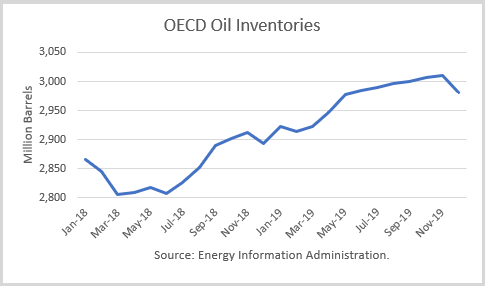
The Energy Information Administration released its Short-Term Energy Outlook for December, and it shows that OECD oil inventories likely bottomed in March at 2.807 billion barrels. It estimated a 10-million barrel gain for November to 2.902 billion. Though it forecasts that stocks will drop in December to 2.894 billion, that is 50 million barrels higher than a year ago.

Throughout 2019, OECD inventories are generally expected to rise, reaching 3.010 billion barrels in November. Its projections end the year with 88 million barrels more than at the end of 2018, glut territory.

oil

OPEC pledged to cut its production by 800,000 b/d from the October level for the first six months of 2019. EIA estimates OPEC production at 32.9 million barrels per day (mmbd), including Qatar, which will no longer be a member of OPEC in January. EIA’s assume OPEC production for 2019 is 31.8 mmbd, and so that represents a larger 1.1 mmbd drop. Continue reading "World Oil Supply, Demand And Price Outlook, December 2018"

Is The Fed Done Tightening After December?

It’s beginning to look a lot like the Federal Reserve is done tightening, at least after next week’s monetary policy meeting, when it’s expected to raise interest rates another 25 basis points, to 2.5%, its fourth rate hike this year. After that, however, it’s looking less and less likely that it will raise rates at all next year, certainly not four times, which seemed to be the market consensus not all that long ago.

As we know well, Fed chair Jerome Powell told the Economic Club of New York late last month that interest rates are “just below” the so-called neutral rate, a retreat from his comments less than two months earlier that the fed funds rate was a “long way” from neutral. That sparked a big, but short-lived, rally in both bonds and stocks, as it left investors with the idea that Powell and the Fed are going to be a lot less hawkish moving forward in light of still somnolent inflation and now signs of a weakening economy, exacerbated by the recent inversion of some Treasury bond yield curves, which traditionally have been a sign of impending recession.

As CNBC’s Jim “Mad Money” Cramer noted on Monday, the Fed "risks its credibility" if it doesn’t raise rates next week, a move it has been telegraphing for several months. Failure to do so risks setting off a market panic because, as Cramer said, the Fed could create the impression that “there's something really wrong that we don't know about.” So the Fed has largely backed itself into a corner and must go through with it, whether it wants to now or not.

But what about next year? Continue reading "Is The Fed Done Tightening After December?"