The History & Likelihood Of V-shaped Oil Recoveries

Adam Feik - INO.com Contributor - Energies


In recent days, crude oil and natural gas prices have continued to undulate within a range near their lows. What’s next for the commodities, and for the energy companies whose fortunes are joined at the hip of oil and gas?

With producers like Shell, Occidental Petroleum, BP, and ConocoPhillips announcing big-dollar capital spending cuts, will oil’s chart soon be tracing a V-shape?

Will history rhyme?

Phil Flynn presented the following analysis in his article for Futures Magazine yesterday:

“In 12 data points when oil had a break of 40% or more within a year the market rallied back 52.8% within 12 months. Even when the break was only 30% with 20 times the rebound was still a very impressive 45.5% within 12 months. This snap back comes usually as the market realizes that a period of low prices will stimulate demand and cut backs in production will take their toll.”

Richard Hirayama, portfolio manager for WHV Investments, provided a similar perspective – based on calendar years – in his portfolio manager letter this month. Hirayama furnished this nugget: Continue reading "The History & Likelihood Of V-shaped Oil Recoveries"

Why Bond ETF's May Not Be Your Best Choice

Matt Thalman - INO.com Contributor - ETFs


One of the greatest things about the world of finance is we have so many different options when it comes to investing. We have stocks, bonds, mutual funds, ETF's, real estate, commodities, metals, currency, the list goes on. But, with all of these different options, it is difficult to navigate through what we should be investing in and what we should leave alone. Each of the different options investors have at their disposal has their own pros and cons.

With that in mind, let's take a look at Bond Exchange Traded Fund's to help determine if they are the best option for you.

Issues with Bond ETF's

First what is a bond ETF? Similar to other ETF's it is a highly liquid asset which investors can trade in and out of daily, hourly, or even by the minute. These funds hold a variety of different "bond's", based on the restrictions the fund manager has set for the ETF. For example the Pimco Total Return Active ETF (BOND) states its own restrictions as following; Continue reading "Why Bond ETF's May Not Be Your Best Choice"

One ETF to Play the European QE

Matt Thalman - INO.com Contributor - ETFs


While the worlds investing community continues to concentrate on what is happening in Europe, due to the recent quantitative easing recently announced by the European Central Bank, you may be wondering how you can play the situation.

What is Going on in Europe?

But before we get to how you may be able to profit, let's look at what is happening. Last week the European Central Bank announced they would buy 60 billion Euro worth of bonds each month until the end of September 2016. This will essentially put 1.1 trillion euro into the European economy in an effort to help it get moving again. The quantitative easing process injects cash into an economy (increasing the money supply) which keeps interest rates low, making it easier for consumers and businesses to borrow, in the hope they will do so and boost economic growth. Continue reading "One ETF to Play the European QE"

How To Manage A Natural Resources Fund When You're Bearish On Natural Resources

Adam Feik - INO.com Contributor - Energies


I wrote a couple weeks ago about whether we're seeing the end of the oil supercycle. In my article, I heavily referenced a money management firm (WHV Investments) that has been bullish on energy investments since predicting a “supercycle” in 2000 (great call at the time!). Despite the massive turmoil since last June, WHV continues to be bullish.

An oil-bullish money manager

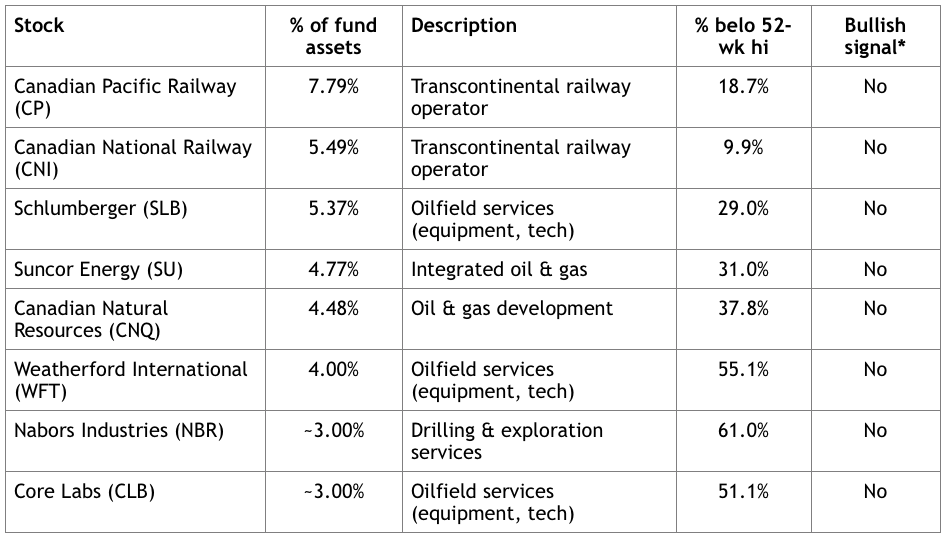
To get a flavor for stocks owned by a manager who is bullish on the continuation of the energy supercycle, check out this partial list of WHVIX's stock holdings. Granted, the holdings data are a few weeks old, but WHV tends to have very low turnover and says it’s sticking with its thesis. WHV management believes we’re still in the oil supercycle; accordingly, WHVIX owns stocks like these (as of 12/31/2014, source: WHV.com; this list represents selected stocks rather than a complete Top 10 list):

WHVIX Natural Resources Stock List

* “Bullish signal” refers to whether MarketClub is displaying “green triangles” for both the intermediate - and long-term outlook.

Of the above holdings, WHVIX appears to have (during 4Q 2014) increased its exposure to Suncor, which derives a large plurality of its business from “downstream” refining and marketing activities. Additionally, Suncor has significant development efforts in Canada’s Athabasca oil sands. Continue reading "How To Manage A Natural Resources Fund When You're Bearish On Natural Resources"

Will Whirlpool's Price Continue to Climb?

WilliamCikos_Contributor_ImageBadge350


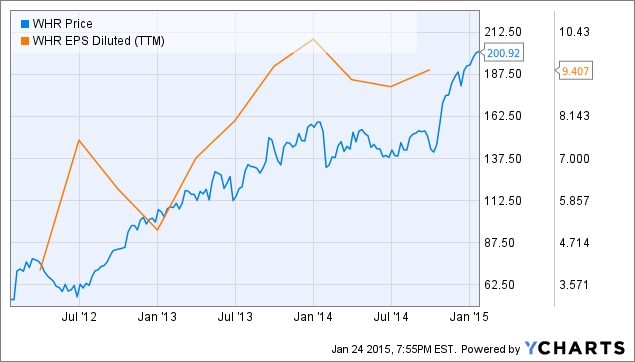
On January 12th, shares of Whirlpool Corp. (NYSE:WHR) crossed the $200/sh threshold for the first time ever. Now trading at $200.92/sh, the stock has risen by 44% in the last 4 months.

Whirlpool (WHR) stock price increase from 2012 - 2015.
Chart courtesy of YCharts.com.

The rapid price rise is nothing new; Whirlpool’s stock is in the midst of an extended run of robust performance. Over the last 3 years, WHR has increased almost four-fold, climbing by 277% since being quoted at $53.33/sh on January 23rd, 2012. During that same period, the company’s earnings expanded by 137% to their current level of $9.41/sh.

Looking at these numbers alone, one might assume that the stock is due for a correction. Has its price climbed too quickly? Is the stock overvalued? I’d argue that WHR remains undervalued, and that investors can expect the stock to continue outperforming the market with ease. Continue reading "Will Whirlpool's Price Continue to Climb?"