ETFs That Track Retail Investing Trends

Over the past few years, retail investors have shown they have the power (money) to take stock prices to 'the moon' if they operate as a group.

Last year it was GameStop (GME) and AMC (AMC).

Just a few weeks ago, it was AMTD Digital Inc (HKD), which was IPO'd in July and has had a trading range of $13.52 per share up to $2,555.30 per share since the initial public offer. HKD is currently trading in the low $200 range.

But just because retail investors can do something, does that mean they should? Are the retail crowd good stock pickers? And should you follow their lead?

At this time, we don't know the answer to these questions. That is because we don't have enough data on whether or not retail investors operating as a whole are good stock pickers. They have only really been flexing their muscle for a little more than a year.

Plus, when they started with GME and AMC, we were still in a bull market. But now, we are in a bear market. So it would be unfair to say the retail investor's recent performance shows their lack of sophistication and that they don't belong picking stocks.

A few Exchange Traded Funds track what retail investors are talking about on social media or buying in their brokerage accounts, and as of late, retail investor stock picks are not outperforming the market.

The VanEck Social Sentiment ETF (BUZZ), which tracks the top 75 companies with the most popular sentiment online based on a proprietary AI model to select stocks, is down 32% year-to-date.

The SoFi Social 50 ETF (SFYF), which tracks the 50 most widely held stocks in self-directed brokerage accounts of Sofi Securities, is down 25.55% year-to-date.

And the FOMO ETF (FOMO), which invests in the areas of the market that are currently in favor with retail and individual investors or currently 'trending,' is down 17.94% year-to-date. Continue reading "ETFs That Track Retail Investing Trends"
Gold And Silver: Is It A Trap?

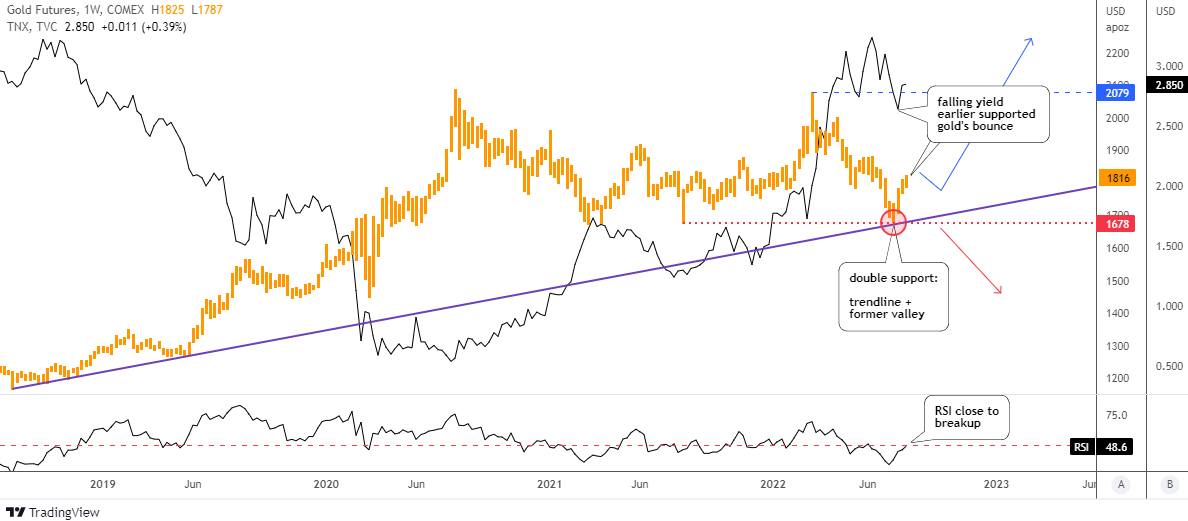
Back in June, I shared with you an alternative scenario for gold with a downside trigger on the trendline support.

I highlighted it with a purple color in the weekly gold futures chart below. This area is fortified with the red horizontal trendline based on the former valley of $1,678. Though, it’s a double support level.

Gold Futures Weekly

Source: TradingView

It is amazing how accurately the price bounced off that strong support. The metal took its chance to jump to the upside amid the falling yield of 10-year U.S. government bonds (10Y).

The easing inflation data limits the hawkish expectations on the Fed rate hikes. Though, the 10Y’s advance has been paused as the market took some gains amid uncertainty.

However, the real interest rate is still strongly negative at -6%. The labor market shows vitality according to statistics. This leaves the room for the Fed to keep tightening until something breaks down.

The 10Y bounced off recently from 2.6% to 2.85% and nobody knows if it’s a continuation or a consolidation.

The gold market has been trapped with the whole uncertainty as it has built a large sideways consolidation since August 2020. Continue reading "Gold And Silver: Is It A Trap?"

Chesapeake Energy All in on Natural Gas

Forget oil—the real money is in natural gas.

Or at least that’s the message coming from a pioneer of the U.S. shale revolution, Chesapeake Energy (CHK).

From Prince to Pauper to Prince Again?

Once upon a time—when its stock was valued at more than $35 billion and its CEO, Aubrey McClendon, had the biggest pay package of any CEO of a listed firm—Chesapeake Energy was America’s best-known fracker.

But those glory days disappeared quickly, and Chesapeake became the poster child for the shale sector’s excesses.

About a year and a half ago, in the autumn of 2020, Chesapeake was in the midst of bankruptcy proceedings after the coronavirus pandemic-led crash in energy demand proved to be the final straw in the company’s fall from grace.

And for the industry more broadly, the prospects for liquefied natural gas (LNG) exports were looking bleak after a $7 billion contract to supply the French utility Engie went down the tubes on concerns over the emissions profile of U.S. natural gas.

Fast forward to 2022 and the picture has changed dramatically. Natural gas exports are booming!

Thanks to the Russian invasion of Ukraine and subsequent sanctions, Europe is in the middle of an energy crisis. It is buying up as much American LNG as it can. Those concerns about emissions are long forgotten.

In the first four months of the year, the U.S. exported 11.5 billion cubic feet a day of gas in the form of LNG, an 18% increase from 2021. Three-quarters of those exports went to Europe. And European leaders have pledged to ratchet up their imports by the end of the decade. There is also a massive opportunity in Asia, where LNG demand is set to quadruple to 44 billion cubic feet a day by 2050, according to a recent report released by think-tank, the Progressive Policy Institute.

And even here in the U.S., natural gas supplies look set to be tight this winter. Hot summer weather and high demands for power generation are sucking up supplies and leaving storage precariously low. Continue reading "Chesapeake Energy All in on Natural Gas"

2 REITs to Buy and Hold

Despite the macroeconomic headwinds, real estate investment trusts (REITs) are expected to remain resilient due to rising demand, appreciation of property prices amid the high inflation, and increasing rental income. Moreover, REITs are considered ideal investments in uncertain market conditions since they pay out at least 90% of their income as dividends.

So, quality REITs LTC Properties (LTC) and Getty Realty (GTY) could be ideal investments to survive the short-term market fluctuations and create solid long-term returns.

High inflation, rising interest rates, and economic uncertainties have discouraged home buyers this year. However, increased regional population distribution, rising demand for rental properties, and appreciating property prices bode well for real estate investment trusts (REITs).

In addition, the inclination of businesses toward local sourcing after the pandemic is expected to drive further growth in this sector. The real estate sector in the United States is projected to grow at a 3.7% CAGR to $412.60 billion by 2025.

Moreover, REITs are considered safe investments in uncertain times since they must pay at least 90% of their taxable income as dividends.

Fundamentally sound REITs LTC Properties, Inc. (LTC) and Getty Realty Corporation (GTY) could offer diversification, inflation hedge, and superior dividend returns to long-term investors.

LTC Properties, Inc. (LTC)

LTC invests in senior housing and healthcare properties. It invests in four broad segments: Skilled Nursing centers (SNF); Assisted Living Facilities (ALF); Independent Living Facilities (ILF); and Memory Care facilities (MC). Its operations include sale-leasebacks, mortgage financing, joint ventures, construction financing, and structured financing solutions. Continue reading "2 REITs to Buy and Hold"

Single Stock ETFs Are Here

In July, AXS Investments debuted US-based investors' first single stock Exchange Traded Funds. These ETFs allow investors to gain leverage on certain individual stocks.

However, because you are using leverage, there is more risk involved, and the authorities want investors to understand these risks before purchasing these new products.

The risks are associated with the leveraged exposure these new ETFs offer and the risk associated with investing in individual stocks. But since leverage is being applied, the risk level multiplies.

For example, one of the new ETFs being offered is the AXS 2X NKE Bull Daily ETF (NKEL) which provides investors 2X leverage to Nike (NKE) stock. This would mean that if you owned NKEL on a day when Nike stock increased by 0.50%, the NKEL ETF, which is 2X leverage, will go up 1.00%.

But, the opposite is also true. So if Nike stock fell by 1%, the NKEL ETF, which tracks Nike stock at a 2X leveraged ratio, would lose 2%.

Leverage is a very nice thing to have when it is being applied in the direction you want it to move. But leverage can be deadly when it is going against you.

Hence why the Securities and Exchange Commission is warning investors of the dangers associated with any single stock ETF, even if it is not marketing itself as leveraged.

One example of a new single stock ETF that is not marketing itself as leveraged is the AXS TSLA Bear Daily ETF (TSLQ). This ETF only tracks Tesla, but to the downside with just 1X leveraged exposure.

This essentially means that the TSLQ is shorting Tesla. But, unlike having to short a stock, which would require approval from your broker, a margin account, and the risk of not losing more than 100% of your investment, you simply have to buy this one ETF and not worry about the other things. Continue reading "Single Stock ETFs Are Here"