This is a Trader You'll Want to Know

We have got to introduce you to someone.

That's if you don't already know him - after all, he is one of the most followed technical analysts on the globe.

JC Parets is the real deal when it comes to technical analysis. Not only is he a Chartered Market Technician (CMT), but he shows his followers how to unlock market secrets hiding in the charts.

We're teaming up to bring you a free technical analysis basics course.

In this 5-part series, you'll learn:

  • why technical analysis trumps fundamental analysis
  • when and why to use particular chart types
  • a crucial strategy when looking at trends that most traders get wrong
  • plus much more

There is no cost for this course, and you'll get your first lesson right away.

We know you'll thank us once you meet JC - there aren't many quite like him!

Start The Course

Enjoy,
The INO.com Team

Here's What's Next for BTC and Stocks

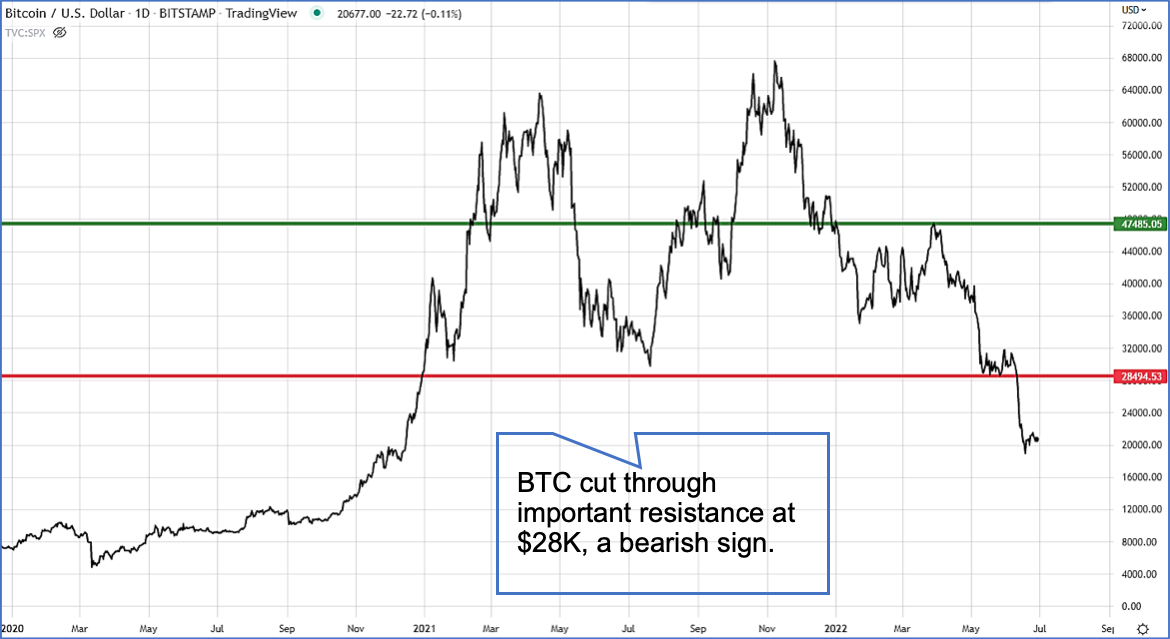
There’s no doubt about it: Bitcoin (BTC) has broken down. In fact, it recently sliced through significant support at the $28K level like a hot knife through butter. Take a look...

BTC Daily Chart

Source

As you can see from this daily chart of BTC, the dominant crypto dropped below resistance that had been firmly established back in 2021. I recently wrote about this level being a crucial line in the sand for BTC. And unfortunately, it failed to hold up.

So, where do go from here? If you look at the left side of the above chart, it’s clear that the best case for BTC support now sits somewhere in the range of $6K to $12K. And from its current level, it’s pretty much a straight shot to that range.

In addition, BTC spent quite a bit of time meandering in that range during 2020. I wouldn’t be surprised that, if we get that low, you’ll see similar sideways action.

And it’s not just BTC that’s gotten hammered. In fact, the entire cryptocurrency space now stands at somewhere around $1 trillion in market cap. That’s a far cry from the $3 trillion it enjoyed late last year.

Ouch.

But before you sound the death knell of crypto, remember that it’s not the only asset that’s been taken out back recently. In fact, I could just as easily put a chart up there of the Dow, the S&P, the Nasdaq, and the Russel 2000 and you would be reading much the same story, albeit not as dramatically.

Fear is Driving Selling

As I’ve been saying for months, investors are looking at crypto just like they do every other risky asset... they are selling. And they’re selling pretty much regardless of what’s happening to the asset’s underlying fundamentals.

Why all the selling? Pretty simple: The markets are oozing with fear right now. And when fear takes over, lots of assets get thrown out, no matter how good their underlying fundamentals may actually be.

That’s sad, but it’s true.

So, what’s driving all the fear? Take your pick. Inflation, global supply chain issues, the war in Ukraine, geopolitical uncertainty, higher interest rates.

And the rub of it is that all of these are playing a significant role in amping up the fear in the marketplace. If it was just one, it wouldn’t be so bad. But it’s not - it’s all of them.

The war in Ukraine is contributing to inflation of energy and food prices. Supply chain issues are contributing to higher prices and operational uncertainty. Meanwhile, inflation is making everything more expensive.

But it’s the last fear driver that I mentioned - higher interest rates - that really has everyone on edge. And while we all agree that those higher interest rates are the medicine to fight inflation, no one knows for sure how high they must go to get results. So far, inflation continues to roar higher despite higher interest rates.

Maybe we can take some solace in the fact that the Fed will likely continue to raise rates until the inflation numbers are headed in the right direction. Chairman Powell’s said as much to Congress just last week. And I don’t have much doubt about his - or the Fed’s - resolve to bring inflation down.

But until we begin to see inflation numbers drop, it’s a done deal that you’ll see more of the fear-based volatility and chop that you’ve seen for stock, tech, and crypto since the beginning of the year.

Sure, you’ll likely see some up weeks in the meantime. And there’s little doubt that an outlier or two in these asset classes are likely to thrive. But overall, until inflation gets under control, the outlook for crypto, stocks, and tech is lousy.

We Shouldn’t Be Surprised

The fact is we shouldn’t be surprised by what’s happening in all these risky asset classes. There’s had been gobs of money sloshing around the economy for years. And that low-priced capital has made just about everyone go out and buy a ton of stuff.

In my book, that’s been a good thing. It’s helped people and business weather a massive pandemic, driven innovation, and provided much-needed jobs for millions.

But one of the side effects of that cheap money has been inflation levels, unlike anything we’ve seen in decades. Certainly, because of all that cheap money, I figured we might see an uptick in inflation. But I had no idea it would come at us in such magnitude. Nobody did.

And when it comes to crypto, we shouldn’t be surprised that it’s been beaten up even more than its peers. While risk has had a hand in that, the fact that crypto is still a nascent and largely unproved asset class and marketplace make it worse. It’s simply going to get beat up worse when investors lose their appetite for risk.

So, what to do? As I mentioned, I think we’re going to see a moderation in inflation down the road. And when that happens the markets - including crypto - will start to recover. When that happens - and let’s say we get a handful of decent inflation reports - I would begin heeding my golden rule: Buy companies that know what they’re doing in markets with strong upside. And don’t sweat the small stuff. Take a long-term view. And don’t devote any more than 1% to 2% of your portfolio to all your crypto holdings, including BTC.

Stay safe,
Wayne Burritt
INO.com Contributor

Disclosure: This contributor may own cryptocurrencies, stocks, or other assets mentioned in this article. This article is the opinion of the contributor themselves. The above is a matter of opinion provided for general information purposes only and is not intended as investment advice. This contributor is not receiving compensation (other than from INO.com) for their opinion.

Rising Rates: Financials Will Greatly Benefit

The Federal Reserve raised interest rates by 75-basis points at its most recent meeting and forecasted that a similar rate hike could on the table in July. These efforts are necessary to stamp out the persistently high inflation throughout the economy.

The most recent 75-basis point rate hike was the largest since the 1994 rate tightening cycle.

The financial cohort will benefit via a confluence of a rising interest rates, financially strong balance sheets and the easy passage of annual stress tests to support expanded buybacks and increased dividends.

Bank of America (BAC), JPMorgan Chase (JPM), Morgan Stanley (MS), Citigroup (C) and Goldman Sachs (GS) look appealing at these levels, off substantially from their 52-week highs.

Net Interest Income

Net interest income is an important financial measure that is essentially the difference between interest paid and interest received thus the revenue generated by its loans and interest paid out on its deposit base.

Bank stocks perform well in a rising interest rate environment as the interest income earned from loans rises faster than what they pay for funding. The higher interest rates go, the greater the net interest income banks earn.

Immaterial Geopolitical Exposure

The big banking cohort has minimal to no direct exposure to Russia/Ukraine thus not tied directly to the geopolitical conflict. This is especially important as the geopolitical tensions rage on and possibly snap up these stocks as a function of overall market sentiment.

Overall, the big banks generate an inconsequential amount of revenue from Russia. For example, BAC, JPM and MS do not have direct exposure to Russia in their regulatory filings.

However, GS is estimated to have $940 million total exposure to Russia and Ukraine, or less than 0.1% of its total assets, per Bank of America. Citigroup (C) had $9.8 billion exposure to Russia, including $5.4 billion in Russia-specific exposure, equating to only 0.3% of the bank’s total assets.

As such, there is not a single company within the collective big bank cohort has any more than 0.3% of its total assets exposed to the Russian/Ukraine conflict.

2022 Financial Stress Tests

The financial cohort easily cleared the Federal Reserve's annual stress test, removing any concern that there’s systemic financial risk in the economy, circa 2008.

The results of the Fed's annual stress test exercise showed the banks have enough capital to weather a severe economic downturn and paves the way for them to expand share buybacks and increase dividend payouts.

The 34 lenders with more than $100 billion in assets that the Fed oversees would suffer a combined $612 billion in losses under a hypothetical severe downturn, the central bank said. But that would still leave them with roughly twice the amount of capital required under its rules.

The Fed assesses how banks' balance sheets would fare against a hypothetical severe economic downturn. The results dictate how much capital banks need to be healthy and how much they can return to shareholders via share buybacks and dividends. This stress test gives investors comfort that the big banks are well-prepared for a potential U.S. recession.

The 2022 stress tests are especially important as the world faces a geopolitical crisis that may reverberate through the global economy. All this considered, it’s refreshing to know that these stress tests were easily passed and indicate that the biggest U.S. banks could easily withstand a severe recession.

Conclusion

The geopolitical backdrop, rising inflation, China Covid lockdowns and rising interest rates will continue to weigh on investor sentiment.

The financial cohort is much more resilient and capitalized and have demonstrated their ability to evolve in the face of the pandemic and will weather these economic challenges as well. The 2022 stress tests were easily passed and indicate that the biggest U.S. banks could easily withstand a severe recession or geopolitical crisis.

This cohort presents compelling value, especially with substantially reduced valuations in a rising interest rate environment into 2023, which may serve as a long-term tailwind for banks to appreciate higher.

Just recently, MS and BAC boosted dividend by 11% and 5%, respectively. MS also authorized a new $20 billion share repurchase program. The positive results of these annual stress tests will likely allow expanded capital returns over the years to come in a fiscally responsible and accountable manner.

Noah Kiedrowski
INO.com Contributor

Disclosure: Stock Options Dad LLC is a Registered Investment Adviser (RIA) firm specializing in options-based services and education. There are no business relationships with any companies mentioned in this article. This article reflects the opinions of the RIA. Any recommendation contained in this article is subject to change at any time. No recommendation is intended to constitute an entire portfolio. The author encourages all investors to conduct their own research and due diligence prior to investing or taking any actions in options trading. Please feel free to comment and provide feedback; the author values all responses. The author is the founder and Managing Member of Stock Options Dad LLC – A Registered Investment Adviser (RIA) firm www.stockoptionsdad.com defining risk, leveraging a minimal amount of capital and maximizing return on investment. For more engaging, short-duration options-based content, visit Stock Options Dad LLC’s YouTube channel. Please direct all inquires to

in**@st*************.com


. The author holds shares of AAPL, ADBE, AMD, AMZN, ARKK, AXP, BA, BBY, C, CMG, COST, CRM, DIA, DIS, EW, FB, FDX, FXI, GOOGL, GS, HD, HON, INTC, IWM, JPM, MRK, MS, MSFT, NKE, NVDA, PYPL, QQQ, SPY, SQ, TMO, UNH, USO, V and WMT.

Backdoor Marijuana Investment Play

Scotts Miracle-Gro (SMG), a company that is best known for Scotts branded products like fertilizers and grass seeds, is also a backdoor marijuana investment play.

Most marijuana investors know this, but they may not fully understand how Scotts is involved in the marijuana industry and why that could make Scotts slightly more of a risky investment than some people believe it to be.

Scotts Miracle-Gro is a very well-known business and it has a good reputation. However, its core business is not one that is typically booming.

Over the past ten years, prior to 2020, Scotts average sales grew just 2%. This shouldn’t bee much of a surprise considering the business the company is in. Furthermore, the average 2% sales growth could in many years be contributed to nothing more than price increases.

Then came 2020, when people where stuck at home, looking at their poorly maintained lawns and starting gardens. Due to increased demand, likely because of pandemic-related changes to people’s lives, Scotts' annual sales increased by 24%.

Company management and analysts all believe that most of the people who took up gardening or did decide to improve their yard, will continue to stick with Scotts and their new hobby.

With that said, analysts are only expecting Scotts' sales growth to be in the 2-4% annual growth range during the coming years. Not the kind of growth you may expect from a high-flying marijuana stock.

Scotts has exposure to the marijuana industry through its fertilizers and the basic equipment needed to set up a marijuana farm.

Back in 2014, Scotts formed the Hawthorne Gardening Company, which sells products used by cannabis growers. Then in 2015, Hawthorne bought General Hydroponics, a 35-year-old liquid nutrient producer, of which its products are considered the gold standard by many marijuana farmers.

While the Hawthorne Gardening Company does sell fertilizer, due to its acquisition of General Hydroponics, the growth in the division comes from new marijuana growing facilities being opened.

So as the pace of legalization of marijuana in US States and major countries around the world slowly diminished, the need for new hydroponic growing equipment that Hawthorne sells also began to drop.

More recently the marijuana industry has been in an ‘oversupply’ situation. This not only nearly stopped all sales from Hawthorne, but it also hurt Scotts' sales figures. With annual sales growth dropping from 24% to a more expected 2-4%, Scotts' stock price has taken a massive hit, falling from a 52-week high of $193.50 down to currently trading in the low $80 range.

Some investors argue that now is the time to buy SMG because of the low valuation, decent dividend and potential for the marijuana industry to make another move forward.

For that to happen, we will need to see one of two things to occur:
1. A massive increase in marijuana usage in the states that it is legal, or
2. New states in the US or countries around the world open their doors to the marijuana industry.

Either of these situations would increase demand for marijuana, thus new grow houses would need to be built and supplied so they can begin growing marijuana. Without either happening, Scotts' Hawthorne business will continue to produce just mediocre numbers.

Some investors believe that SMG is undervalued, and that very well may be true. If the marijuana industry continues to grow in the future and we see more and more US States and countries around the world legalize the substance, then Scotts' Hawthorne division will perform better, helping push the SMG stock price higher again.

But there are two problems investors face while they wait for legalization to occur.

First is that SMG's management has reportedly been considering spinning off the Hawthorne business, and thus their whole marijuana industry connection. This would be force SMG investors to consider whether or not they owned SMG for the marijuana play. Analysts believe that the growth will largely come from the Hawthorne side of the business, and thus spinning it off would allow investors to reap the greatest benefits since it will no longer be ‘held back’ by the Scotts side of the business.

The second issue investors will be facing is simply time. The amount of time that they will have to wait for the new laws to be passed. Investors need to consider the opportunity cost of waiting a long time. In the past, in the US, the legalization cycle has taken a few years. We have a few new states all at once and then nothing for a few years. So, it may be a few more years before we see another big demand surge for Hawthorne’s products.

Some analysts will agree that SMG is a good buy with or without Hawthorne and that it is even worth holding, as long as Hawthorne is still a subsidiary, while you wait for new states to legalize marijuana. But that is a decision each investors needs to consider individually especially since SMG has shown us a very good example of a boom-and-bust business just over the past few years. This has been evident in the SMG stock price peaking at $244 per share back in March of 2021 and the stock now trading at just over $80.

Matt Thalman
INO.com Contributor
Follow me on Twitter @mthalman5513

Disclosure: This contributor did not hold a position in any investment mentioned above at the time this blog post was published. This article is the opinion of the contributor themselves. The above is a matter of opinion provided for general information purposes only and is not intended as investment advice. This contributor is not receiving compensation (other than from INO.com) for their opinion.

Gold Miners Trading At Their Largest Discount

Amidst a backdrop of elevated inflation, near-record high gold prices, and negative real rates, many gold bulls are puzzled by the lack of upside follow-through in the Gold Miners Index (GDX). This is because, despite this favorable environment, the index is down 6% year-to-date and 40% from its Q3 2020 highs.

However, it’s important to note that the gold producers are up against significant headwinds which have dented margins, including higher labor, fuel, and materials costs. So, while they have historically performed well in this environment, some of the gold price’s upside has been offset by these rising costs.

Given that the GDX is littered with several high-cost producers with sub-par track records, this has weighed on the index’s performance, dragging down nearly all the stocks in the sector and the GDX.

The good news is that this 22-month decline (August 2020 – June 2022) has left some of the highest-quality miners sitting at their cheapest valuations since Q1 2020.

In this update, we’ll look at three miners that are not only less affected by the inflationary pressures but are trading at a significant discount to their historical multiples: Kinross Gold (KGC), Alamos Gold (AGI), and Wesdome Mines (WDOFF).

Kinross Gold (KGC)

Beginning with Kinross, the company is a 2.0-million-ounce producer with operations in Mauritania,
Brazil, Nevada, Alaska, and Chile.

The company has been performed the worst among its larger peers over the past year, punished by the acquisition of a development-stage project in Canada and after divesting its Russian assets this spring after the invasion of Ukraine.

While the latter development wiped out more than $1.0 billion in net asset value and 300,000 ounces of annual gold production, the company may be better positioned following the divestment, even if the assets were sold for less than fair value. This is because Kinross was not getting much value for its Russian assets (Kupol, Udinsk) anyways and can now command a higher multiple with an Americas-focused portfolio.

Understandably, investors are disgusted with the stock’s performance, with it down over 60% since Q3 2020. However, at current prices, the correction looks to be overdone.

This is because Kinross has historically traded at 7x cash flow and is currently trading at 3.5x FY2023 cash flow estimates ($1.20 per share). While I think 7x cash flow is a high estimate and 5.5x cash flow is more appropriate, this still translates to a fair value of $6.60 per share, or more than 65% upside from current levels.

It’s also important to note that FY2023 cash flow does not factor in any upside from its Dixie Project that it recently acquired in Canada, which looks to be home to 9+ million ounces of gold and could produce 425,000+ ounces per annum at sub $800/oz costs.
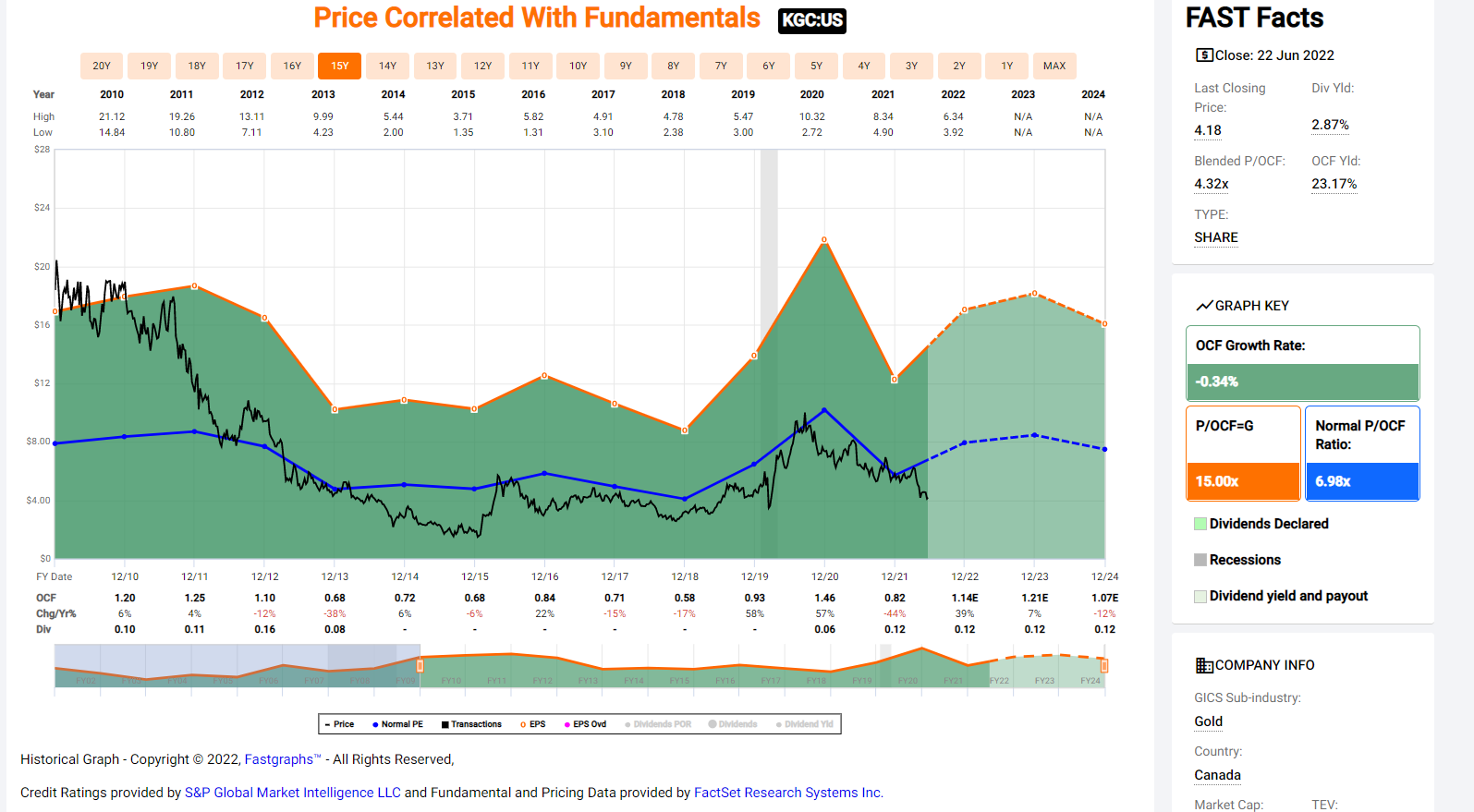
Kinross Historical Cash Flow Multiple

Source: Kinross Historical Cash Flow Multiple, FASTGraphs.com

With production not expected to begin until 2028 at Dixie, this asset has been discounted and Kinross doesn’t get much value for the asset. However, I see a fair value for this asset of $1.7 billion, translating to more than $1.50 per share in additional upside long-term.

While the stock’s 18-month fair value lies 65% higher, the stock has the potential to more than double long-term if it can execute successfully at Dixie. Given this deep discount to fair value combined with a 3.0%+ dividend yield, I see the stock as a steal at $4.00

Alamos Gold (AGI)

The second name worth watching closely is Alamos Gold, a mid-tier gold producer currently churning
out 450,000+ ounces per annum from its three operations in Canada and Mexico.

However, the stock has fallen out of favor recently, given that its costs have risen above $1,200/oz and are expected to come in at levels above the industry average in 2022.

While this certainly dampens the short-term margin outlook ($1,130/oz costs in 2021), Alamos will look like a completely different company by the second half of 2025. This is because it’s currently constructing its Phase 3 Expansion at its high-grade Island Gold Mine, which will push production from ~125,000 ounces per annum to 230,000+ ounces per annum.

Meanwhile, the company aims to construct a 4th mine in Manitoba (Lynn Lake), adding another
150,000 ounces per annum by 2026.
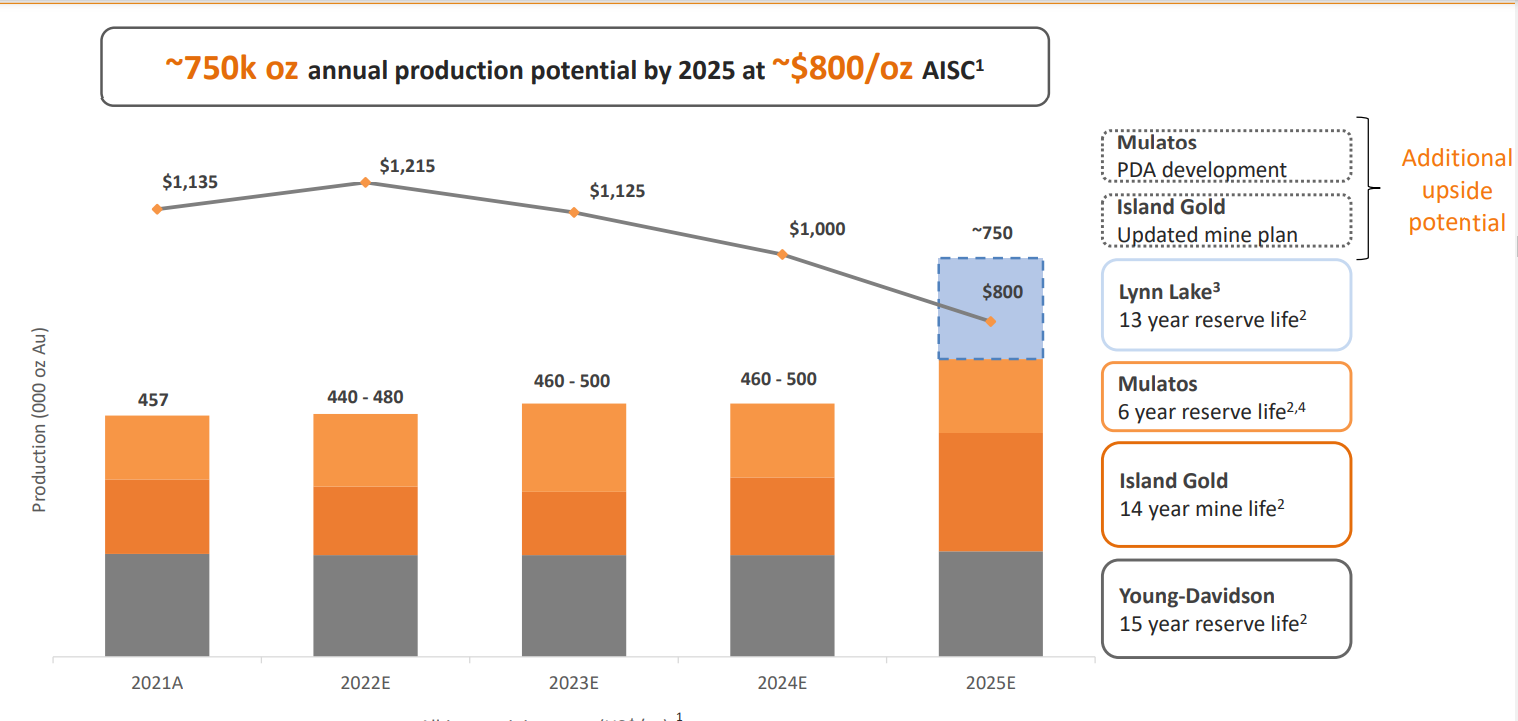
Alamos Gold Growth Plan

Source: Alamos Gold Growth Plan, Company Presentation

If Alamos was only a growth story, it would be unique, and we would already expect it to command a
premium multiple in a sector where growth is hard to find.

However, it’s important to note that this growth will be accompanied by significant margin expansion and a jurisdictional upgrade. This is because its Phase 3 Expansion which will nearly double throughput, is expected to contribute to sub $600/oz costs at Island.

At the same time, Lynn Lake’s costs should come in below $975/oz. The result will be a transformation from a 450,000-ounce producer at $600/oz margins ($1,800/oz gold price) to a ~750,000-ounce producer with $1,000/oz margins ($1,800/oz gold price.

Finally, it will see its exposure to Mexico (Tier-2 rated jurisdiction) dip from 30% to 20%. The result is a company that will enjoy expansion in its P/NAV multiple at the same time as its cash flow increases substantially.

Based on this outlook, I see a fair value for the stock above US$10.00 and view this pullback in AGI as a gift.

Wesdome Mines (WDOFF)

The final name becoming attractive is Wesdome Mines, a junior producer operating out of Canada with
one mine in Ontario and another in Quebec.

While junior producers are a dime a dozen, Wesdome is special given that it has two of the highest-grade gold mines globally, and it’s busy ramping up to full production at one of them (Kiena) over the next year.

Given its 10+ gram per tonne gold grades, it uses considerably less fuel and labor than its peers per ounce of gold produced, given that it’s moving less than one-sixth the rock volume given its grades.
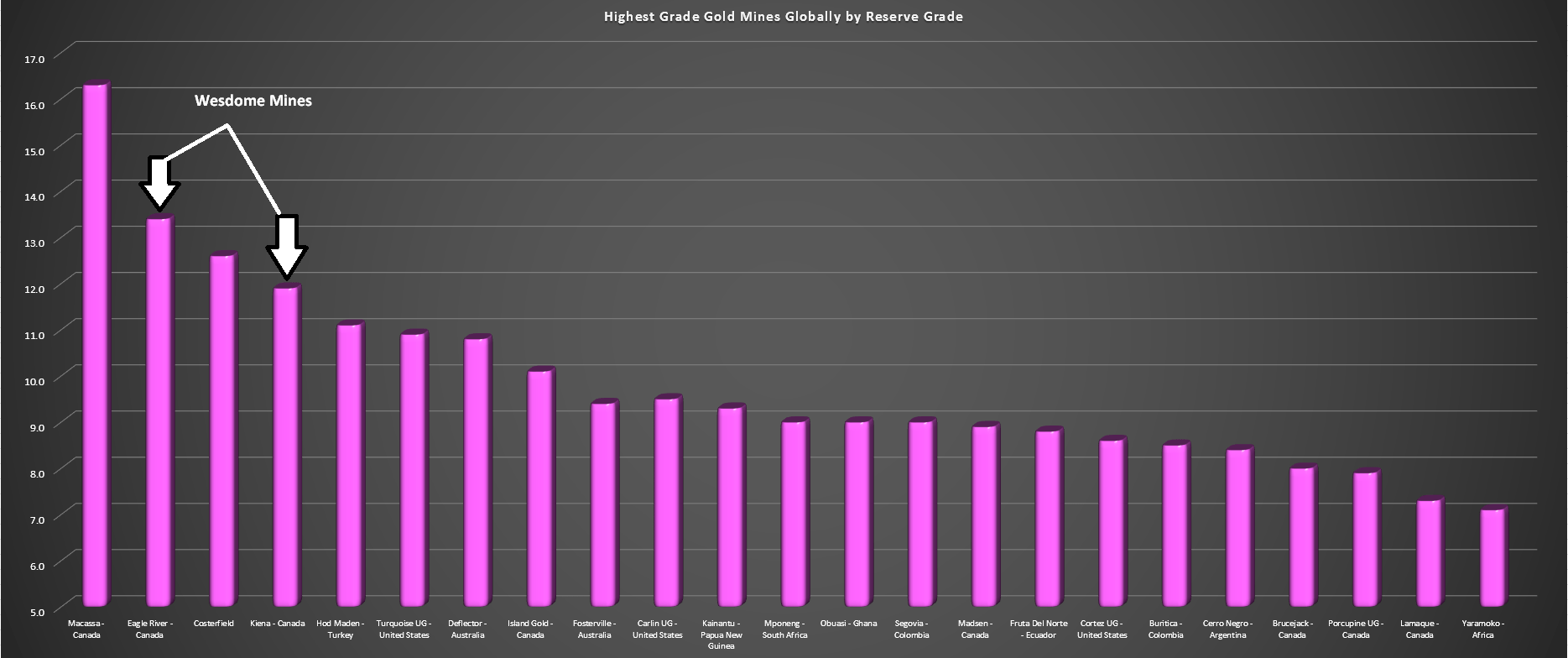
Highest Grade Gold Mines Globally

Source: Highest Grade Gold Mines Globally, Company Filings, Author’s Chart

Wesdome’s steady ramp-up at Kiena means that while its costs may be above $1,100/oz currently,
they’re expected to slide to less than $825/oz by 2024.

Given this enviable position as a company with meaningful margin expansion on the horizon in a period of slight margin contraction sector-wide, I would view any pullbacks below US$8.00 (key technical support level) as buying opportunities.

Final Thoughts

With the gold miners trading at their largest discount to net asset value in two years, I see now as a favorable time to begin adding some exposure. Given KGC, AGI, and WDOFF’s improving margin profiles looking out to 2025, I believe they are three of the best ways to get exposure to the sector.

Disclosure: I am long AGI, KGC

Taylor Dart
INO.com Contributor

Disclaimer: This article is the opinion of the contributor themselves. Taylor Dart is not a Registered Investment Advisor or Financial Planner. This writing is for informational purposes only. It does not constitute an offer to sell, a solicitation to buy, or a recommendation regarding any securities transaction. The information contained in this writing should not be construed as financial or investment advice on any subject matter. Taylor Dart expressly disclaims all liability in respect to actions taken based on any or all of the information in this writing. Given the volatility in the precious metals sector, position sizing is critical, so when buying small-cap precious metals stocks, position sizes should be limited to 5% or less of one's portfolio.