Critical Report Due Out On Wednesday

Chairman Powell’s testimony before Congress this week painted a dire economic outlook which will include the continued contraction of the national GDP coupled with continued interest rate hikes.

During his testimony, it was evident that there was a subtle difference in his word track that was uncharacteristic and a dramatic change from his usual refined method.

The chairman made it clear that the Federal Reserve has one goal in mind above all others and that is to reduce the level of inflation. They emphatically stated that the actions of the Federal Reserve will most likely lead to a recession rather than a soft landing.

Yahoo finance captured his overall demeanor in a most articulate manner saying, “He said a recession caused by the Fed’s own monetary tightening remains a “possibility.”

A soft landing, with higher rates but a still-healthy economy, would be “very challenging” to achieve. And Powell said the Fed’s fight against inflation was “unconditional,” meaning nothing will stand in its way.”

The revisions by the Federal Reserve to their monetary policy most certainly would contract the economy and bring on a recession.

A recession is defined as “a period of temporary economic decline during which trade and industrial activity are reduced, generally identified by a fall in GDP in two successive quarters.”

The last GDP report revealed that the United States had an economic expansion leading to a 6.9% growth in the GDP for Q4 of 2021. If advanced estimates for the GDP Q1 are correct it will indicate a decrease in the real gross domestic product (GDP) for the first quarter of this year.

The last occurrence of a contracting GDP quarter to quarter occurred during Q2 of 2020. However, the following quarter (Q3 2020) revealed a robust increase in national GDP.

This is why next week’s report is so critical. On Wednesday, June 29 the BEA (Bureau of Economic Analysis) will release the U.S. GDP first-quarter report.

According to the advanced estimate released on April 28, “Real gross domestic product (GDP) decreased at an annual rate of 1.5 percent in the first quarter of 2022, according to the "second" estimate released by the Bureau of Economic Analysis. In the fourth quarter, real GDP increased 6.9 percent.”

Currently, there is a high probability that the actions of the Federal Reserve will lead to a recession. The question is not whether or not the United States will enter recession but rather when the recession will begin and how long the recession will last.

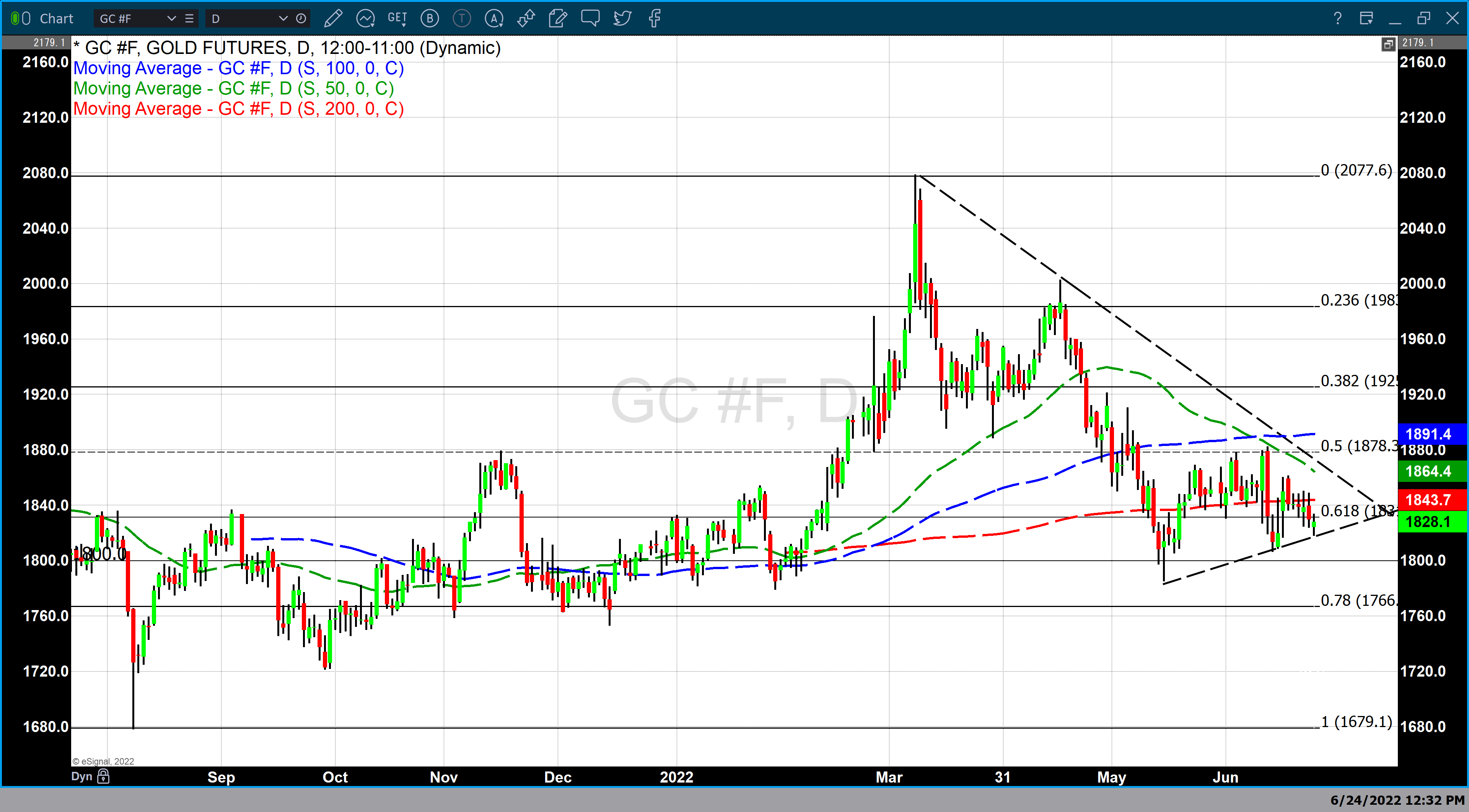
Daily Gold Chart

While a recession can stabilize gold pricing, and higher inflation certainly creates a bullish undertone for the precious yellow metal, rising interest rates have become a primary focus on the future price of gold and has pressured pricing lower since March of this year.

Gold has declined just over 12% from the highs of $2070 in March to gold’s current pricing of $1828. While it seems as though there is strong support for gold at $1800 depending on how aggressive the Federal Reserve becomes in regard to further rate hikes.

Besides the GDP report due out on Wednesday, on Thursday the government will release its latest core inflationary numbers when the U.S. PCE price index report is published.

For those who would like more information simply use this link.

Wishing you, as always good trading,
Gary S. Wagner
The Gold Forecast

Window of Opportunity - Valuations Below Pre-Pandemic Highs

Window of Opportunity

Six months of relentless and indiscriminate selling has roiled the markets. This selling has reduced the frothy pandemic induced run-up in stocks back to pre-pandemic levels. In many cases stocks are trading well below the pre-pandemic highs.

Stocks are now presenting a window of opportunity for long-term investors at this juncture. With the collective P/E ratios reverting to its historical mean, oversold conditions at extremes and the inflation picture at a potential inflection point may combine to be a back half of the year reprieve.

This window of opportunity may not last too much longer based on historical bear market metrics so pounce and pounce harder if the markets slide further.

Mid-June Flushing?

Many commentators in the investing circles stated that a final washout in the market was likely needed prior to moving higher in any meaningful way.

Mid-June saw its worst weekly performance since March of 2020, dropping 5.8% for the S&P 500 while taking its overall decline to ~24%. After this brutal week, there hasn’t been any stock or sector that has been immune to the breadth of participation in this sell-off. As such, the market has now registered abnormal extremes in selling and oversold conditions.

Is this the washout that was needed to arrest the selling pressures in this market, and will this be an inflection point? A battery of indicators suggest that the markets are close to making a meaningful move higher very soon.

Inflection Point?

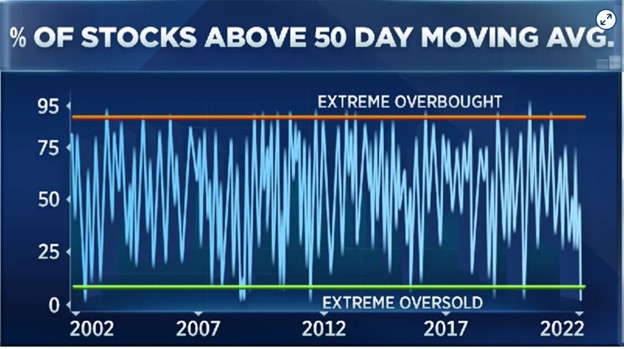
The percentage of S&P 500 stocks trading above their 50-day average hit a level that can’t go any lower as seen over the past 20 years. This level indicates extremely oversold conditions (Figure 1).  

% Stocks Above 50-Day Moving Average

Figure 1 – Assessing overbought and oversold conditions via the percent of stocks relative to its 50 day moving average (adopted from CNBC).

It’s noteworthy to highlight that fewer than 25% of stocks are still within 20% of their 52-week high. The only times this was worse was the Covid crash and the 2007-2009 financial crisis. Over 42% of S&P 500 stocks hit a new 52-week low, only the tenth time since 1985 this total exceeded 40%.

The average Nasdaq stock has undergone a 50% drop from its high. The S&P 500 now trades at a level first reached more than 16 months ago in early 2021. This move negates the post-Covid advance in equity markets. The correction waves in February 2016 and December 2018 both bottomed at levels first reached nearly two years prior. Thus, these markets are reaching the point where the past two years of appreciation has been erased.

Stocks Are Looking Cheap

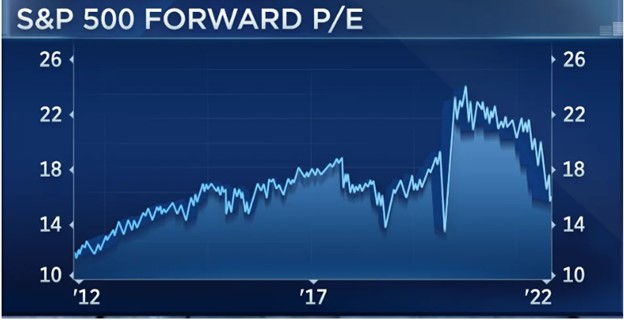
The current collective P/E a ~16, well off the pre-Covid high and not far above where it has bottomed in prior severe sell-offs in 2016, 2018 and 2020 closer to a P/E of ~14. The equal-weight S&P 500 finished mid-June at 13.1-times earnings. It’s noteworthy to point out that the markets bottomed in December 2018 at 12.9 and in March 2020 at 11 (Figure 2).  

SP500 Forward P/E

Figure 2 – Assessing P/E ratios over the past 10 years (adopted from CNBC).

Conclusion

The relentless and indiscriminate selling has reduced the frothy pandemic induced run-up in stocks back to pre-pandemic levels. Stocks are now presenting a window of opportunity for long-term investors at this juncture.

With the collective P/E ratios reverting to its historical mean, oversold conditions at extremes and the inflation picture at a potential inflection point may combine to be a back half of the year reprieve.

The percentage of S&P 500 stocks trading above their 50-day average hit a level that can’t go any lower as measured relative to the past 20 years. This level indicates extremely oversold conditions.

Fewer than 25% of stocks are still within 20% of their 52-week high. The only times this was worse was the Covid crash and the 2007-2009 financial crisis. Over 42% of S&P 500 stocks hit a new 52-week low, only the tenth time since 1985 this total exceeded 40%. The average Nasdaq stock has undergone a 50% drop from its high.

Bank of America’s Bull & Bear Indicator, which captures fund flows and other market-based risk-appetite measures, is well in the fearful depths that typically imply a buying opportunity. During prolonged stressed periods (i.e., 2000-’02 and 2008-’09) bear markets had this gauge persistently stuck at these low levels while prices continued to trend lower.

This window of opportunity may not last too much longer based on historical bear market metrics so pounce and pounce harder if the markets slide further.

Noah Kiedrowski
INO.com Contributor

Disclosure: Stock Options Dad LLC is a Registered Investment Adviser (RIA) firm specializing in options-based services and education. There are no business relationships with any companies mentioned in this article. This article reflects the opinions of the RIA. Any recommendation contained in this article is subject to change at any time. No recommendation is intended to constitute an entire portfolio. The author encourages all investors to conduct their own research and due diligence prior to investing or taking any actions in options trading. Please feel free to comment and provide feedback; the author values all responses. The author is the founder and Managing Member of Stock Options Dad LLC – A Registered Investment Adviser (RIA) firm www.stockoptionsdad.com defining risk, leveraging a minimal amount of capital and maximizing return on investment. For more engaging, short-duration options-based content, visit Stock Options Dad LLC’s YouTube channel. Please direct all inquires to

in**@st*************.com


. The author holds shares of AAPL, ACN, ADBE, AMD, AMZN, ARKK, AXP, BA, BBY, C, CMG, CRM, DIA, DIS, FB, FDX, FXI, GOOGL, GS, HD, HON, IBB, INTC, IWM, JPM, MA, MS, MSFT, NKE, NVDA, PYPL, QCOM, QQQ, SBUX, SPY, SQ, TMO, and V.

Gold Bugs Better Not Look At These Charts

Last week the Fed has lifted its benchmark interest rate aggressively by 0.75 percentage points and that was the biggest increase since 1994. This decision came with the yearly inflation of 8.6% in May running at its fastest pace since December 1981.

Moreover, new hikes are to come this year as the Fed’s benchmark rate is targeted at 3.4% by the end of this year, according to individual FOMC members’ expectations. This factor puts downward pressure on asset prices across the market. Bonds are definitely on that list.

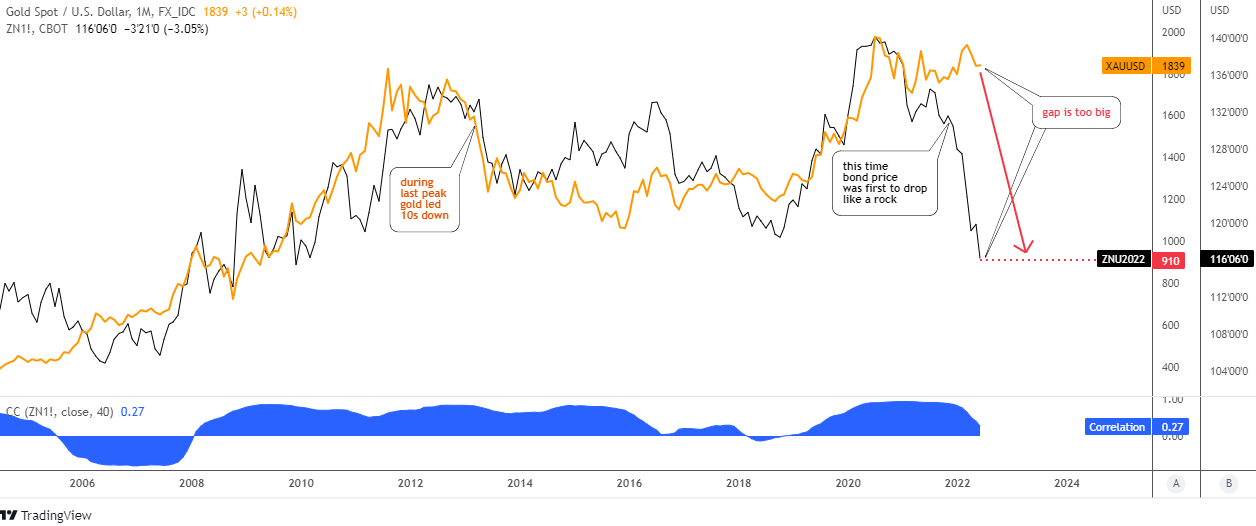
I found an alarming correlation between gold and 10-year U.S. government bonds (10b) that appears these days in the chart below.

Gold VS US 10Y Bonds Monthly

Source: TradingView

The gold price (orange) and the 10b price (futures, black) have a similar trajectory over the considered period since 2006. The blue sub-chart with the indicator of correlation confirms the strong link between these two trading instruments.

The price line of gold looks smooth compared to a volatile 10b line. The major peaks match with each other both during the previous peak in 2011 and the most recent top.

However, the area between peaks does not show the perfect correlation as the gold price continued to the downside from the earlier top while the 10b reversed to the upside in 2014. The top metal had led the drop that time.

This time, we see a strong divergence between assets. The 10b was first to drop like a rock as the inflation spiral only grows. The gap is already too big as the gold price stubbornly keeps under the all-time high. Time is ticking away for the yellow metal which should show a breakup of the major top to keep bullish, otherwise… just look where 10b is now.

The bond price has hit a low of around $114 this month, the level unseen since June 2009. At that time, the gold price had hit the low of $913. I marked the current corresponding level of gold at $910 with the red dotted line. This means that the top metal could lose half of its current price to dive below the valley of 2015 at $1,046.

Do you see the correlation between gold and 10-year U.S. government bonds?

View Results

Loading ... Loading ...

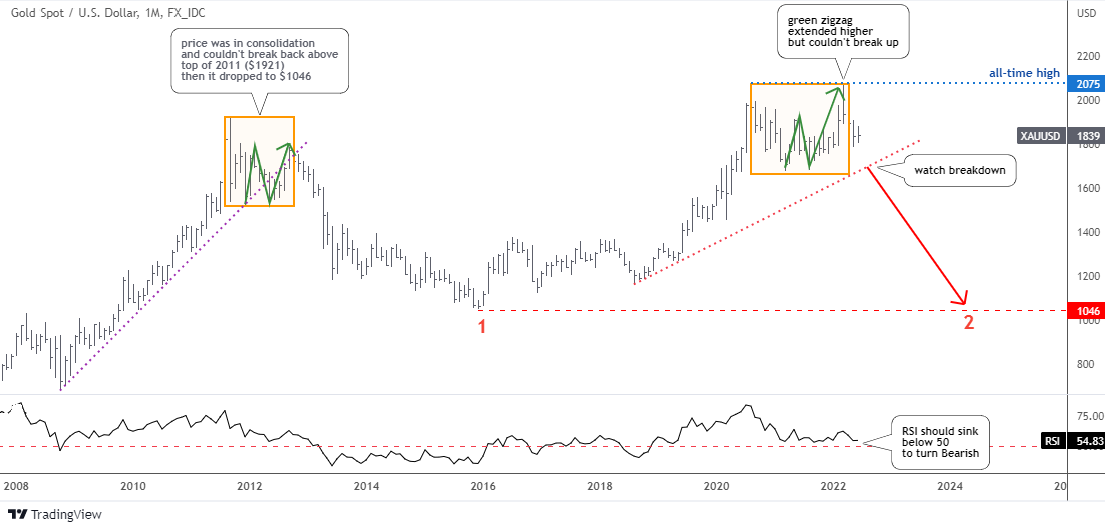
Last year I had shown you the map of possible large leg 2 down to extend the correction in the wake-up call for gold. It is time to dust it off and update here.

Gold Monthly

Source: TradingView

The right green zigzag inside of the right orange box extended higher than expected. However, it could not break the all-time high to repeat the pattern in the left orange box. The chance to continue to the upside is evaporating over time.

The drop below the red dotted support ($1,700) with the bearish confirmation from the RSI sinking under the 50 would open the way for the second large red leg to the downside. It could retest the 2015 low of $1,046.

In my previous gold update, I shared with you the bullish ascending triangle pattern spotted on the weekly chart.

The gold price did not progress to the upside within the pattern as it was supposed to. On the contrary, it almost fell out below the support of a triangle to challenge the validity of the pattern.

The RSI is still under the so-called “waterline” of 50. The collapse below $1,677 mark would totally invalidate the pattern.

The Fed could tighten its policy until it “breaks” the economy as there is a substantial lag between its action and the following effect on the economy. In the meantime, let us watch and see which of the gold triggers appear first – bullish or bearish.

Intelligent trades!

Aibek Burabayev
INO.com Contributor

Disclosure: This contributor has no positions in any stocks mentioned in this article. This article is the opinion of the contributor themselves. The above is a matter of opinion provided for general information purposes only and is not intended as investment advice. This contributor is not receiving compensation (other than from INO.com) for their opinion.

Three Silver Miners To Buy On Dips

While the price of silver (SLV) has held up relatively well in June, considering the sharp declines in global markets, the Silver Miners Index (SIL) has not been as fortunate. In fact, despite silver being down just 7% year-to-date and being a sanctuary from the selling pressure, the Silver Miners Index has been battered, sliding 23% year-to-date and matching the decline of the S&P-500.

While the underperformance might be a head-scratcher for some, it shouldn’t be all that surprising, given that SIL is full of low-quality producers who have dragged down the ETF. However, with the proverbial babies being thrown out with the bathwater, we’ll look at three names approaching low-risk buy zones.

While the gold producers had a tough year in 2021 after lapping all-time highs for the gold price (Q3 2020), the silver producers had a solid year, benefiting from an attempted silver squeeze that kept silver prices elevated for much of 2021.

However, after a brief honeymoon period in 2021, we’re now seeing the hangover. This is because silver producers must lap an average silver price of ~$26.00/oz from last year while contending with higher fuel, labor, and materials costs. Not surprisingly, this has put a severe dent in margins, exacerbated by silver spending most of Q2 below $23.00/oz.

Fortunately, while this has made most names un-investable as they lap insurmountable comps, three names stand out:

Wheaton Precious Metals (WPM - Get Trend Analysis Report)

SilverCrest Metals (SILV - Get Trend Analysis Report)

Hecla Mining (HL - Get Trend Analysis Report)


Wheaton Precious Metals (WPM)

Beginning with Wheaton Precious Metals, the company was raised to handle inflationary periods like we’ve found ourselves in, with a royalty/streaming business model that leaves it insulated from rising operating costs and increased capital expenditures. This is because the company provides upfront payments to producers and developers to help them finance the construction/expansion of their projects, receiving a portion of revenue from the mine in return.

The result is that WPM pays a fixed amount for a portion of metal produced from the mine (15% - 25% of the spot price), allowing it to maintain exceptional margins even when producers’ margins are pinched.
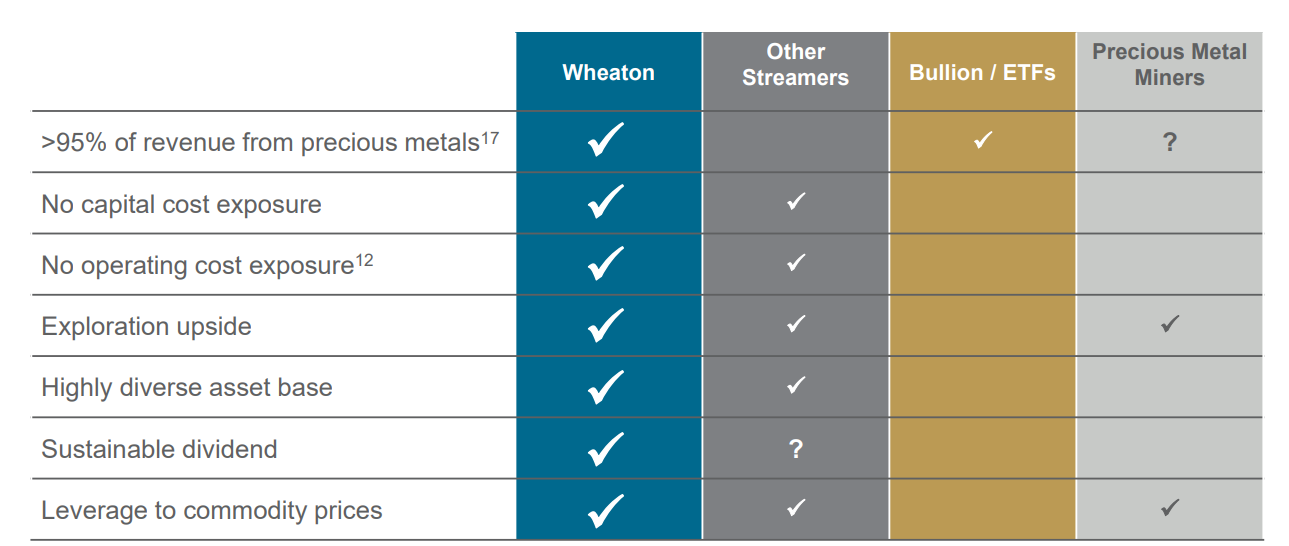
WPM Business Model

Source: WPM Business Model, Company Presentation

Given this superior business model, Wheaton has historically traded at a premium valuation, with a 5-year average earnings multiple of 37.7. Given the inflationary environment that favors exposure to royalty/streaming companies, and the fact that Wheaton has upgraded its 5-year growth outlook with the addition of several streams recently, I believe a more appropriate earnings multiple is 39.

If we multiply this figure with FY2023 annual EPS estimates of $1.46, this translates to a fair value for the stock of $56.95, translating to a 46% upside from current levels. Based on this, Wheaton is currently on a Buy rating, and I see this pullback below $39.00 as a gift.
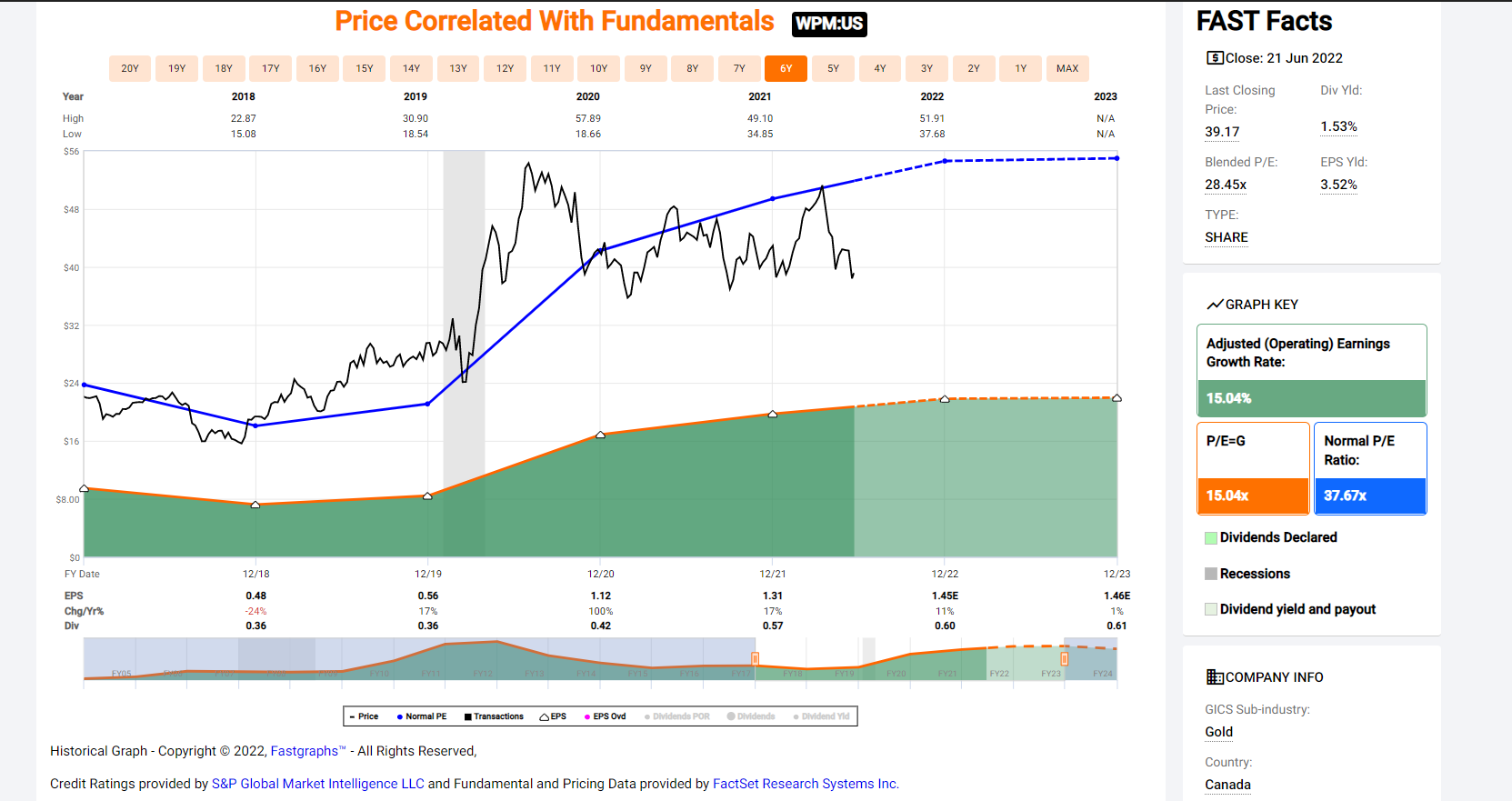
WPM Price Correlated With Fundamentals

Source: FASTGraphs.com

SilverCrest Metals (SILV)

The second name worth keeping a close eye on is SilverCrest Metals (SILV), the newest company to join the producer ranks after commissioning its Las Chispas Project in Mexico last month.

While the mine may be relatively small, with a planned throughput rate of just 1,250 tonnes per day, it certainly packs a punch. This is because it has an estimated head grade of 900 grams per tonne silver-equivalent, a figure that is quadruple the average mined grade sector-wide.

This is expected to translate to an average annual production profile of 12.4MM silver-equivalent ounces per annum over the first seven years (2023-2029) at industry-leading all-in sustaining costs below $7.50/oz.
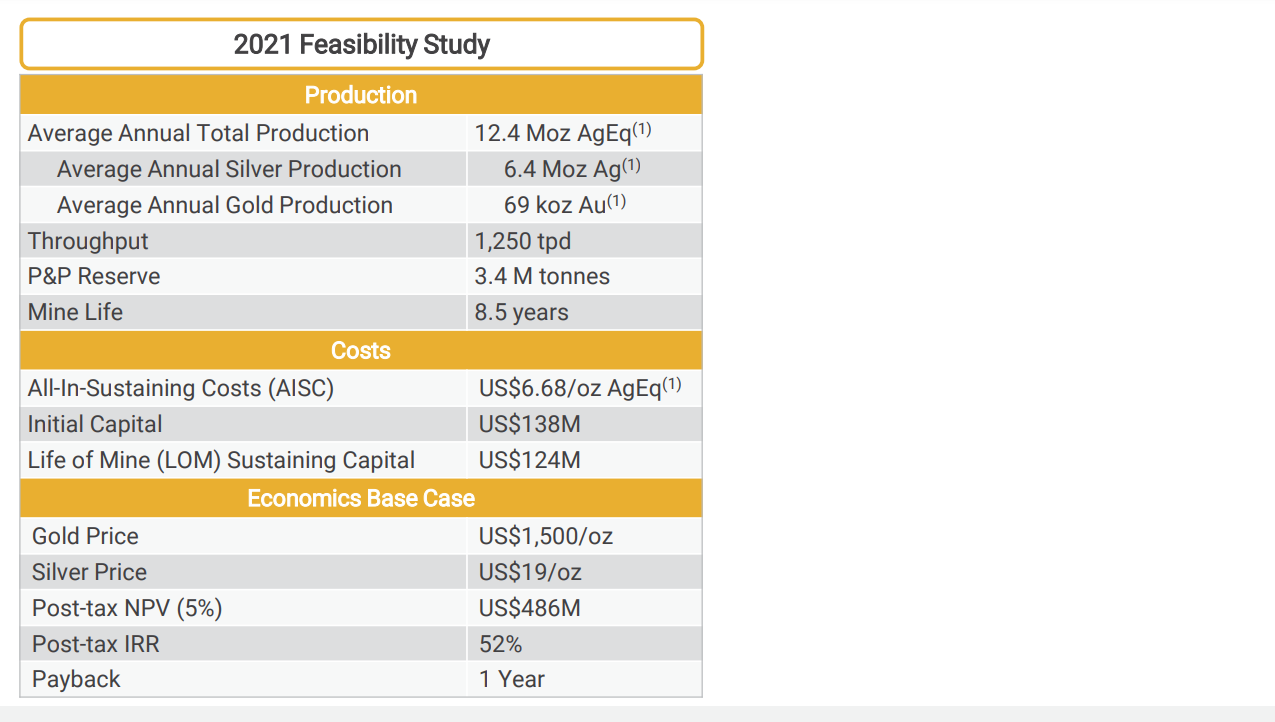
2021 Feasibility Study

Source: Las Chispas Feasibility Study, Company Presentation

Given that SilverCrest is a producer, it is not insulated from inflationary pressures like WPM, meaning that it will see pressure on wages, fuel, and materials costs when it comes to sustaining capital.

However, given that its grades are nearly 4x that of its peers, the company has significantly less labor and uses a fraction of the fuel of its peers, given that it’s a high-grade underground operation. For this reason, it should see less cost creep, and it already has 65% ($22.00/oz silver price), which assumes a 10% cost escalation vs. its most recent study.

So, with SILV being one of the only producers in the silver space relatively insulated from costs combined with industry-leading margins, I see the stock as one of the most attractive buy-the-dip candidates for investors looking for silver exposure.

Hecla Mining (HL)

The final name on the list is Hecla Mining (HL), a multi-asset producer with silver mines in Idaho and Alaska and a gold mine in Quebec, Canada. Like SilverCrest, Hecla ranks very high on grades, with an average silver grade north of 400 grams per tonne and a silver-equivalent grade above 600 grams per tonne.

It also operates two very high-grade underground silver mines and benefits from by-product credits (lead, zinc), allowing it to keep its costs below $10.00/oz. If we compare this to the industry average cost profile of $15.00/oz, this places Hecla in a great position to absorb any cost increases, given that even at a $16.00/oz silver price, its mines would be highly profitable.
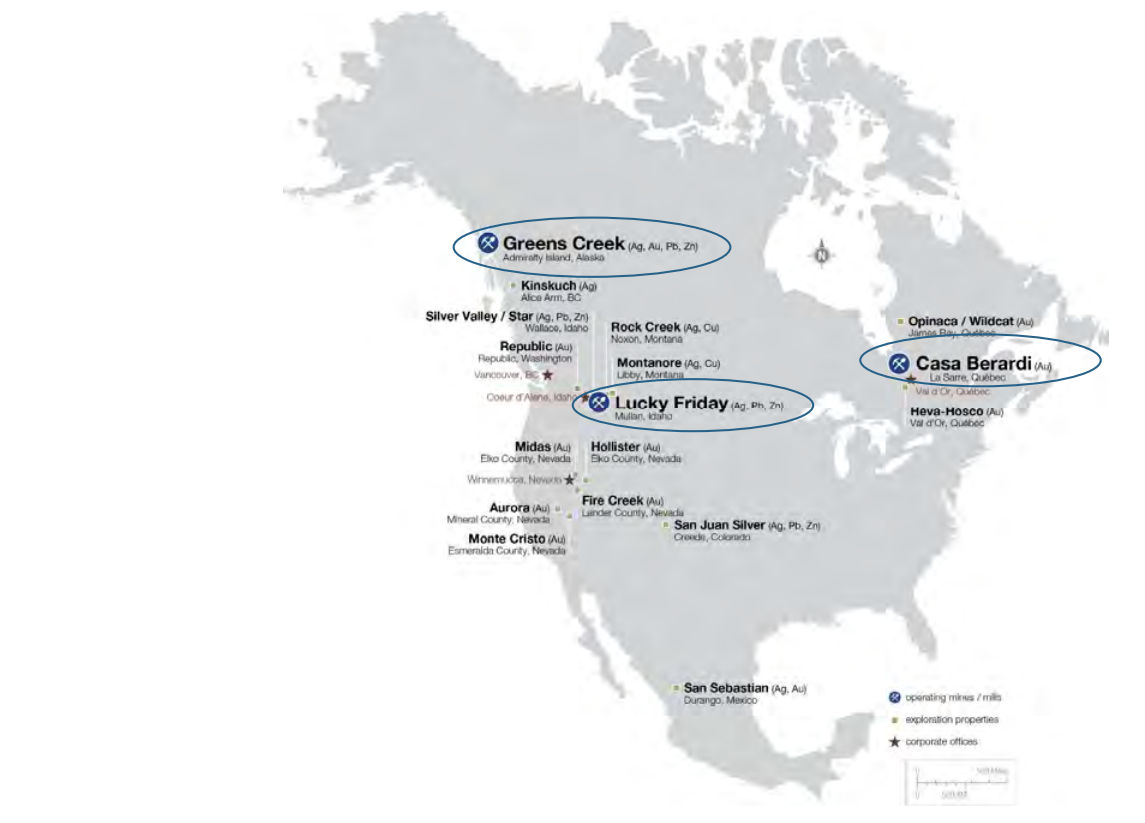
Hecla Operations

Source: Hecla Operations, Company Presentation

Given the benefit of higher zinc prices and its high-grade, relatively low-volume operations, Hecla has skated past most of the inflation experienced sector-wide, except for labor. This means it’s seen much less margin contraction than peers, even with a declining silver price.

Just as importantly, Hecla is one of the only producers with all its operations in Tier-1 jurisdictions, which typically commands a premium multiple. Conversely, most silver producers are based in Peru, Mexico, and Chile, some of the top silver-producing nations.

Hence, not only is Hecla relatively insulated from an inflationary standpoint, but it’s insulated from a risk standpoint, with a low risk of excessive taxes, unfavorable royalties, and or nationalization in the United States/Canada.
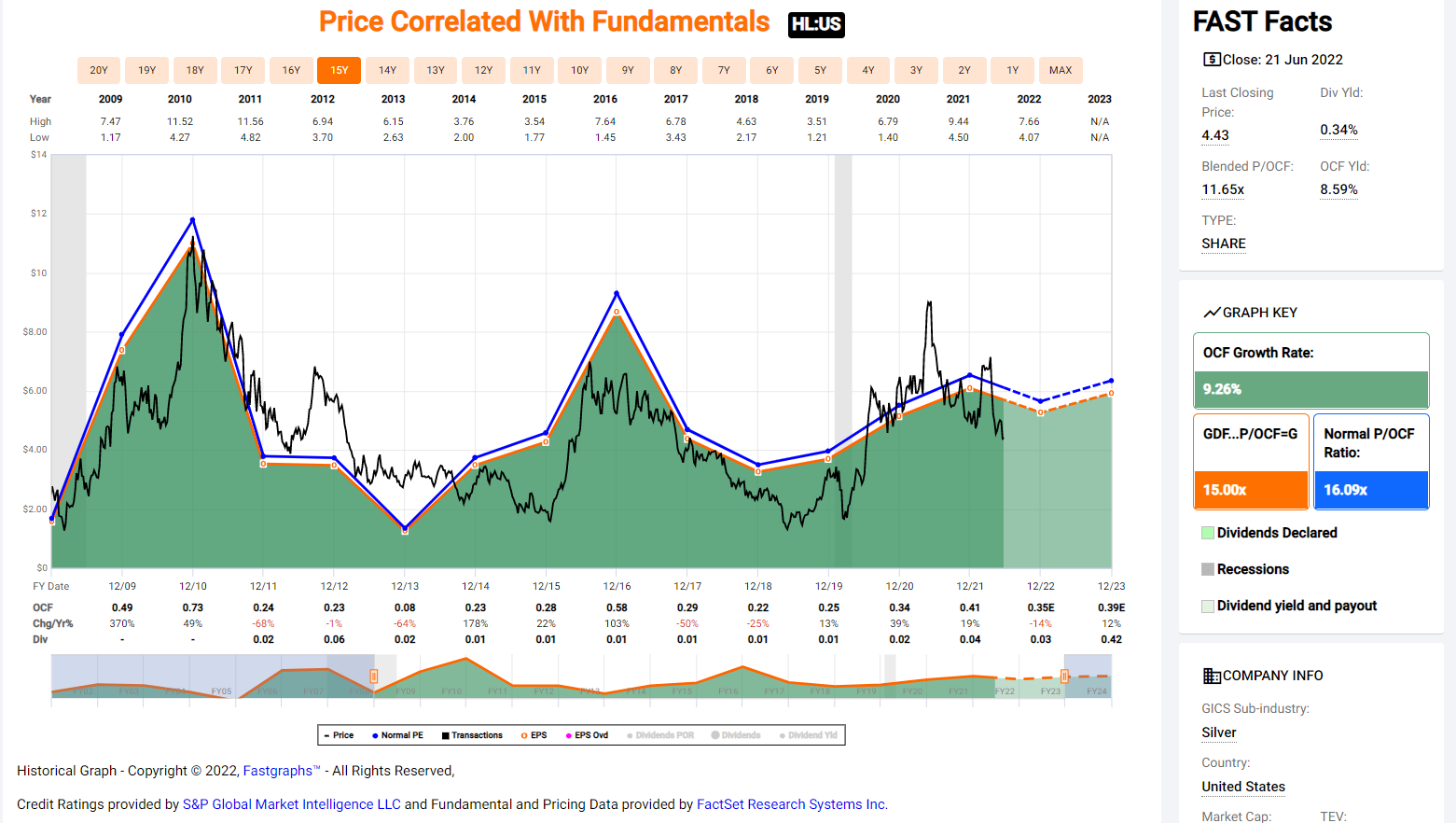
HL Price Correlated With Fundamentals

Source: FASTGraphs.com

Given Hecla’s Tier-1 jurisdictional profile, long reserve life at its assets, and strong margins, the company has historically traded at 16x cash flow, a premium to its peer group. Based on what I believe to be a more conservative multiple of 14.0x cash flow and FY2023 cash flow estimates of $0.40, I see a fair value for the stock of $5.40.

This translates to a 25% upside from current levels ($4.30), and any pullbacks below $4.05 (25% discount to fair value) would present low-risk buying opportunities. So, while I am not long the stock yet, I would view further weakness as a buying opportunity.

Final Thoughts

While the silver miners are out of favor due to declining margins, they will be lapping their toughest comps next month (Q2 2021) and will have much easier comps ahead. This should take the weight off the index and allow for a recovery in the Silver Miners Index by year-end.

Combined with attractive valuations, I see HL, SILV, and WPM as three of the better ways to play a rebound in the silver price.

Disclosure: I am long WPM

Taylor Dart
INO.com Contributor

Disclaimer: This article is the opinion of the contributor themselves. Taylor Dart is not a Registered Investment Advisor or Financial Planner. This writing is for informational purposes only. It does not constitute an offer to sell, a solicitation to buy, or a recommendation regarding any securities transaction. The information contained in this writing should not be construed as financial or investment advice on any subject matter. Taylor Dart expressly disclaims all liability in respect to actions taken based on any or all of the information in this writing. Given the volatility in the precious metals sector, position sizing is critical, so when buying small-cap precious metals stocks, position sizes should be limited to 5% or less of one's portfolio.

Bear Market Q&A

The main question of bull or bear market has been answered quite loudly - BEAR!!! Now more investors are getting the memo and running for the exits at the same time. Steve Reitmeister, CEO of StockNews.com and Editor of the Reitmeister Total Return, is here to answer some questions about the current bear market.

Q: How long will this bear market last?

A: The average bear market in history has lasted for 13 months. That is measured from peak to valley. So in this case the peak of 4,818 was set on January 4, 2022. So if things went according to schedule we would say bottom is likely to be found around February 2023.

However the stock market rarely does anything according to schedule leading to the next question…

Q: Do you believe this bear market will be longer or shorter than the 13 month average?

A: I think it will be shorter because everything about the modern market works faster. Meaning that with so much computer based trading, volatility has increased with stocks rising and falling faster than ever before.

So quite possibly we find bottom faster this time around as well.

Q: Does that mean you expect stocks to fall less than the 34% average bear market decline because it will be a shorter time period?

A: Unfortunately not. I suspect we will wind up a bit closer to 40% decline given that the low rate TINA environment pushed stocks to higher than normal PE levels.

In fact many of the glamorous growth stocks of 2021 were seeing valuations not that far off the 1990’s tech bubble style levels. From that higher peak it will likely be a steeper than normal drop to find equilibrium.

Note that 3,180 represents a 34% decline from peak. And 2,891 is where we end up if 40% decline is in the cards.

Q: How should one interpret a positive day for stocks like today if we are in the midst of a bear market?

A: Consider this... does a bull market go straight up?

Of course not. There are extended bull runs followed by pullbacks and corrections. Yet as you look back over time the gains of the bull are undeniable.

Bear markets are no different. They don’t go straight down either. It is an ongoing process of bear runs to new lows followed by bounces and then another leg lower so on and so forth til bottom is found.

Now everything I said is my current guestimate with a wide range of potential outcomes. NOTHING about this bear, or any other, will go according to a preset pattern. That means we need to be flexible to adjust our plan according to the realities on the ground.

That includes when we start bottom fishing for the next bull run. We would rather be a touch early than a touch late.

That’s because on the late side there is usually a wicked 10-20% bounce from bottom that catches everyone by surprise.

So I suspect we will kind of work our way back to fully invested in 2-3 phases to never be leaning too far in the wrong direction when the market is finally ready to explode off the bottom.

Right now I imagine that first attempt at buying bottom would be around -30%…then down 34%…then hold on to that last part to see if indeed -40% is in the cards. However, at this stage we are getting WAY ahead of ourselves.

For now, there is likely a few months’ worth of bear market to come. Scary drops…shocking bounces (rinse and repeat).

Wishing you a world of investment success!

Steve Reitmeister… but everyone calls me Reity (pronounced “Righty”)
CEO, StockNews.com & Editor, Reitmeister Total Return


About the Author

Steve is better known to the StockNews audience as “Reity”. Not only is he the CEO of the firm, but he also shares his 40 years of investment experience in the Reitmeister Total Return portfolio. Learn more about Reity’s background, along with links to his most recent articles and stock picks.