Tesla (TSLA) Gets Booted from the ESG Index

On May 2nd, the S&P 500 removed Tesla (TSLA) from its ESG Index, which is short for environmental, social, and governance. In recent years ESG investing has grown in popularity as more and more investors push for companies to treat the environment and their stakeholders to a higher standard. But, Tesla, a company that many people would point to as the poster child of an environmentally-friendly company, is no longer on the S&P 500's list of companies that are considered environmentally friendly.

If you are confused, you are not alone. Let's take a deeper look at this change and how it could affect your investments.

The idea behind ESG investing is that only companies promoting environmental sustainability, low carbon emissions, green energy initiatives, and good waste management would meet the environmental sustainability aspect of ESG investing. However, the S&P 500 said that Tesla's "lack of low-carbon strategy" and "codes of business conduct" heavily factored into the decision. The S&P said that Tesla's factories produced very high levels of pollutants. Tesla ranked 22nd on last year's Toxic 100 Air Polluters Index, a list compiled by U-Mass Amherst Political Economy Research Institute. For context, ExxonMobil ranked 26th on that same list last year. Continue reading "Tesla (TSLA) Gets Booted from the ESG Index"
Is the Fed Put Kaput?

For those new to the game, the "Fed put" is a belief among investors that the Federal Reserve will come to the rescue anytime the stock market drops a certain amount. While much of the belief in the Fed Put is based on wishful thinking, it has proven to be the case enough times over the past 35 years or so that many investors have come to expect it.

Belief in the Fed put dates back to former Fed chair Alan Greenspan, who lowered interest rates and eased monetary policy numerous times during market turmoil, starting with the 1987 stock market crash. Since then, all his successors have followed the same basic policy, from Ben Bernanke to Janet Yellen to Jerome Powell, from the 2001 terrorist attacks to the 2008 global financial crisis to the 2020 coronavirus outbreak.

Of course, nearly all of those examples of the Fed put occurred during periods of benign inflation, when the Fed felt safe lowering interest rates to zero and injecting enormous amounts of money into the economy without fear of igniting price increases. Now, however, we live in a world of 8% inflation, and the Powell Fed has stated quite clearly that battling inflation is Priority No. 1, practically its only mission at the moment.

Indeed, when the S&P 500 fell 18% between reaching its all-time high of 4766 on December 27 through the recent low of 3901 on May 16 (the plunge in NASDAQ was even worse), the Fed sat on its hands, indicating the put is no longer suitable in this environment.

But since then (as of June 8) the S&P has rallied more than 6%. Is that a sign that some market watchers believe the Fed is once again going to exercise its put, or was it merely a dead cat bounce or buying the dip (or whatever you want to call it) on the road to even lower stock prices? Continue reading "Is the Fed Put Kaput?"

Stocks And Bitcoin Holding Up

In last week’s installment, I told you about how we finally got a solid weekly up bar across every major stock index. In fact, I went into detail about the 6% plus bullish action for the Dow, the S&P 500, the Nasdaq, and even the broad market Russell 2000.

In addition, across the board, they all reversed multi-week down bars. And the Dow’s reversal was the most longed-for of all four indexes: It snapped an eight-week collection of weekly down bars.

All in all, the action was a welcome sigh of relief. So, what happened after that? Did we get much follow-through last week?

While we didn’t get another weekly up bar in all four indexes, all four did manage to book higher lows than the prior week.

Is that a good thing? You bet. It means that despite selling, prices held up. It also means that sellers didn’t have to resort to continually lower lows to attract buyers: Buyers were finally willing to pay up for shares. And I don’t have to tell you that change in sentiment was a huge improvement over the constant bearish price action over the last two months.

Are we out of the woods yet? Not by a long shot. In fact, as I mentioned last week, the recent positive action in all four stock markets could just be a temporary bull market rally.

It might also develop into what’s called a “dead cat bounce.” Here’s what I mean: Continue reading "Stocks And Bitcoin Holding Up"

Some Are Expecting "Rolling Brownouts" Or "Blackouts"

“The following is an excerpt from Tim Snyder’s “Weekly Quick Facts” newsletter. Tim is an accomplished economist with a deep understanding of applied economics in energy. We encourage you to visit Matador Economics and learn more about Tim. While there, you can sign up for his completely free Daily Energy Briefs and Weekly Quick Facts newsletters.”

Brownouts and blackouts are terms that describe the gradient of power loss, from limited in scale and time and transitioning to total darkness, with no idea of when the loss of power will subside. Valentine’s Day week 2021, Texans were told that ERCOT had not prepared for the deep cold that centered on Texas, and reserves for fueling power plants either were stuck in frozen pipes or just were not available. As a result, 151 people lost their lives due to exposure or other related effects of that storm.

This week, as we begin the first full week of June, we hear those same words, but this time we’re hearing them for the entire country. We all are asking how can we be here again and when will it happen? We’ll address these today in this article.

Let’s start with some perspective. On January 1, 2020, the futures price for Natural Gas was $2.1890 per MMBtu (million Btu). President Biden took office on January 20, 2021, and the price for Natural Gas was $2.5460 per MMBtu. On January 1, 2022, the futures price for Natural Gas was 3.7300 per MMBtu, and Tuesday’s closing price for Natural Gas was $9.293 per MMBtu.

Let’s look at a graph: Continue reading "Some Are Expecting "Rolling Brownouts" Or "Blackouts""

Dollar Index: The Last Shall Be First

Since my last update, the dollar advanced further to the upside establishing the new multi-year top of $105 in the middle of May. Later, the market started the correction as the dollar index (DX) drifted into the area of $101.

Last time, you bet the most on the further rise of the dollar to $121 (Neckline of Giant Double Bottom pattern). The second choice was the Bearish scenario for the main currency. It is early to judge the results as the price dynamics are somewhat mixed.

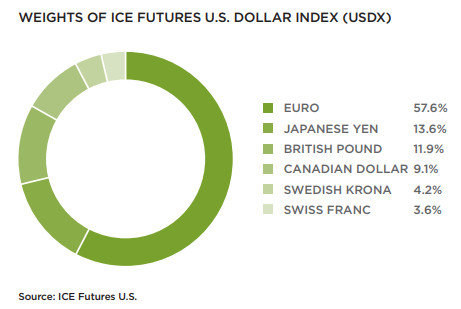
Let me show you one comparison graph that shows the underlying fundamentals of the dollar index. But, before that, to refresh the memory, firstly, I put below the chart showing the composition of the dollar index.

Dollar

The euro takes the largest piece of cake with 57.6%; the Japanese yen with 13.6% is the second largest component, although the gap with the euro is huge. The third is the British pound, as its part weighs 11.9%. Continue reading "Dollar Index: The Last Shall Be First"