Stocks Have Worst Week Since March

As we head into Friday afternoon trading and the last trading day of October, the stock market is headed for its worst week since March of this year. Why? There are a few reasons, it's been a difficult week in which coronavirus cases are on the rise both here in the U.S. and Europe. U.S. fiscal stimulus talks broke down in Washington D.C. and traders are bracing for volatile swings during next week's election. How long do you think this volatility will last?

On a weekly level, all three indexes are having their worst week in 7 months. The S&P 500 will post a weekly loss of -6%, the DOW's loss stands around -7%, and the NASDAQ will post a loss of around -5%. Continue reading "Stocks Have Worst Week Since March"
Trade Triangles Signal Volatility Ahead

We are exactly one week away from the 2020 Election, and we have seen a serious spike in COVID-19 infections not only in the U.S. but around the world, which has led to a spike in market volatility.

If you have your Trade Triangle alerts set for the major indexes that we track, you were alerted on Monday that the DOW issued a new red weekly Trade Triangle when it fell -2% on the day, signaling that it was time to head for the sidelines. The S&P 500 and NASDAQ joined the party today, with both indices issuing new red weekly Trade Triangles and falling over -2% on the day. Continue reading "Trade Triangles Signal Volatility Ahead"

Mitigating Election And COVID-19 Volatility

The confluence of the impending U.S. Presidential election, rising COVID-19 cases domestically and abroad, and market dependency on stimulus measures give rise to a potentially volatile environment in November. Positioning your portfolio to be as agile as possible is essential when navigating these potentially volatile events. Cash on-hand, exposure to broad-based ETFs, and options is an ideal mix to achieve the portfolio agility required to mitigate uncertainty and volatility expansion.

Options trading at its core defines risk, leveraging a minimal amount of capital, and maximizing investment return. Proper portfolio construction is essential when engaging in options trading to drive portfolio results. This cash liquidity position provides portfolio agility to adjust when faced with extreme market conditions such as the September market correction rapidly.

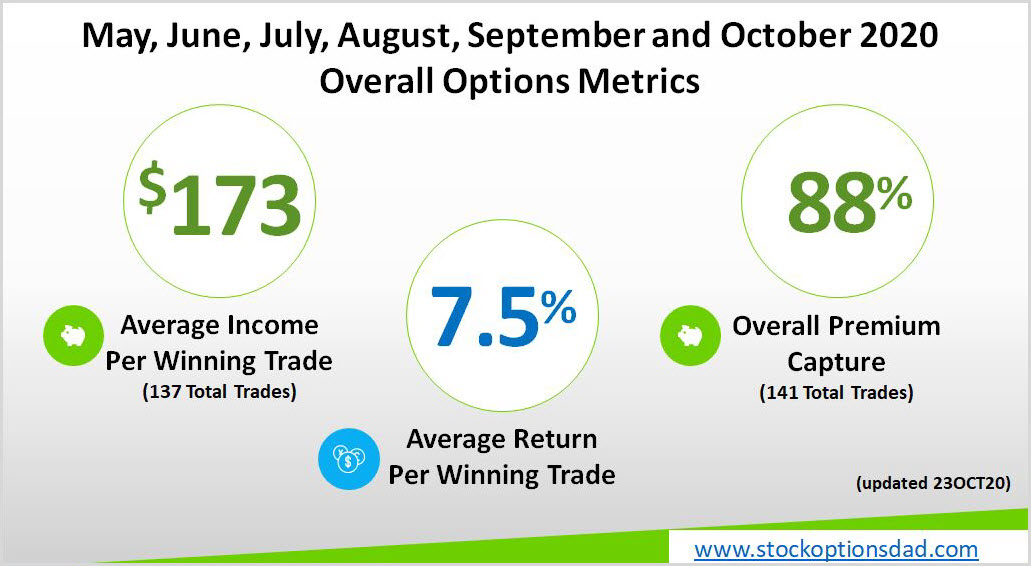
An agile options based portfolio is essential to navigating these pockets of volatility. The recent September correction is a prime example of why maintaining liquidity is one of the many keys to an effective long term options strategy. In May, June, July, August, September, and October, 141 trades were placed and closed. An options win rate of 97% was achieved with an average ROI per trade of 7.5% and an overall option premium capture of 88% while outperforming the broader market despite the September correction (Figures 1 and 2).

volatility
Continue reading "Mitigating Election And COVID-19 Volatility"

Put The Blame On Me

At least since the global financial crisis of 2008, Federal Reserve officials have, by and large, denied or downplayed the idea that their zero-interest-rate policies and mammoth bond purchases have artificially inflated financial assets even as the Fed is buying trillions – with a capital T – of U.S. Treasury and mortgage-backed securities markets and more recently corporate bonds. Now the presidents of a few of the Fed’s regional banks are suggesting that the Fed study whether its monetary policies are encouraging overly risky investor behavior.

Loretta Mester, the president of the Cleveland Fed, conceded that prolonged periods of low rates could incite “higher levels of borrowing and financial leverage, increased valuation pressures, and search-for-yield behavior.”

“While monetary policy that leads to a stable macroeconomy encourages financial stability, it is also possible that in an environment with low neutral rates, a persistently accommodative monetary policy could, in some cases, increase the vulnerabilities of the financial system,” she said.

Boston Fed President Eric Rosengren went even further, suggesting that the Fed “rethink” financial regulation – but apparently not monetary policy – to rein in speculative behavior. Continue reading "Put The Blame On Me"

Futures Market Looks To Heat Up

Heating Oil Futures

Heating oil futures in the December contract settled last Friday in New York at 118.48 while currently trading at 116.85, down about 200 points for the week as prices are still stuck in a tight 7-week consolidation pattern looking to break out to the upside in my opinion.

I will recommend a bullish position if prices break the October 9th high of 121.44, which could happen next week as prices are trading right at their 20-day but still below their 100-day moving average, which stands at the critical 123 level.

The volatility in this commodity will start to explode to the upside as we start to enter the winter months as seasonably speaking. That's when prices can have tremendous spikes to the upside due to frigid weather out in the eastern part of the United States. I think demand will also start to come back for this commodity, and if you look at most commodity sectors, they are rallying significantly. I do not have any energy recommendations at the current time, but it looks to me that heating oil has bottomed out as the risk/reward would be in your favor as this is a very large contract.

TREND: LOWER - MIXED
CHART STRUCTURE: EXCELLENT
VOLATILITY: AVERAGE

Silver Futures

Silver futures in the December contract are currently trading at 24.61 an ounce after settling last Friday in New York at 24.40, up slightly for the week experiencing high volatility as prices are looking to break out the upside in my opinion despite the recent pullback. Continue reading "Futures Market Looks To Heat Up"